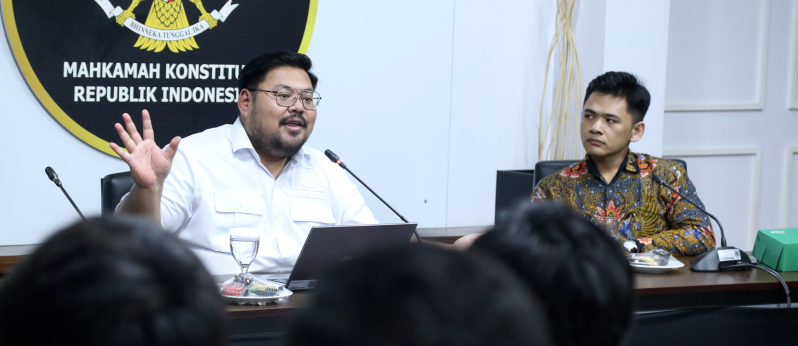
Constitutional Court Legal Analyst Arinta Sulistyo receives a visit from the Center for the Study of Law and Constitutional Theory (PSHTK) of Satya Wacana Christian University during a field study to the Court. MKRI/Fauzan
JAKARTA (MKRI) - The group of students from PSHTK (The Center for the Study of Law and Constitutional Theory) UKSW was received by Constitutional Court Legal Analyst Arinta Sulistyo, widely known as Tyo, at the Hall of the Constitutional Court’s Building II on Thursday, November 20, 2025, in the afternoon.
A total of fifty students from the Constitutional Law Study Program participated in the visit. They received an explanation regarding the structure, authorities, and strategic role of the Court within Indonesia’s constitutional system. The activity aimed to provide students with a concrete picture of how state institutions operate and how law functions in practice.
In his presentation, Legal Analyst Arinta Sulistyo elaborated on the selection process of Constitutional Justices, who are appointed from three branches of power such as the Supreme Court, the President, and the House of Representatives as part of the check-and-balance mechanism under the trias politica system. He emphasized that although the justices originate from different institutions, once inaugurated, they no longer represent their nominating bodies.
“After inauguration, Constitutional Justices are not ‘representatives’ of the Supreme Court, the President, or the House of Representatives. They must become statesmen who align with no one except the interests of the Constitution and the state,” he asserted.
Legal Analyst Arinta Sulistyo also explained that the primary function of the Court is adjudicating judicial review petitions against statutes in relation to the 1945 Constitution. He noted that the Court’s decisions hold the same binding force as law and apply universally.
“Because what is reviewed is legislation, the legal norms may change depending on the petition. Constitutional Court decisions apply erga omnes, binding throughout Indonesia,” he explained.
As an illustration, Legal Analyst Arinta Sulistyo referred to one of the Court’s well-known decisions concerning the legal status of children born out of wedlock, in a case brought by Machica Mochtar.
“At that time, the Court emphasized that a child has civil relations not only with the mother but also with the biological father. This decision provided legal protection and legal certainty for the child,” he said.
During the session, Legal Analyst Arinta Sulistyo encouraged students to play an active role in strengthening law and democracy through mechanisms provided by the Constitution. He highlighted that students themselves have the right to file judicial review petitions before the Court.
“Students are part of the citizenry who can effect change through judicial review petitions. Many significant changes have emerged from intellectual courage,” he stated.
Legal Analyst Arinta Sulistyo also conveyed an important message from the Constitutional Justices regarding how to read Court decisions. He noted that the public, including students, often focuses solely on the dispositive ruling.
“Do not read only the verdict. Read the legal considerations as well. That is where the complexity of reasoning, the foundations of argumentation, and the messages of the Justices lie,” he explained.
He underscored that understanding the legal considerations is crucial for building a critical academic tradition and cultivating a strong generation of jurists. “By reading the legal considerations, we can understand why a petition is granted or denied, and what principles the Court seeks to safeguard,” he added.
The visit concluded with a question-and-answer session during which students enthusiastically explored further aspects of the Court’s authorities and the dynamics of case handling. After the discussion, the students were guided to the Constitutional History Center on the 5th and 6th floors of the building to view archives and documentation of Indonesia’s constitutional development. (*)
Author: Fauzan Febriyan
Editor: Lulu Anjarsari P.
Translator: Aski V. Rumere
Disclaimer: The original version of the news is in Indonesian. In case of any differences between the English and the Indonesian versions, the Indonesian version will prevail.
Thursday, November 20, 2025 | 17:30 WIB 101