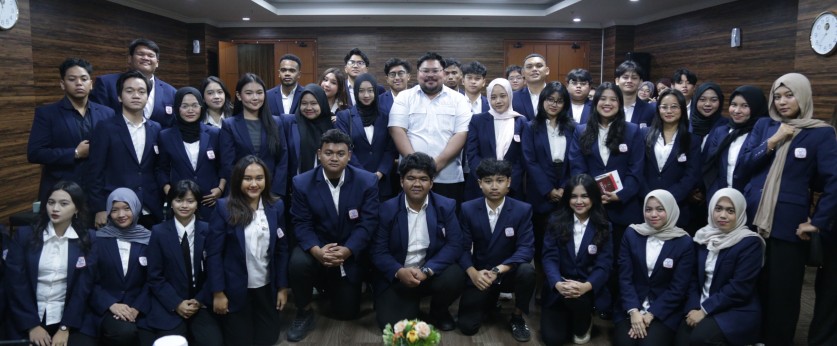
The Constitutional Court of the Republic of Indonesia received a visit from law students of President University, welcomed by Arinta Sulistiyo, Legal Analyst of the Court, on Tuesday, November 18, 2025.
During the session, Arinta explained that the Court has formulated sixty-six constitutional rights icons as an effort to clarify the scope of rights guaranteed under the 1945 Constitution of the Republic of Indonesia.
According to Arinta, the formulation of these icons serves as an important point of reference in every petition for judicial review submitted by the public. The constitutional rights encompassed therein include, inter alia, political rights, the right to justice, economic and social rights, as well as cultural rights. The existence of these icons is intended to assist the public in understanding the constitutional basis that may be invoked when they consider themselves adversely affected by a statutory norm.
Thus far, petitions for judicial review before the Court are generally filed by parties who deem that their constitutional rights have been infringed. Petitioners typically argue that “the norm contained in Article X of Law Y has harmed their constitutional rights.” With the establishment of the sixty-six icons as guidance, the drafting of legal arguments is expected to become more structured and readily comprehensible.
Arinta further emphasized that all procedural stages before the Court are free of charge. From the registration of a petition, the hearing process, up to the pronouncement of a decision, every stage is accessible to citizens without any financial burden. This policy reflects the Court’s commitment to broadening access to justice.
She elaborated that petition registration may now be conducted online without the need for physical presence at the Court. Moreover, several cases may be resolved entirely through virtual hearings. The Court developed its remote-hearing platform even before the Covid-19 pandemic, and its use was subsequently expanded through video-conferencing applications. “Many cases—from the initial stages until the issuance of the decision—are never attended physically; everything is conducted through Zoom,” she stated.
In addition, she conveyed that the Court is composed of nine constitutional justices, each appointed respectively by three institutions: the Supreme Court, the House of Representatives, and the President. Concerning the age requirement for constitutional justices, Arinta added, “Previously, the minimum age requirement for appointment was forty-seven years and the maximum sixty-five years, but following legislative amendments, it has been raised to seventy years.”
Arinta also underscored the paramount importance of judicial independence. “Constitutional justices perform their duties independently and are bound solely by the Constitution. No external party may intervene,” she remarked. She expressed hope that the students would understand that the Court serves as the guardian of constitutional supremacy within Indonesia’s constitutional system.
Following the presentation, the students were invited to visit the Court’s Constitutional Studies Center (Puskon). There, they were introduced to various archives of decisions, hearing documentation, and constitutional education materials prepared by the Court. Puskon staff explained that the facility was established to support research, learning, and the development of constitutional studies for students, academics, and the broader public.
Author : Utami Argawati
Editor : Tiara Agustina
Translator : Aski/Nies Lindy
Disclaimer: The original version of the news is in Indonesian. In case of any differences between the English and the Indonesian versions, the Indonesian version will prevail.
Tuesday, November 18, 2025 | 16:01 WIB 188