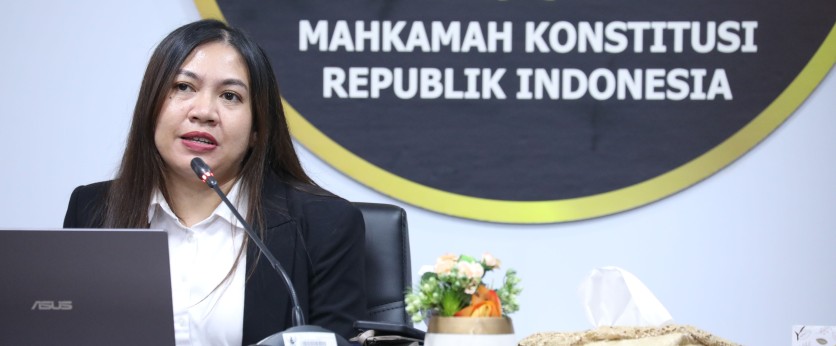
Court’s Expert Legal Analyst, Haifa Arief Lubis, welcoming Student Executive Board of UIN Syarif Hidayatullah Jakarta at the auditorium of court building II on Tuesday (11/18/2025). Photo by MKRI/Panji.
JAKARTA (MKRI) – The Student Executive Board of UIN Syarif Hidayatullah Jakarta visited the Constitutional Court (MK) to get to know the institution better. This introduction took place through a direct discussion with the Court’s Expert Legal Analyst Haifa Arief Lubis at the auditorium of the second building on Tuesday, November 18, 2025.
Opening her presentation, Haifa said that the Court was officially established in August 13, 2003. “The Court was established in 2003 as a result of the amendment to the 1945 Constitution,” she explained, accompanied by Expert Legal Educator Rika Dewi Andryani as moderator.
Haifa explained that Court’s authorities are stipulated in Article 24C paragraphs (1) and (2) of the 1945 Constitution. Court has the authority to review laws against the 1945 Constitution, settle disputes over the authority of state institutions whose authorities are granted by the Constitution, decide on the dissolution of political parties, decide on the disputes over general election results, and must give a decision on the House of Representatives (DPR) opinion regarding alleged violations committed by the president and/or vice president according to the 1945 Constitution.
However, up to this day, Court has never exercised the authority to rule on the dissolution of political parties nor to decide on the impeachment of the president/vice president. On a daily basis, Court exercises its authority to review laws against the Constitution and, every five years, to decide disputes over election results, including regional election disputes.
Haifa further explained the procedural law for judicial review of laws against the 1945 Constitution. Based on Article 4 paragraph (1) of Court Regulation No. 7 of 2025 on Procedures in Judicial Review Cases, a Petitioner is a party who believes their constitutional rights and/or authority have been harmed by the enactment of a law. Petitioners may be individual Indonesian citizens or groups with common interests, customary law communities that are still alive and in accordance with societal developments and the principles of Indonesia, public or private legal entities, or state institutions.
Haifa emphasized that any Indonesian citizen who can explain a constitutional loss due to the enactment of a legal norm that contradicts the 1945 Constitution may file a petition with the Court. She then gave an example: Court Decision No. 100/PUU-X/2012 on the judicial review of Law No. 13 of 2003 on Manpower, filed by Marten Boiliu, a security guard who had experienced termination of employment.
In his petition, Marten claimed he was unable to pursue claims for wages and other employment-related payments due to an expiration clause. The Court granted the petition in full and declared Article 96 of the Manpower Law unconstitutional and no longer legally binding.
Article 96 of the Manpower Law, which was declared unconstitutional, stated: “Claims for wages and all payments arising from employment relationships expire after a period of 2 (two) years from the time the right arises.”
Haifa noted that although the Petitioner was only one person, Court decisions are final and binding on everyone (erga omnes). “Just one person, but the decision applies to all of us,” she concluded.
Author : Mimi Kartika
Editor : Tiara Agustina
Translator : Jessica Rivena Meilania/Donny Yuniarto
Disclaimer: The original version of the news is in Indonesian. In case of any differences between the English and the Indonesian versions, the Indonesian version will prevail.
Tuesday, November 18, 2025 | 15:56 WIB 282