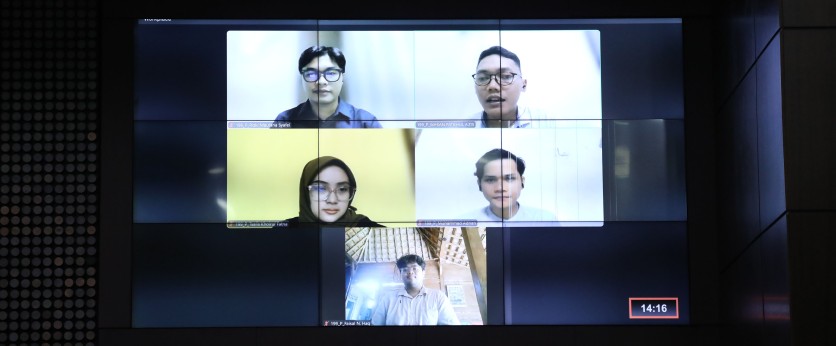
Petitioners for online judicial review of Law No. 17 of 2014 on the People's Consultative Assembly, the House of Representatives, the Regional Representative Council, and the Regional Legislative Council (MD3 Law) delivering their revised petition, on Monday (11/17/2025). Photo by MKRI/Panji.
JAKARTA (MKRI) – The Petitioners of Case No. 199/PUU-XXIII/2025 submitted a revised petition for material judicial review of Article 239 paragraph (1) letter c of Law No. 17 of 2014 on the MPR, DPR, and DPRD (MD3 Law) against the 1945 Constitution of the Republic of Indonesia (UUD NRI) to the Constitutional Court (MK) on Monday, November 17, 2025. Initially, during the first preliminary examination few days ago, the Petitioners consisted of four people and in today's petition revision hearing, it was submitted that the Petitioners had added one more person.
"There has been an increase in the number of Petitioners, from four to five. The rationale is to strengthen the legal standing, especially in terms of actual and specific losses," said Ikhsan Fatkhul Azis (Petitioner I), who attended the online hearing along with Rizki Maulana Syafei (Petitioner II), Faisal Nasirul Haq (Petitioner III), Muhammad Adnan (Petitioner IV), and Tsalis Khoirul Fatna (Petitioner V).
The Petitioners also outlined the legal standing related to the loss of constitutional rights in the form of political rights as citizens to oversee the running of the government, especially those elected through general elections (elections). Furthermore, there was a change in the object of the review, thus changing the petitum section as well. Previously, the object of this petition was Article 239 paragraph (1) letter c of the MD3 Law, now changed to Article 239 paragraph (2) letter d of the MD3 Law.
The Petitioners also added arguments regarding the mechanism for dismissing council members through the Council's Ethics Council (MKD). They also modified and added arguments regarding comparisons of recall practices in various countries and the addition of arguments regarding recall simulations in Indonesia.
"The Petitioners' a quo petition is not based on hatred for the DPR and political parties, but rather on a commitment to reform. The Petitioners do not want any more lives lost due to the deadlock over control of the DPR," Ikhsan said.
In their petitum, the Petitioners requested the Court to declare Article 239 paragraph (2) letter d of the MD3 Law to be in conflict with the 1945 Constitution of the Republic of Indonesia (UUD NRI) and not have conditional binding legal force insofar as it is not interpreted as being proposed by their political party and/or constituents in their electoral district in accordance with the provisions of statutory regulations.
Article 239 paragraph (1) letter c MD3 states that (1) DPR members are dismissed from their positions due to: a. death; b. resignation; or c. dismissal. Meanwhile, the next paragraph stipulates that DPR members are dismissed from their positions if they are unable to carry out their duties continuously or are permanently prevented from serving as DPR members for three consecutive months without any explanation; violate the oath/promise of office and the DPR code of ethics; are found guilty based on a court decision that has obtained permanent legal force for committing a crime that is punishable by imprisonment of five years or more, are proposed by their political party in accordance with the provisions of statutory regulations; no longer meet the requirements as a candidate for DPR member in accordance with the provisions of statutory regulations regarding the general election of DPR, DPD, and DPRD members; violate the prohibition provisions as regulated in this Law; are dismissed as members of a political party in accordance with the provisions of statutory regulations; or become members of another political party.
By the enactment of the provisions in the article being challenged, according to the Petitioners, there has been a clear exclusion of political parties from dismissing DPR members, where the current practice is often that political parties dismiss DPR members without clear reasons without considering the principle of people's sovereignty, or vice versa when there are DPR members who should be dismissed at the request of the people because they no longer receive legitimacy from the people, are instead retained by political parties. The absence of a mechanism for dismissal by constituents in the provisions of the article being challenged has placed the role of the Petitioners as voters in the general election (election) only as a formal procedure, because elected DPR members are determined based on the most votes in the election mechanism, while for their dismissal no longer involves the people.
The Petitioners also cannot ensure that their representatives in the DPR will truly fight for the people's welfare and carry out their campaign promises before being elected because they no longer have any bargaining power after the election. The practices that arise as a result of the provisions in the articles being challenged have ignored the principle of people's sovereignty which has been guaranteed through Article 1 paragraph (2) of the 1945 Constitution of the Republic of Indonesia.
By the enactment of the provisions in the article being challenged, the Petitioners acknowledge that their constitutional rights to actively participate and receive equal treatment in the running of government as guaranteed by Article 27 paragraph (1) of the 1945 Constitution of the Republic of Indonesia; to advance themselves in collectively fighting for their rights to build their society, nation and state as guaranteed by Article 28C paragraph (2) of the 1945 Constitution of the Republic of Indonesia; and to obtain recognition, guarantees, protection and fair legal certainty as well as equal treatment before the law as guaranteed by Article 28D paragraph (1) of the 1945 Constitution of the Republic of Indonesia cannot be realized. The loss of the Petitioners' constitutional rights is specific and actual, or at least potential.
In addition, in line with the implementation of the recall authority held by political parties, there have been clear practices that are contrary to the provisions of the MD3 Law and the will of the people as happened to Ahmad Sahroni and Nafa Indria Urbach from the National Democratic Party (Nasdem), Surya Utama or Uya Kuya and Eko Hendro Purnomo or Eko Patrio from the National Mandate Party (PAN), and Adies Kadir from the Functional Groups Party (Golkar), who based on statements from each party concerned have been temporarily dismissed or deactivated after pressure from the public. According to the Petitioners, instead of carrying out dismissals and replacements in accordance with the provisions of the MD3 Law as demanded by the public, the parties have instead carried out practices that are not regulated in the MD3 Law and have instead caused confusion among the public.
The case was heard by a panel of justicees chaired by Constitutional Justice Suhartoyo, Constitutional Justice Daniel Yusmic P. Foekh and Constitutional Justice M. Guntur Hamzah. Before closing the hearing, Justice Suhartoyo stated that the petition would be submitted to a Justice deliberation meeting of nine constitutional justices to determine whether the petition could be decided without a hearing or whether a hearing for further evidence would be required at a plenary session. (*)
Author : Mimi Kartika
Editor : Lulu Anjarsari P.
PR : Andhini Sayu Fauzia
Translator : Donny Yuniarto
Disclaimer: The original version of the news is in Indonesian. In case of any differences between the English and the Indonesian versions, the Indonesian version will prevail.
Monday, November 17, 2025 | 16:19 WIB 252