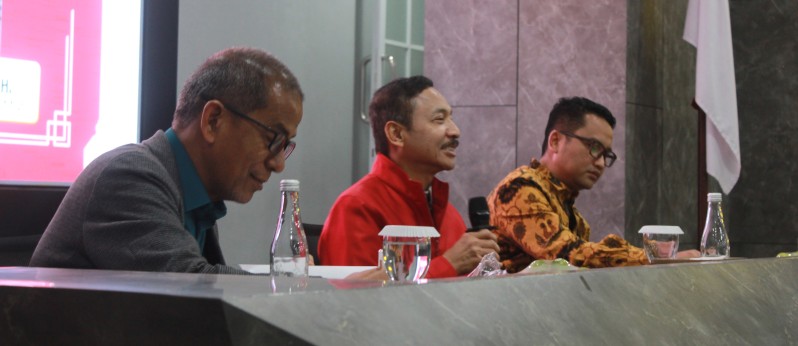
Chief Justice Suhartoyo (center) and Deputy Chief Justice Saldi Isra (left) as speakers in the Constitutional Dialogue organized by Court in collaboration with the Center for Law Study and Constitutional Theory (PSHTK), Law Faculty of Satya Wacana Christian University (UKSW), and the Sharia Faculty of State Islamic University (UIN) Salatiga, on Saturday (11/15/2025). Photo by MKRI/Istimewa.
JAKARTA (MKRI) — The Constitutional Court (MK), in cooperation with the Center for the Law Study and Constitutional Theory (PSHTK) of the Law Faculty of Satya Wacana Christian University (UKSW), and the Sharia Faculty of State Islamic University (UIN) Salatiga, held a Constitutional Dialogue on Saturday, November 15, 2025. The event, themed “The Role of the Court in Realizing a Constitutional State,” presented Chief Justice Suhartoyo and Deputy Chief Justice Saldi Isra as speakers in Session I, held at the UKSW campus in Salatiga, Central Java.
Chief Justice Suhartoyo explained that Court has the authority to resolve disputes over constitutional authority between state institutions. For example, if the House of Representatives (DPR), Regional Representative Council (DPD), or People’s Consultative Assembly (MPR) face institutional conflicts, they may bring the dispute before the Court. The Court also has the authority to review laws against the 1945 Constitution. This authority is the core business of the Court, as the fundamental rights of citizens are embedded within laws enacted by the legislature. This is the very essence of establishing the Court.
“If a law contains provisions that only serve the interests of certain groups, the Court is responsible for correcting them. And you, as students who engage daily with constitutional law and legislation, play a central role. If observed carefully, one will always find norms that violate constitutional rights. No citizens have their constitutional rights harmed,” Chief Justice Suhartoyo stated, guided by moderator Hani Adhani, the Constitutional Registrar.
Students Litigating Before the Court
Litigating before the Court does not require one to be an advocate, allowing students to assist people whose constitutional rights have been harmed. According to Chief Justice Suhartoyo, this reflects the Court’s commitment to reaching citizens whose constitutional rights are marginalized or neglected. Therefore, students should not hesitate to assist members of their communities in defending their constitutional rights.
Moreover, parties filing a judicial review petition with the Court do not need to worry about petition procedural structure. During hearings, petitioners will receive guidance from the justices to refine their petitions. Before filing, parties may study previous petitions available on the Court’s website (mkri.id) and consult relevant Court Regulations to ensure their petitions meet procedural standards. Litigating before the Court is free of charge and can be done remotely if petitioners live far from Jakarta. They may visit universities or “constitutional villages” partnered with the Court to facilitate remote hearings.
“For this reason, the Court exists to ensure that the state plays its role in protecting the constitutional rights of its citizens,” Chief Justice Suhartoyo stated.
Concept of Constitution
Deputy Chief Justice Saldi Isra encouraged students to understand the concept of the constitution. A good constitution, he explained, is one that is not overly detailed so that it can adapt to social developments. Essentially, constitutional change and evolution occur through judicial interpretation by justices.
“The constitution is intentionally drafted in broad terms, giving rise to concepts such as constitution, constitutionality, and constitutionalism. In law, this is tied to the idea of checks and balances. Within this framework, the Court exists not to match legislative bodies in numbers but to prevent excessive power from undermining constitutional limits,” Deputy Chief Justice Saldi Isra explained.
Deputy Chief Justice Saldi Isra added that judicial authority, including that of the Court, inevitably invites debate. As long as facts are presented in court, justices may interpret them using proper legal reasoning. Regarding the current trend of “No Viral, No Justice” among young people, Deputy Chief Justice Saldi Isra stated that such a notion is not relevant to the Court’s work. The Court does not resolve concrete cases but examines abstract legal norms.
“In recent years, many petitions to the Court have come from young people. For instance, a judicial review involving fiduciary issues linked to violent debt collectors, the presidential threshold challenge by students of UIN Sunan Kalijaga, and petitions concerning the police. Many petitioners are young and newly practicing lawyers. The Court welcomes such participation as part of its commitment to protecting citizens’ constitutional rights,” Deputy Chief Justice Saldi Isra said.
Response from Justices
“How far can legislative candidates submit cases to the Court, and how do justices maintain independence from political influence, for instance, from the House?” asked Aji.
Chief Justice Suhartoyo replied that legislative candidates cannot file cases directly; petitions must be filed through political parties. However, candidates may still become individual parties as related parties in a case.
“There are two avenues: if sued first, legislative candidates can join as individuals or as representatives of their political party, depending on which petition is filed first. As for judicial independence, it is an ongoing discussion. A constitutional justice must not have even the slightest personal interest in any case. Once sworn in, a justice must detach from all institutional or political connections,” Chief Justice Suhartoyo explained.
Another student, Ala Sinurat from UKSW, asked: “Does Indonesia’s constitution contain loopholes that allow arbitrary government?”
“Any law that leads to racism or discrimination will be struck down by the Court. The Court exists to protect the constitutional rights of citizens,” Chief Justice Suhartoyo replied.
Deputy Chief Justice Saldi Isra added that although he was nominated by the President, the relationship ended upon his appointment. “One cannot become a justice without an appointing institution. What matters is the justice’s strength in resisting intervention. As a Muslim, I ground myself spiritually and decide cases based on sincere conviction, free from external influence,” Deputy Chief Justice Saldi Isra said.
Session II also presented speakers including Titon Slamet Kurnia, Lecturer/Researcher at PSHTK UKSW, and Cholida Hanum, Head of the Constitutional Law Study Program at UIN Salatiga. The Constitutional Dialogue is one of the Court’s collaborative efforts to involve academia and the public in meaningful discussions. The program aims to broaden and deepen understanding across various sectors regarding the Court’s role and citizens’ constitutional rights.
Author : Sri Pujianti.
Editor : N. Rosi.
Translator : Jessica Rivena Meilania/Donny Yuniarto
Disclaimer: The original version of the news is in Indonesian. In case of any differences between the English and the Indonesian versions, the Indonesian version will prevail.
Saturday, November 15, 2025 | 16:11 WIB 248