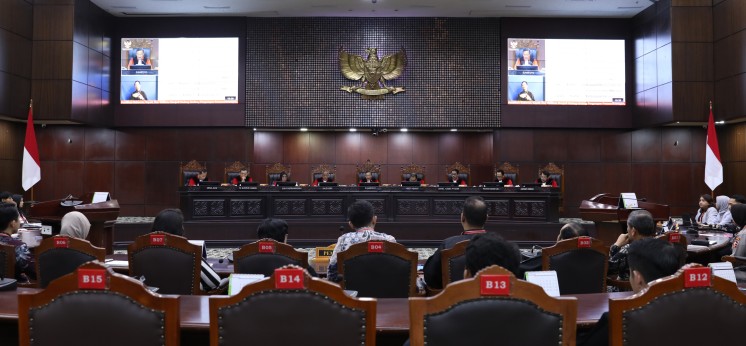
Decision Pronouncement Hearing of the judicial review of Law No. 2 of 2002 on National Police, Thursday (13/11), at the Constitutional Court. Photo by MKRI/Ifa.
Jakarta (MKRI) – The Constitutional Court rejected the petition on the material judicial review Article 25 paragraph (1) and Article 18 paragraph (1) and its Elucidation of Law No. 2 of 2002 on the National Police of the Republic of Indonesia filed by an Advocate Leon Maulana Mirza Pasha (Petitioner I) and a private employee, Panji (Petitioner II), on Case No. 183/PUU-XXIII/2025. This petition originated from alleged instances of abuse of authority by police officers experienced by each petitioner as a consequence of the enactment of the article being reviewed.
In legal consideration, as Justice Arsul Sani delivered, the Court holds that the concrete cases experienced by the Petitioners must be categorized as the implementation of norms, rather than a constitutional issue. Regarding the application of norms deemed inconsistent with prevailing provisions, a mechanism exists for their assessment and review.
Related to violations committed by police officers when exercising their duties, the Court had provided interpretation in several of its decisions, namely Decision No. 60/PUU-XIX/2021, pronounced on January 25, 2025, and reaffirmed in Decision No. 84/PUU-XXIII/2025, which in essence declare that police officers are bound and subject to standard operating procedures, disciplinary regulations, and the Chief of the National Police Regulation when conducting their duties.
“Any violation of the prevailing regulations, the related officer must be held accountable legally, morally, and professionally, especially pertaining to human rights. In the decision a quo, the Court considers adding and reaffirming that the Police Officer maintains their dignity and standing as a human by upholding just and civilized humanity in exercising the Police’s duties and authorities,” Justice Arsul stated on Thursday, November 13, 2025, at the Plenary Courtroom.
He added that, systematically, the existence of the norms in Article 25 paragraph (1) of Law No. 2 of 2002 could not be separated from other norms, including those in Article 13 of Law No. 2 of 2022, which outlines the Police’s duties. The provisions on the Police’s duties cannot be separated from the provisions of Article 30 paragraph (4) of the 1945 Constitution of the Republic of Indonesia, which states that the National Police serve as the state’s tool to maintain security and public order by protecting, safeguarding, and serving the public, as well as upholding law.
It means that the regulation serves as a response to the development of the supremacy of law principles, human rights, globalization, democratization, decentralization, transparency, and accountability. Such regulation is also related to the shift in the paradigm within the state system, particularly with the separation between the armed forces and national police.
Moreover, when exercising their duties and authorities, police officers not only take into account the legal aspects, in this case, legal norms and human rights, but also consider the religious norms, customs, and morality that are rooted in and alive within society. Such consideration is essential to align with society's demands, as they are expected to be public-oriented.
Article 25 paragraph (1) of the Police Law states: “Every member of the Indonesian National Police shall be granted a rank that reflects their role, function, and competence, and serves as the legitimacy of their authority and responsibility in carrying out their duties.” Meanwhile, Article 18 paragraph (1) of the Police Law provides: “For the public interest, officials of the Indonesian National Police, in carrying out their duties and authorities, may act at their own discretion.” The Elucidation to Article 18 paragraph (1) clarifies: “What is meant by ‘act at their own discretion’ refers to actions that may be undertaken by members of the Indonesian National Police, provided that the member considers the benefits and risks of such action and genuinely acts for the public interest.”
Also read:
Two Citizens Challenge Police Law After Receiving Threats Over Alleged Abuse of Authority
Advocate and Private Employee Add Articles Tested in Police Law Review
Previously, at the preliminary hearing, the petitioners claimed to have received threats from a police officer suspected of abusing his authority. The incident began when Petitioner I was contacted by M. Rifky Widyanto Pratama, who identified himself as an active police officer in the information and communications technology unit of the Jakarta Metropolitan Police. The officer inquired about the stage name “Icha Lovely,” formerly used by Leon’s client’s wife.
“The incident the Petitioner experienced not only reflects an abuse of power but also shows an intent to exploit the attributes of the Police for personal gain, without any legal basis,” Leon stated during the preliminary hearing of Case No. 183/PUU-XXIII/2025 on Wednesday, October 15, 2025.
Petitioner I is an attorney representing his client, a company identified as PT RCM. He explained that the company owned the stage name. However, Rifky rejected the explanation and began questioning the company’s legality, accusing it of lacking valid registration.
Rifky allegedly demanded access to the company’s private legal documents, which Leon could not provide due to confidentiality. Refusing to hand over the documents, Leon was threatened when Rifky warned that he would initiate an official investigation into the company’s legality.
“I conducted a profiling check and confirmed that this individual is indeed an active police officer. He even stated explicitly via WhatsApp that he is an active officer assigned to that specific division,” Leon explained.
Author: Mimi Kartika
Editor: Lulu Anjarsari P.
PR: Fauzan Febriyan
Translator: Rizky Kurnia Chaesario
Disclaimer: The original version of the news is in Indonesian. In case of any differences between the English and the Indonesian versions, the Indonesian version will prevail.
Decision in the Indonesian language.
Thursday, November 13, 2025 | 15:15 WIB 582