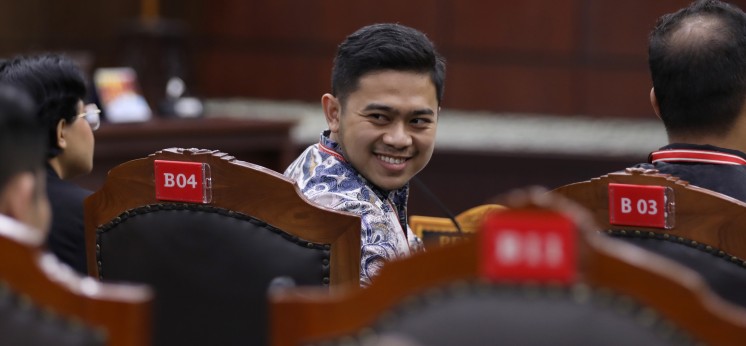
Gilang Muhammad Mumtaaz, legal counsel for the Petitioners, attends the Constitutional Court’s ruling hearing on the judicial review of provisions governing candidacy thresholds in regional elections, Thursday (13/11) in the Court’s Plenary Room. Photo by Humas/Ifa.
JAKARTA, MKRI – The Constitutional Court (MK) has rejected in full the petition for judicial review of Article 40 paragraph (1) of Law No. 10 of 2016 concerning the Second Amendment to Law No. 1 of 2015 on the Stipulation of Government Regulation in Lieu of Law No. 1 of 2014 on the Election of Governors, Regents, and Mayors (the Regional Election Law). The ruling in Case No. 90/PUU-XXIII/2025 was pronounced in the Court’s Plenary Chamber on Thursday (13/11/2025).
The petition was filed by eight individuals: Khalid Irsyad Januarsyah (Petitioner I), Robby Ardiansyah (Petitioner II), Zamroni Akhmad Affandi (Petitioner III), Panji Muhammad Akbar (Petitioner IV), Zahira Nurmahdi Hanafiah (Petitioner V), Muhammad Azis (Petitioner VI), Muhammad Faisal Hamdi (Petitioner VII), and Hasan Kurnia Hoetomo (Petitioner VIII).
Court: Threshold Expands Voters’ Options
In delivering the Court’s legal reasoning, Deputy Chief Justice Saldi Isra stated that Article 40 paragraph (1) of Law 10/2016 forms part of broader efforts to expand voter choice in regional head elections. He referenced the Court’s earlier Decision No. 60/PUU-XXII/2024, which had lowered the threshold percentage required for political parties or coalitions to nominate a candidate pair.
“With regard to Article 41 of Law 10/2016, the Court finds that the provision is not inconsistent with the principles of popular sovereignty, democratic regional elections, the right to advance oneself in collective efforts to develop society, the nation, and the state, nor the right to equal opportunity in government. These rights are guaranteed under Article 1(2), Article 18(4), Article 28C paragraph (2), and Article 28D paragraph (3) of the 1945 Constitution, and not as alleged by the Petitioners. Thus, the Petitioners’ arguments are entirely without legal merit,” Saldi said.
Requirements for Independent Candidates
Saldi further explained that the Court’s reasoning also rests on the longstanding recognition of independent candidacies, as articulated in the Court’s Decision No. 5/PUU-V/2007 and subsequently adopted in Law No. 12 of 2008 on Regional Government. That decision set out four key principles.
First, individuals seeking to run as independent candidates must secure a minimum level of voter support, making this requirement essential. Second, the minimum support requirement maintains balance between independent candidates and those nominated by political parties or coalitions. Third, the support threshold for independents must not be heavier than requirements for party-backed candidates. Fourth, the threshold must not be so low that it invites unserious candidates, which would ultimately diminish the value of democracy and erode public trust in regional elections.
Creating a New Proportional Balance
The Court emphasized that abolishing the minimum support requirement for independent candidates is not an option. The requirement must remain robust. However, Saldi noted that this does not bar lawmakers from revising the threshold for nomination, both for independent candidates and those backed by political parties.
“Such changes are intended to create a new proportional balance following Decision No. 60/PUU-XXII/2024. In this regard, lawmakers may adjust the nomination threshold so long as it does not exceed the percentage established in Decision No. 60/PUU-XXII/2024,” Saldi explained.
Accordingly, the Court held that the Petitioners’ claim that Article 40 paragraph (1), as interpreted in Decision No. 60/PUU-XXII/2024, and Article 41 of Law 10/2016 violate the 1945 Constitution was legally groundless.
“[The Court] rules to reject the Petitioners’ request in their entirety,” Chief Justice Suhartoyo declared, reading the dispositive portion of the ruling.
Also read:
Removing the Electoral Threshold for Regional Election Candidates
Argument for Abolishing Regional Head Candidacy Threshold Strengthened
During the preliminary hearing on Wednesday (4/6/2025), the Petitioners argued that following Decision No. 60/PUU-XXII/2024, there exists doctrinal harmony between regional elections (pilkada) and national elections (pemilu). They claimed this development strengthened the view that pilkada should be treated under the broader election regime established by Law No. 22 of 2007 on General Elections, which implicitly integrates regional elections into the national election framework under the term pemilu kepala daerah.
They further contended that, akin to presidential electionswhich must be conducted directly by the people under Decision No. 55/PUU-XVII/2019, the candidacy thresholds for regional elections require reassessment as part of ensuring meaningful political participation and equal competitive opportunities.
In their petitum, the Petitioners requested the Court to declare Article 40 paragraph (1) of Law 10/2016— as construed in Decision No. 60/PUU-XXII/2024 unconstitutional and non-binding insofar as it is not interpreted to mean “political parties or coalitions participating in the election may register candidate pairs.”
Writer: Sri Pujianti
Editor: N. Rosi
Public Relations: Andhini S.F.
Translator: SO
The full decision is available in Bahasa Indonesia at Decision No. 90/PUU-XXIII/2025.
Disclaimer: The original version of the news is in Indonesian. In case of any differences between the English and the Indonesian versions, the Indonesian version will prevail.
Thursday, November 13, 2025 | 15:30 WIB 222