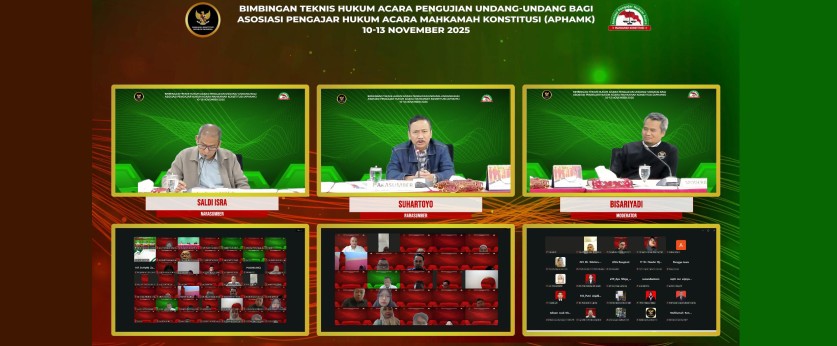
Chief Justice Suhartoyo and Deputy Chief Justice Saldi Isra as speakers at Online Workshop on the Court’s Procedural Law for Judicial Review for the Association of Constitutional Court Procedural Law Lecturers (APHAMK), on Wednesday (11/12/2025). Photo by MKRI/Teguh.
JAKARTA (MKRI) – In judicial review cases, the Constitutional Court (MK) has refined its procedural law mechanism through Constitutional Court Regulation No. 7 of 2025. To file a case before the Court, several adjustments have been introduced to simplify and shorten the procedural chain for submitting petitions. This was explained by Chief Justice Suhartoyo during the Technical Online Workshop on the Constitutional Court’s Procedural Law for Judicial Review for the Association of Constitutional Court Procedural Law Lecturers (APHAMK), on Wednesday, November 12, 2025.
Chief Justice Suhartoyo elaborated on the characteristics of the Court’s procedural law for judicial review, which include the types of review, parties involved, objects of review, and legal basis. Based on the types of review, laws may be subject to formal or material review. As for the parties eligible to submit petitions, they may consist of Indonesian citizens, legal entities, customary law communities, and state institutions.
“When a case submitted by a petitioner requires further clarification, the Court will hold a hearing to request statements from the MPR, DPR, DPD, or the President as providers of information,” explained Chief Justice Suhartoyo during the session moderated by Constitutional Justice’s Expert Assistant Bisariyadi, held online.
Furthermore, Chief Justice Suhartoyo stated that if a law is deemed to infringe upon constitutional rights, several requirements must be met in submitting a petition. These include the petitioner’s ability to explain which constitutional rights guaranteed by the 1945 Constitution of the Republic of Indonesia are being harmed by the enactment of the law under review, whether the loss is actual, potential, or imminent, and such explanation must be clearly specified.
In filing a petition, the petitioner must follow a systematic structure to describe their constitutional loss. The petition should include the petitioner’s identity, the Court’s jurisdiction, legal standing, legal reasoning, and petitum (the request).
“If it is a formal review, the petitum may request the annulment of the norm from the point of its formation. Meanwhile, for a material review, the petitum may involve conditional interpretation or suspension of the law’s implementation,” explained Chief Justice Suhartoyo.
In handling judicial review cases, the Court holds several stages of hearings namely, a preliminary hearing, examination hearing, and decision/ruling hearing. As for the nature of its rulings, the Constitutional Court’s decisions are final, erga omnes, and self-executing. In simpler terms, the Court’s rulings take effect immediately after being pronounced in an open plenary session.
“Unlike other courts whose decisions only bind the disputing parties, the Constitutional Court’s decisions in judicial review cases are of a public nature, binding on all citizens, and do not involve two opposing parties,” emphasized Chief Justice Suhartoyo.
Constitutional Interpretation
Deputy Chief Justice Saldi Isra began his presentation by recalling the origins of judicial review in the United States. He noted that although the U.S. Constitution does not explicitly grant judicial review to assess the constitutionality of laws, the practice emerged through judicial interpretation. In contrast, in Indonesia, judicial review did not arise from judicial reasoning but was explicitly conferred by the Constitution itself.
In this context, Deputy Chief Justice Saldi Isra explained that Article 24C paragraph (1) of the 1945 Constitution of the Republic of Indonesia grants one of the Court’s authorities the power to review laws. Therefore, in interpreting the Constitution, everything within it must be considered valid. Consequently, what may be reviewed, according to the text, are laws against the 1945 Constitution.
“In this context, legal interpretation must adhere to the text. No matter how clearly the Constitution is written, it still requires interpretation. The steps include first reading the constitutional text and its explanation, then studying the debates among the drafters. However, not all of these debates can be accessed by judges, so when interpreting a statutory norm, judges must read and analyze its meaning, and if these two steps are insufficient, they will refer to the legislative records from the law’s drafting process,” concluded Deputy Chief Justice Saldi Isra. (*)
Author: Sri Pujianti
Editor: Lulu Anjarsari P
Translator: Aski V. Rumere/Donny Yuniarto
Disclaimer: The original version of the news is in Indonesian. In case of any differences between the English and the Indonesian versions, the Indonesian version will prevail.
Wednesday, November 12, 2025 | 15:32 WIB 521