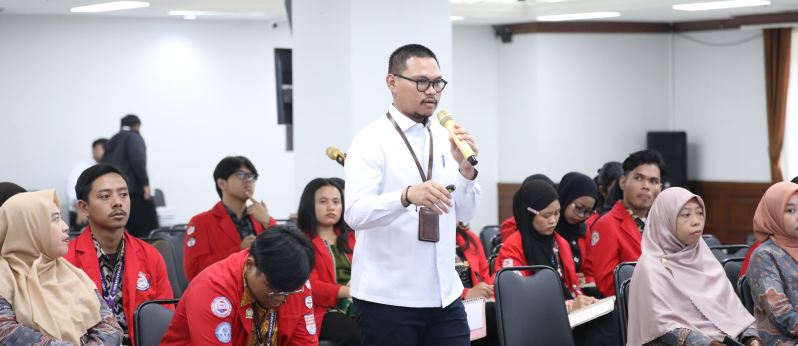
The students of Universitas Indonesia Maju (UIMA) listen to a lecture by the Constitutional Court’s Young Expert Legal Analyst, Muhammad Ramlan Amiruddin, or Alan, at the Court’s Building I Auditorium, Jakarta. Photo by MKRI/Fauzan.
JAKARTA, (MKRI) — A total of 47 students representing various student organizations from Universitas Indonesia Maju visited the Constitutional Court (MK) on Monday (11/10/2025), to learn about the procedural law of constitutional review of statutes against the 1945 Constitution of the Republic of Indonesia (UUD 1945). The students attended a lecture delivered directly by the Court’s Young Expert Legal Analyst, Muhammad Ramlan Amiruddin, familiarly known as Alan, at the Court’s Building I Auditorium in Jakarta.
Alan explained that the Court has the authority to review laws against the 1945 Constitution, to adjudicate disputes over the authorities of state institutions, to decide on the dissolution of political parties, and to resolve disputes over the results of general elections, including regional elections. Additionally, the Court has the authority to rule on the House of Representatives’ opinion concerning alleged violations committed by the President and/or Vice President - a process commonly referred to as impeachment.
“However, the Court has never exercised its authority to dissolve a political party or to handle impeachment cases up to this day,” Alan remarked.
He further explained that any citizen who believes their constitutional rights have been infringed upon by the enforcement of a law may file a petition for judicial review before the Court. Petitioners may include individual Indonesian citizens, groups of people with common interests, customary law communities (as long as they are still viable and consistent with the principles of the Unitary State of the Republic of Indonesia), legal entities, or state institutions.
The petitioner must be able to prove that their constitutional rights and/or authority have been or will be impaired by the enactment of a law or government regulation in lieu of law. This causal link must be clearly explained to establish the petitioner’s legal standing before the Court, by demonstrating the contradiction between the law’s provision being challenged and the relevant articles of the 1945 Constitution used as the touchstone of the review.
Students as Petitioners
Alan also noted that several recent petitioners in judicial review cases have been university students. While some petitions were rejected due to lack of legal standing, a number of student petitions have indeed been granted by the Court.
“One example is the petition filed by A. Fahrur Rozi from UIN Syarif Hidayatullah Jakarta in Decision No. 52/PUU-XXII/2024 concerning the judicial review of Law No. 10 of 2016 on Regional Head Elections,” Alan explained.
He added that in the same case, Ahmad Farisi, a constitutional law researcher and observer from UIN Sunan Kalijaga Yogyakarta, was also deemed to have legal standing. In that decision, the Court reinterpreted Article 70 paragraph (2) of Law No. 10/2016 to read:
“Governors and Deputy Governors, Regents and Deputy Regents, Mayors and Deputy Mayors, other state officials, and regional officials may participate in campaign activities by applying for campaign leave in accordance with prevailing laws and regulations, provided that:
a. they do not use facilities attached to their positions, except for security facilities for state officials as stipulated by law; and
b. they take unpaid leave from their positions.”
Alan encouraged the students to remain confident and proactive in upholding constitutional values.
“So don’t lose spirit, students must stay motivated. As long as you can argue the loss of constitutional rights and demonstrate the contradiction between a law’s provisions and the 1945 Constitution, you can bring your petition before the Court,” Alan concluded. (*)
Author : Mimi Kartika
Editor : Lulu Anjarsari P.
Translator : Aski Violeta Rumere/Agusweka Poltak Siregar
Disclaimer: The original version of the news is in Indonesian. In case of any differences between the English and the Indonesian versions, the Indonesian version prevails.
Monday, November 10, 2025 | 12:56 WIB 421