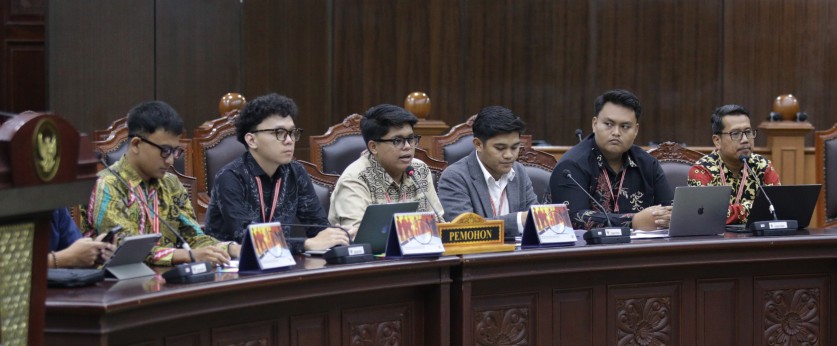
Petitioners attending the Petition Revision Hearing on Case No. 191/PUU-XXIII/2025 on the material judicial review of Law No. 12 of 1980 on Financial/Administrative Rights of the Leadership and Members of the High State/State Institutions and Former High State/State Institutions, Monday (10/11/2025). Photo by MKRI/Bay.
Jakarta (MKRI) – The Constitutional Court resumed a hearing on the judicial review of Article 12, Article 16 paragraph (1) letter a, Article 17 paragraph (1), Article 18 paragraph (1) letter a, and Article 19 paragraphs (1) and (2) of Law No. 12 of 1980 on Financial/Administrative Rights of the Leadership and Members of the High State/State Institutions and Former High State/State Institutions (Law No. 12 of 1980) on Monday, November 10, 2025. The hearing of Case No. 191/PUU-XXIII/2025 was set to hear the Petitioners’ revised petition. The petition was filed by Ahmad Sadzali (Petitioner I) and Anang Zubaidy (Petitioner II), both lecturers at the Faculty of Law, Islamic University of Indonesia (UII), along with several law students from UII, namely Muhammad Farhan Kamase (Petitioner III), Alvin Daun (Petitioner IV), Zidan Patra Yudistira (Petitioner V), Rayhan Madani (Petitioner VI), and Muhammad Fajar Rizki (Petitioner VII).
Farhan Kamase noted improvements made throughout the petition, including reference to the Court’s jurisdiction as set out in PMK No. 7 of 2025. The petitioners also bolstered the legal grounds for review and strengthened claims of constitutional harm.
“Among others, Petitioner I is harmed as an educator because he can no longer demonstrate legal, social, and moral justice from the DPR when lifelong parliamentary pension funding is provided. Petitioner II is also harmed as an educator, given that the law in question remains unamended and he cannot explain to students why this outdated legal framework, including lifetime pensions for DPR leaders, persists,” Farhan explained in Plenary Courtroom.
The petition further emphasizes that members of the DPR, who enjoy considerable financial means and privileged economic positions, should not be entitled to lifelong pensions. Such pensions, they argue, should instead be reserved as a form of social security for non-political public workers with modest salaries and limited resources after retirement.
“Granting pensions to secure DPR members financially constitutes misuse of state funds, which contravenes the principle of social justice as guaranteed by Articles 33 and 34 of the 1945 Constitution. Meanwhile, 55% of informal workers in Indonesia have no pension guarantees or social protection,” Zidan stated.
Also read:
Pension Allowance for House Members Protested
During the preliminary hearing on Monday, October 27, 2025, the Petitioners argued that the provisions granting pensions to DPR members infringe upon their constitutional rights, as taxpayers’ money should be directed toward fulfilling citizens’ basic needs and developing public facilities rather than providing lifetime pensions to members of the highest state institutions.
For instance, Article 16 paragraph (1) letter a of Law No. 12 of 1980 stipulates that pension payments for state officials cease upon their death. However, Article 17 paragraph (1) of the same law provides that, if the pension recipient dies, the benefit continues as a widow’s or widower’s pension amounting to half of the previous pension.
Meanwhile, in Indonesia, the DPR pension scheme, funded by the State Budget (APBN) without sufficient contribution from the recipients, is seen as unjust when compared to national pension systems. Such a scheme is perceived as a misuse of public funds, as state resources could instead be prioritized for essential sectors like education and health to achieve social welfare.
“On average, the income received by DPR members is nearly 42 times higher than Jakarta’s minimum wage of IDR 5,390,000. With such high earnings during their tenure, coupled with lifetime pension benefits, the balance between individual rights and the public interest, namely social welfare, becomes distorted,” one Petitioner stated.
Based on these arguments, the Petitioners requested the Court to declare Article 12 paragraphs (1) and (2) of Law 12/1980 conditionally unconstitutional insofar as they apply to officials elected through general elections. They also sought a ruling that Article 16 paragraph (1) letter a, Article 17 paragraph (1), Article 18 paragraph (1) letter a, and Article 19 paragraphs (1) and (2) are conditionally unconstitutional insofar as they contain the phrase “death.”
Author : Sri Pujianti.
Editor : Nur R.
PR : Tiara Agustina
Translator : Rizky Kurnia Chaesario/Agusweka Poltak Siregar.
Disclaimer: The original version of the news is in Indonesian. In case of any differences between the English and the Indonesian versions, the Indonesian version prevails.
Monday, November 10, 2025 | 16:30 WIB 482