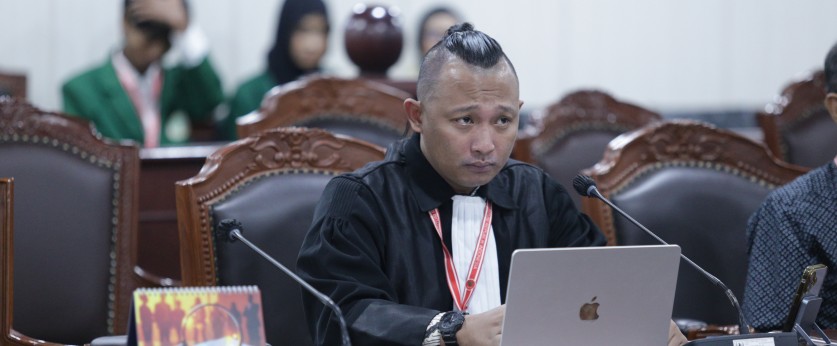
The Petitioners attending the preliminary hearing of Case No. 209/PUU-XXIII/2025 on the material judicial review of Law No. 3 of 2025 on the Amendment to Law No. 34 of 2004 on the Indonesian National Armed Forces, Friday (11/7/2025). Photo by MKRI/Bay.
JAKARTA (MKRI) — Two lawyers, Syamsul Jahidin and Ratih Mutiara Louk Fanggi, filed a material judicial review petition against Article 47 paragraph (1) of Law No. 3 of 2025 on the Indonesian National Armed Forces (TNI Law) with the Constitutional Court (MK). In Case No. 209/PUU-XXIII/2025, the Petitioners contest the provision for granting TNI personnel an alternative pathway to occupy certain civilian positions without first resigning or retiring from active military service.
Syamsul, appearing in person at the preliminary hearing on Friday, November 7, 2025, asserted that a constitutional issue arises because “the provision fails to explicitly distinguish between institutions within the national defense architecture and those that are purely civilian and administrative.”
Article 47 paragraph (1) of the TNI Law reads: “Prajurit dapat menduduki jabatan pada kementerian/lembaga yang membidangi koordinator bidang politik dan keamanan negara, pertahanan negara termasuk dewan pertahanan nasional, kesekretariatan negara yang menangani urusan kesekretariatan presiden dan kesekretariatan militer presiden, intelijen negara, siber dan/atau sandi negara, lembaga ketahanan nasional, search and rescue (SAR) nasional, narkotika nasional, pengelola perbatasan, kelautan dan perikanan, penanggulangan bencana, penanggulangan terorisme, keamanan laut, Kejaksaan Republik Indonesia, dan Mahkamah Agung.”
The Petitioners argued that the article contradicts national policy directions aimed at expanding employment opportunities for all Indonesian citizens. In practice, they said, the public, including the Petitioners, are confronted with ongoing layoffs, rising unemployment, and difficulty accessing stable and decent jobs.
Meanwhile, the provision allowing active TNI personnel to occupy civilian posts without resigning, they argued, deepens inequitable access to civilian positions and the broader civilian labor market. It potentially enables military dominance in civilian bureaucratic structures that should be governed by meritocracy and equality before the law.
The Petitioners further contended that the norm not only distorts the national labor ecosystem but also risks exacerbating unemployment rates, including among university graduates who should be part of the nation’s efforts to strengthen its legal and social development. As such, they argued, the norm violates equality before the law and reflects the State’s failure to realize its constitutional promises.
They also warned that the provision opens a backdoor to power abuse, weakening democratic principles and civilian supremacy, fundamental pillars of constitutional governance. Active-duty personnel assigned to civilian roles remain bound by military chain of command, which they said runs counter to the accountability and transparency required in civilian bureaucratic culture.
Allowing TNI personnel to enter civilian offices without transparent, merit-based appointments could erode bureaucratic neutrality and impede administrative reforms anchored in good governance. It may also violate the principle of non-discrimination because it provides TNI members with privileges unavailable to ordinary civilians, thereby creating substantive inequality before the law.
Therefore, the Petitioners requested the Court to declare Article 47 paragraph (1) of the TNI Law contrary to the 1945 Constitution (45C) to restore alignment between statutory norms and democratic principles and to guarantee fair legal certainty for all citizens. They asked the Court to declare the provision conditionally unconstitutional, arguing that it contradicts the principle of legal certainty under Article 28D paragraph (1) of the 1945 Constitution.
In their petitum, the Petitioners asked the Court to rule Article 47 paragraph (1) unconstitutional and not legally binding insofar as it is not interpreted as: “Prajurit dapat menduduki jabatan … dengan mengedepankan prinsip supremasi sipil.”
The panel hearing was chaired by Constitutional Justice Saldi Isra, accompanied by Justice Ridwan Mansyur and Justice Arsul Sani. During the advisory session, Ridwan emphasized that the Petitioners must explain the constitutional loss resulting from the provision—whether potential, actual, or both, to substantiate their legal standing.
Ridwan also noted that the provision had been previously reviewed by the Court. Thus, the Petitioners must demonstrate that the current petition does not violate the ne bis idem principle.
“You need to elaborate further to show that this is not ne bis idem and present arguments distinct from previous petitions,” Ridwan explained.
Before adjourning, Saldi informed the Petitioners that they may revise their petition within 14 days, with the revision required to reach the Court no later than Thursday, November 20, 2025, at 12:00 PM WIB.
Author: Mimi Kartika
Editor: Lulu Anjarsari P.
PR: Raisa Ayuditha M.
Translator : Yuanna Sisilia
Disclaimer: The original version of the news is in Indonesian. In case of any differences between the English and the Indonesian versions, the Indonesian version will prevail.
Friday, November 07, 2025 | 14:24 WIB 242