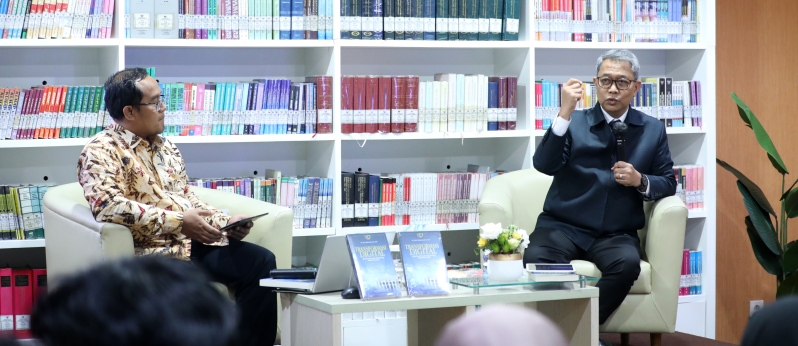
Secretary General Heru Setiawan serving as a speaker at the Ngaji Konstitusi session on his book Digital Transformation: Procedural Law on the Constitutional Court’s Judicial Review, Friday (11/7). Photo by PR/Fauzan
JAKARTA (MKRI)-Secretary-General of the Constitutional Court (MK) Heru Setiawan discussed his book Digital Transformation of the Constitutional Court’s Judicial Review Procedures. He conveyed this during the “Ngaji Konstitusi” public lecture organized by the Court in collaboration with Raja Grafindo Persada Publishing, the Faculty of Law of Universitas Negeri Semarang, and the Jimly School of Law and Government (JSLG), held in a hybrid format on Friday (11/7/2025).
Heru emphasized that to realize good judiciary governance, the Court must implement the principles of transparency, certainty, and legal justice so its decisions remain consistent and transparent. He also stressed the importance of integrating progressive and developmental legal theories to accommodate modern technology in the judicial process, especially in judicial review cases, whose decisions are final and binding (erga omnes).
“Prof. Jimly Asshiddiqie (the first Chief Justice, 2003-2008) stated as early as 2003 that the Constitutional Court must be a modern and trustworthy judiciary,” Heru said from the Court’s Library at Building I, Jakarta.
He explained that Articles 27 to 32 of the 1945 Constitution guarantee citizens’ constitutional rights. Citizens who consider statutory laws unfair and restricting or harming their constitutionally protected rights may file a petition with the Constitutional Court.
Given that the Indonesian population is scattered from Sabang to Merauke and from Miangas to Rote Island, while the Court is located only in the nation’s capital, the Court utilizes technology to facilitate access to justice, the right of every citizen to obtain justice through a transparent, swift, and cost-free judicial institution.
Heru highlighted that since its establishment, the Court has demonstrated a strong spirit to continually transform itself to become one of the most modern judiciaries in Indonesia and even globally. Digital transformation is essential due to both the Court’s founding principles and technological developments. Digital constitutionalism emphasizes adhering to constitutional principles when regulating governmental and private-sector digital technology use, ensuring that such technologies maximize the protection of citizens’ constitutional rights.
“Digital constitutionalism pushes for the maximization and optimization of the judiciary’s role in examining, hearing, and deciding cases on rights requiring judicial protection. It must advance across all spheres of governmental duties,” Heru added.
He also noted that the Court often faces large volumes of case data, decisions, legal arguments, and periodic changes in the composition of justices. Without advanced information systems, justices may struggle to access and analyze data efficiently. For that reason, the Court is developing big data management and an anti-corruption data center to support decision-making using artificial intelligence (AI).
“Anyone capable of integrating law and technology will produce transparent, efficient, accountable systems that improve time management and support justices in issuing fair decisions,” he remarked.
A New Paradigm
Heru further explained that a new paradigm has emerged in the Court’s digital transformation: ensuring accessibility and transparency in judicial review processes, alongside effective use of technology to support justices in reaching decisions. Judicial transparency is rooted in Article 28F of the 1945 Constitution, while accessibility is crucial given the Court’s central location. Transparency and accessibility at every stage of judicial review enhance public participation.
Digital case management systems and access to legal databases allow justices to easily search for previous decisions and relevant arguments. Robust data analysis helps identify patterns human analysis might overlook, supporting consistency and adherence to established legal principles.
To implement digital transformation, Heru outlined several strategies: developing policies and regulations supporting digital transformation, strengthening human resource training, and integrating Court systems with stakeholders. Accessibility and transparency are reflected in online and offline petition filing, open hearings accessible through social media, and swift access to decisions via the Court’s official website, mkri.id.
“The realization of the principles of ‘DIGITALS’ represents a modern and trustworthy judiciary, one that offers accessible and equitable services to litigants and the public,” Heru stated.
In addition to Heru, the event was also attended virtually by the Deputy Chairperson of JSLG/Professor of Law at Ubaya, Prof. Hesti Armiwulan, and the Dean of the Faculty of Law of Universitas Negeri Semarang, Prof. Ali Masyhar Mursyid. Lecturer at Usahid Faculty of Law/Deputy Director of JSLG Wahyu Nugroho also attended in person at the Court’s Library and served as moderator accompanying Heru Setiawan. (*)
Author: Mimi Kartika
Editor: Lulu Anjarsari P.
Translator: Siti Rosmalina Nurhayati/ASKI
Disclaimer: The original version of the news is in Indonesian. In case of any differences between the English and the Indonesian versions, the Indonesian version will prevail.
Friday, November 07, 2025 | 16:31 WIB 128