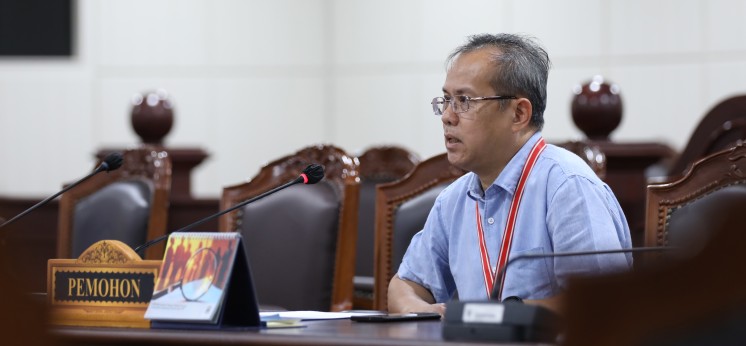
The Petitioner at the preliminary hearing for the judicial review of Law No. 39 of 1999 on Human Rights for case No. 207/PUU-XXIII/2025, Friday (11/7/2025). Photo by MKRI/Bayu.
JAKARTA (MKRI) — Taxpayer Haryanto has filed a petition for the judicial review of Law No. 7 of 1983 on Income Tax, as last amended by Law No. 6 of 2023 on the Stipulation of Government Regulation in Lieu of Law No. 2 of 2022 on Job Creation as Law, before the Constitutional Court. The preliminary hearing for Case No. 207/PUU-XXIII/2025, chaired by Constitutional Justice Arief Hidayat, took place on Friday, November 7, 2025 in a panel courtroom.
The Petitioner challenges Article 4 paragraph (1) of the Income Tax Law, which states: “The object of tax shall be income, that is, any additional economic capacity received or obtained by a Taxpayer, whether originating from within or outside Indonesia, which can be used for consumption or to increase the wealth of the Taxpayer concerned, by any name and in any form.”
The Petitioner stated that auditors of the Tax Office often use this provision to correct taxpayer transactions. However, such corrections frequently result in an underpayment. As an example, he illustrated that accounts receivable and payable recorded in the balance sheet are subject to income tax on interest by auditors, even though there is an agreement between the parties that such receivables and payables are interest-free. According to the Petitioner, the wording of the article suggests that a taxpayer actually receives or obtains money or gifts in the form of goods or property—something tangible and not merely hypothetical, as interpreted by the tax auditors.
“In every tax audit, disputes often arise with the auditors. If we have bad debts, we are often charged interest on the debt, as though the audit assumes there must be interest. Therefore, I ask the Court to provide an opinion on whether such treatment is reasonable for this kind of transaction,” the Petitioner requested before the Court.
Petition’s Format
In her advice, Constitutional Justice Enny Nurbaningsih stated that the Petitioner’s petition was not yet in accordance with the procedural requirements of the Constitutional Court. “Therefore, it should be structured in accordance with the rules for judicial review petitions before the Constitutional Court so that it meets the formal requirements for submission,” she explained.
Meanwhile, Constitutional Justice Arsul Sani stated that the Petitioner’s request was more appropriately addressed to the tax office, as it was in the nature of a question. “However, if you wish to adjust it to the format of a petition before the Court, please refer to Constitutional Court Regulation No. 7 of 2025 and examine the Court’s previous decisions, especially the facts of the cases,” he explained.
In agreement to Justice Arsul, Constitutional Justice Arief advised the Petitioner to follow the provisions of Constitutional Court Regulation No. 7 of 2025 in revising his petition. “[You] may review sample petitions available on the website https://www.mkri.id/, or seek assistance from an advocate or a university legal aid center for consultation in preparing this petition,” he advised.
Before adjourning the session, Justice Arief stated that the Petitioner would have 14 days to revise the petition. The revised petition must be received by the Court’s Registrar’s Office no later than Thursday, November 20, 2025 at 12:00 WIB, after which the Court will then schedule a second session to hear the revisions to the petition.
Track the case No. 207/PUU-XXIII/2025 here.
Author : Sri Pujianti
Editor : N. Rosi
PR : Fauzan F.
Translator : Yuniar Widiastuti (NL)
Disclaimer: The original version of the news is in Indonesian. In case of any differences between the English and the Indonesian versions, the Indonesian version will prevail.
Friday, November 07, 2025 | 14:12 WIB 225