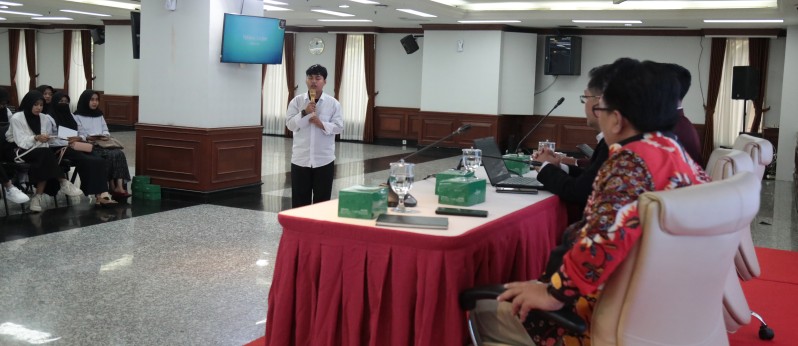
Students of the Constitutional Law Study Program, Faculty of Sharia, Islamic State University (UIN) Madura visiting the Constitutional Court on Wednesday, November 5, 2025, with one of the students seen asking a question. Photo by Public Relations/IlhamWM.
JAKARTA (MKRI)-A total of 40 students from the Constitutional Law Student Association (HMPS HTN), Faculty of Sharia, Islamic State University (UIN) Madura visited the Constitutional Court (MK) on Wednesday, November 5, 2025. They were received and immediately engaged in a discussion with the Court’s Intermediate Legal Analyst, Rio Tri Juli Putranto, at the Auditorium of Building I of the Court, Jakarta.
One of the students asked how to submit a complaint to the Court in cases of injustice at the regional level. Rio explained that petitions can be filed in relation to constitutional rights guaranteed by the 1945 Constitution that are harmed by the enactment of a law.
“The link to rights guaranteed by the Constitution must be proven, and it must be shown that the harm arises from a law,” Rio said.
Meanwhile, if such injustice arises from regulations below the level of a law, such as a ministerial regulation, the petition may be submitted to the Supreme Court (MA). This is because the Supreme Court has the authority to adjudicate at the cassation level and to review regulations below a law against the law.
The Constitutional Court, meanwhile, is authorized to review laws against the 1945 Constitution, decide disputes over authorities of state institutions whose powers are granted by the Constitution, decide the dissolution of political parties, adjudicate disputes over the results of general elections and regional head elections, as well as decide the House of Representatives’ opinion regarding alleged violations committed by the President and/or Vice President under the 1945 Constitution. Rio added that petitioners in a judicial review of a law may include parties who consider that their constitutional rights and/or authority have been harmed by the enactment of a law or a government regulation in lieu of a law (Perppu).
Petitioners may be Indonesian individuals or groups with shared interests, customary law communities as long as they remain alive and are in accordance with societal developments and the principles of the Unitary State of the Republic of Indonesia as regulated by law, public or private legal entities, or state institutions. The constitutional rights and/or authority claimed to have been harmed by the enactment of the law/Perppu must be proven to strengthen their legal standing in the petition.
Rio further explained that petitioners residing far from the Constitutional Court, which is located in the capital city, may file their petition online through the electronic application at simpel.mkri.id, in addition to filing it offline by directly visiting the Court. Petitioners may also request an online or remote hearing, no later than one working day before the scheduled hearing date.
Author: Mimi Kartika
Editor: Lulu Anjarsari P.
Translator: Siti Rosmalina Nurhayati/Jessica
Disclaimer: The original version of the news is in Indonesian. In case of any differences between the English and Indonesian versions, the Indonesian version will prevail.
Wednesday, November 05, 2025 | 14:22 WIB 89