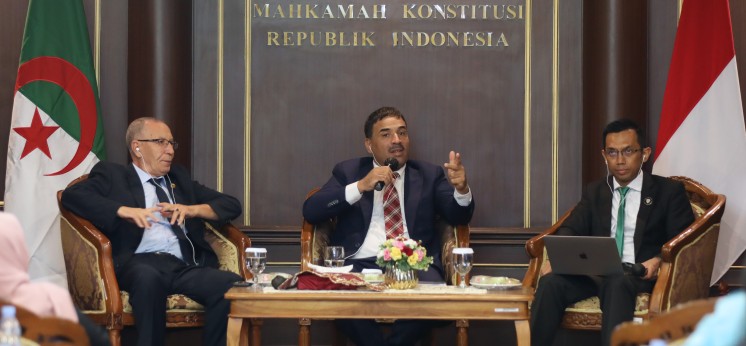
Justice Bouziane Aliane and Justice Ahmed Bennini of the Algerian Constitutional Court as speakers at a public lecture moderated by Pan Mohamad Faiz, Head of the Court's Public Relations and Protocol Bureau, on Wednesday (11/5/2025) at the Court Building. Photo by MKRI/Ifa.
JAKARTA (MKRI) — The Constitutional Court of the Republic of Indonesia (MK RI) in collaboration with the Constitutional Court of Algeria held a general lecture titled “The Jurisdiction of the Constitutional Court of Algeria: Between Constitutional Oversight of Institutions and the Protection of Rights and Freedoms.” The event, aimed at exchanging legal and constitutional knowledge, was conducted in a hybrid format — online via Zoom and the Court’s YouTube channel, and in person in the delegation room of the building I on Wednesday, November 5, 2025.
The session featured two speakers from the Algerian Constitutional Court, Justices Bouziane Aliane and Ahmed Bennini, with Pan Mohamad Faiz, Head of the Public Relations and Protocol Bureau, serving as moderator. Justice Bouziane introduced the functions and jurisdiction of the Algerian Court in safeguarding the nation’s constitution. He explained that when the government and parliament face differences in interpreting the constitution, the Algerian Court serves as the final interpreter in such disputes.
“The Algerian Court supervises all regulations issued by the president and parliament. These regulations can only take effect after the Court provides its interpretation, such as laws concerning elections, the media, and all matters related to citizens’ interests,” Justice Bouziane explained. “The Court is an independent institution whose president holds the third-highest position in the state hierarchy — after the President of the Republic and the Speaker of Parliament. All rulings of the Court are binding on all institutions, and it is important to note that the President of the Court can assume the functions of both the President and the Speaker if both positions become vacant simultaneously.”
Justice Bouziane shared that the Algerian Court was previously known as the Constitutional Council. Following constitutional reforms, it was renamed the Constitutional Court of Algeria. Article 185 of the 2020 Constitution outlines key distinctions between the former Council and the new Court, particularly in terms of the composition of judges, appointment criteria, and the selection process for members of the Court.
The Independence of Algerian Court
Justice Bouziane emphasized that the new Court’s independence is reflected in its institutional autonomy, allowing it to establish its internal regulations and define principles governing its own operations. This independence ensures the impartiality and integrity of the Court in resolving jurisdictional disputes. Moreover, the Court plays a vital role in maintaining the stability of state power and constitutional institutions through its prerogative authority to settle inter-institutional conflicts, supervise election results, and provide advisory opinions to the Head of State during extraordinary circumstances.
“Therefore, the Algerian Court acts as a supervisory and regulatory body overseeing both chambers of parliament, as well as governmental and presidential activities,” said Justice Bouziane. “This role strengthens cooperation and balance among branches of government, preventing political crises that could threaten public order and political stability.” The event was also attended online by Former Justice Wahiduddin Adams for the 2014–2024 term.
Justice Composition at Algerian Court
The second speaker, Justice Ahmed Bennini, elaborated on the Court’s membership. The Algerian Court consists of 12 career justices, each possessing at least 20 years of professional legal experience, especially in constitutional law for those selected from academia. Candidates must also be at least 50 years old at the time of nomination, as stated in Article 187 of the 2020 Constitution.
“Two-thirds of the members are selected through a process that prioritizes judicial independence,” Justice Ahmed explained. “Six members are chosen from universities located in the eastern, central, and western regions of the country, while two others are elected by their peers from ordinary and administrative courts.”
Judicial Review Petition at Algerian Court
Participants also had the opportunity to ask questions. One attendee from President University inquired about the procedure for filing petition at Algerian Court.
“How can citizens submit a judicial review petition to the Court of Algeria? Can individuals file directly, or is there a specific mechanism?” the participant asked.
Justice Bouziane explained that petitions must be submitted through registered state bodies. Additionally, petitions can be filed through 40 members of parliament representing citizens, or submitted via judicial channels.
“In short, citizens cannot directly file petitions to the Constitutional Court of Algeria. They must go through legal channels, such as appeals, often with the assistance of legal counsel.” Justice Bouziane clarified.
Read also:
Indonesia’s Court and Algeria’s Court Strengthen Bilateral Relations
It is worth noting that cooperation between the Indonesian Court and the Algerian Court have good relations since 2015, marked by the signing of a Memorandum of Understanding (MoU) to strengthen bilateral relations in constitutional justice. Since then, both institutions have actively engaged in reciprocal visits and joint programs, reflecting their mutual commitment to friendship and collaboration.
In 2017, during the 4th Congress of the World Conference on Constitutional Justice (WCCJ) in Vilnius, Lithuania, the Indonesian Court supported the Algerian Constitutional Council’s bid to host the 5th WCCJ Congress, which was initially scheduled for 2020. Through this general lecture, both courts aim to reaffirm their spirit of friendship and continue the exchange of constitutional knowledge, united by their shared commitment to democracy and constitutional justice.
Author : Sri Pujianti.
Editor : N. Rosi.
Translator : Jessica Rivena Meilania/Donny Yuniarto
Disclaimer: The original version of the news is in Indonesian. In case of any differences between the English and the Indonesian versions, the Indonesian version will prevail.
Wednesday, November 05, 2025 | 14:23 WIB 764