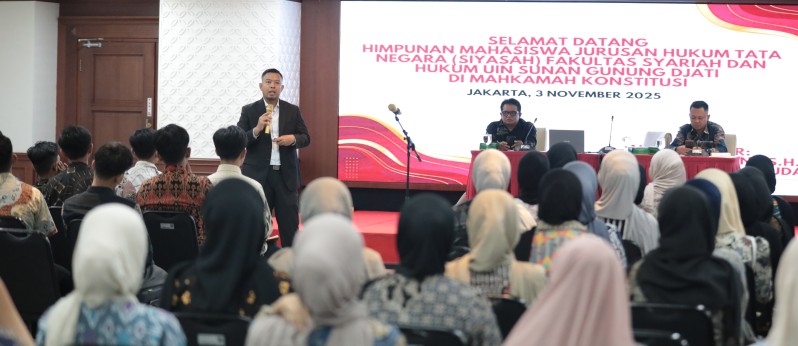
Court Expert Legal Analyst Muhamad Doni Ramdani explaining the Court's position in the Indonesian constitutional system to Constitutional Law Students from the Faculty of Sharia and Law, Sunan Gunung Djati State Islamic University Bandung, on Monday (10/3/2025). Photo by MKRI/IlhamWM.
JAKARTA, MKRI – The Constitutional Court (MK) welcomed Constitutional Law Students, Faculty of Sharia and Law, State Islamic University (UIN) Sunan Gunung Djati Bandung, on Monday, November 3, 2025. The delegation was received directly by Court’s Expert Legal Analyst Muhamad Doni Ramdani in the Court’s Building.
In his presentation, Doni explained that the Court is a relatively new institution within Indonesia’s constitutional system, as it was established following the 3rd Amendment to the 1945 Constitution of the Republic of Indonesia (UUD 1945). Prior to the reform era, all judicial authority rested in the Supreme Court (MA). However, after the reforms, new institutions emerged—such as the Constitutional Court, the Judicial Commission (KY), and the General Elections Commission (KPU)—enriching Indonesia’s constitutional framework.
“The Constitutional Court operates within the judicial branch alongside the Supreme Court and the Judicial Commission. Its establishment is regulated under Article 24C of the 1945 Constitution and by Law No. 24 of 2003 on the Constitutional Court, which has been amended by Law No. 8 of 2011 and Law No. 7 of 2020,” said Doni.
Doni further noted that, following the constitutional amendments, all state institutions now stand on an equal footing. Previously, the People’s Consultative Assembly (MPR) was considered the highest state institution. The formation of the Court was driven by the need for a body authorized to review laws against the Constitution and to provide a clear legal mechanism for the impeachment of the President and/or Vice President.
He went on to elaborate on the Court’s key jurisdictions, which include reviewing laws against the 1945 Constitution, adjudicating disputes over the authority of state institutions, resolving disputes concerning election results, and ruling on the dissolution of political parties.
“The Court’s authority to dissolve political parties arose from past experiences when political parties were arbitrarily disbanded by those in power without due legal process,” he explained.
Doni emphasized, despite its significant authority, the Court is not a “superpower” institution. Its existence embodies the principle of checks and balances among the branches of state power. With its jurisdiction, the Court serves as the guardian of the constitution, protector of democracy, final interpreter of the Constitution, defender of citizens’ constitutional rights, and guardian of the state ideology.
During the session, Doni also explained that the Court now allows hearings to be conducted online. Many students have filed petitions for judicial review cases at the Court. He encouraged students to recognize that they don’t need to rely solely on demonstrations to express their aspirations, as they also have a formal legal avenue to defend their constitutional rights through the Court’s mechanisms.
He then outlined the procedural stages of a case at the Court, from the filing of a petition and preliminary examination, through examination hearings to ruling hearing of the decision. Doni reaffirmed that all Court decisions are open to the public and accessible immediately after they are read out.
In closing, Doni highlighted several Court decisions that have drawn public attention, including one concerning the separation of national and local elections. He underscored that the Court may change its stance on judicial review cases if new constitutional arguments arise that differ from previous cases.
“A Court Justice must possess the spirit of a statesperson, thinking of the interests of the nation and state above personal or group interests,” Doni concluded.
Author : Utami Argawati
Editor : Lulu Anjarsari P.
Translator : Jessica Rivena Meilania/Donny Yuniarto
Disclaimer: The original version of the news is in Indonesian. In case of any differences between the English and the Indonesian versions, the Indonesian version will prevail.
Monday, November 03, 2025 | 14:38 WIB 205