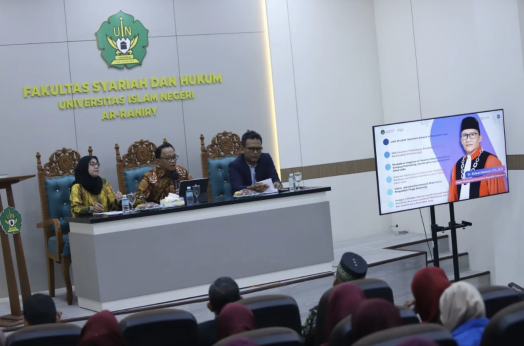
Constitutional Justice Ridwan Mansyur as a source person in a public lecture at the Faculty of Sharia and Law (FSH), Ar-Raniry State Islamic University (UIN) Banda Aceh, on Friday (10/31/2025). Photo by AcehSiber.com
BANDA ACEH (MKRI) - Constitution is the supreme law of the land or the source of all laws governing state life. This statement was delivered by Constitutional Justice Ridwan Mansyur during a public lecture at the Faculty of Sharia and Law (FSH), Ar-Raniry State Islamic University (UIN) Banda Aceh, on Friday, October 31, 2025.
According to Justice Ridwan, all laws, government regulations, and presidential decrees must remain in harmony with the spirit of the 1945 Constitution. “Every decision and legal act of the state, no matter how small, must not deviate from the Constitution. This is the essence of constitutional supremacy,” said Justice Ridwan.
Justice Ridwan further explained that judicial review serves as a manifestation of constitutional sovereignty and a main instrument to ensure the supremacy of the Constitution over all forms of political and legislative power. It is not merely a legal process but a realization of democratic ideals that guarantee every public policy adheres to constitutional values. Moreover, Justice Ridwan noted that judicial review functions as a mechanism of checks and balances to ensure that democratic practices do not deviate from fundamental legal principles.
“Democracy can go astray when power operates without control. This is where the Court plays its role to ensure that the ideals of the Constitution, such as justice, equality, and the protection of human rights, continue to live within the realities of politics and state policies,” Justice Ridwan stated.
On this occasion, Justice Ridwan also highlighted the dualism in Indonesia’s judicial review system. The Supreme Court is authorized to review regulations below the level of laws, while the Constitutional Court examines laws against the 1945 Constitution. According to him, this dualism reflects institutional balance in maintaining the national legal order. These two institutions bear different responsibilities but complement one another in upholding constitutional justice.
In his presentation, Justice Ridwan also emphasized the procedural principles of the Constitutional Court, which embody substantive justice independence, impartiality, open hearings, speedy and cost-free trials, and the principle of hearing both parties (audi-et alteram partem). “Every constitutional case must be handled based on principles that guarantee justice, not mere legal formalities,” he added.
At the conclusion of his presentation, Justice Ridwan underscored the importance of understanding citizens constitutional rights, both explicitly stated (enumerated rights) and implied within the spirit of the Constitution (implied rights). These rights include the right to legal assistance, the presumption of innocence, and the right to social justice.
Meanwhile, Dean of the Faculty of Sharia and Law (FSH) UIN Ar-Raniry, Kamaruzzaman Bustamam Ahmad, stated that the event provided an important space for students and lecturers to understand constitutional law not merely as a normative text but as a living socio-political dynamic.
“This event is part of the institutional collaboration between UIN Ar-Raniry and the Constitutional Court of the Republic of Indonesia. Through forums like this, we aim to strengthen constitutional awareness within the academic community, that the law must serve as a means to uphold justice and democratic balance,” said the dean, familiarly known as KBA.
KBA explained that the public lecture, titled “Judicial Review as a Democratic Control Mechanism: Between Ideality and Reality,” featured Constitutional Justice Ridwan Mansyur and was attended by more than 100 students and lecturers in the campus theater hall.
“We are committed to this collaboration as part of a broader strategy to strengthen national legal education based on Islamic values. We want students not only to memorize legal articles but also to understand the philosophy behind them. This is a small yet meaningful step toward building a just, democratic, and constitutional nation,” he concluded.(*)
Source: AcehSiber.com
Translator: Aski V. Rumere/Donny Yuniarto
Disclaimer: The original version of the news is in Indonesian. In case of any differences between the English and the Indonesian versions, the Indonesian version will prevail.
Friday, October 31, 2025 | 19:30 WIB 250