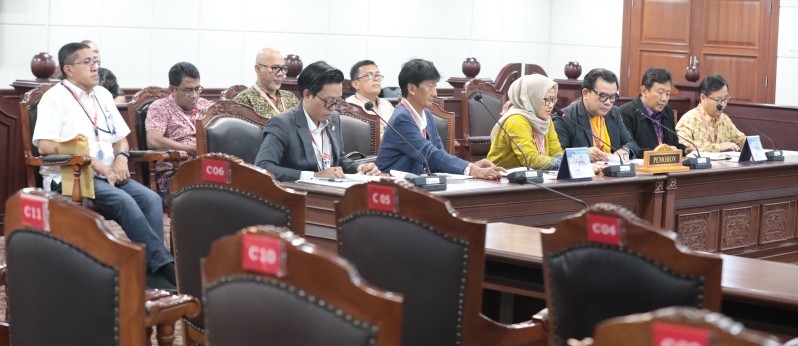
Petitioners of the Harmonization of Tax Regulations review explaining the revised petition, Thursday (30/10). Photo by MKRI/IlhamWM.
Jakarta (MKRI) – The petitioners of case No. 186/PUU-XXIII/2025 delivered the revised petition for judicial review of Article 4 paragraph (1) and Article 17 of Law No. 7 of 1983 on Income Tax (PPh Law), as last amended by Law No. 7 of 2021 on Harmonization of Tax Regulations (HPP Law), on Thursday, October 30, 2025.
“Almost all of it has been revised, Your Honours, should I just read the petitum? Thank you, Your Honours, I will proceed,” Petitioner Wahyuni stated in the Courtroom.
In their petitum, the Petitioners requested that the Court declare Article 4 paragraph (1) of the HPP Law, insofar as the phrase “allowances and pension” as included in taxable income and resulting in tax liability on pension funds, conditionally non-binding in law. They specified that this provision should not apply and cannot be enforced to include as taxable objects any social security savings funds such as pensions, Old Age Security (JHT), and Old Age Allowance (THT), as these are not additional economic capacity, but social entitlements of workers protected by the 1945 Constitution.
They further asked the Court to declare Article 17 of the PPh Law juncto the HPP Law contrary to the 1945 Constitution, and to interpret the provision as only conditionally constitutional if “taxable income” does not include post-employment compensation (severance, pensions, THT, and JHT) that is social, compensatory, and non-productive in nature. Accordingly, the exclusion of tax from such post-employment benefits should be recognized as a constitutional guarantee, not a fiscal policy subject to change at will.
Also read:
Employees Seek Tax Exemption for Severance Pay and Pensions
The petitioners in this case were originally nine people, later expanded to twelve private bank employees from different banks, as well as the chairperson of an employees’ union in one of the banks. They argued that the relevant provisions treat severance and pensions, fundamentally the normative rights of workers after years of service, as equivalent to new income arising from economic activity.
Article 4 paragraph (1) of the Income Tax Law defines taxable income as “any additional economic capacity received or obtained by a taxpayer, whether originating from Indonesia or abroad, that can be used for consumption or to increase the taxpayer’s wealth, by any name and in any form, including salaries, wages, commission, bonuses or gratuities, pensions, or other remuneration for work performed.” Article 17 of the same law sets progressive tax rates based on income brackets, applied to the final pay period for permanent employees, non-permanent employees earning more than IDR 2.5 million per day, non-employee income earners, activity participants, pension fund withdrawals, and former employees.
The petitioners argued that, philosophically and sociologically, severance pay and pensions cannot be equated with business profits or capital gains. They represent a worker’s final savings—the result of lifelong effort. According to the petition, the government and House of Representatives (DPR) wrongly classify severance pay received in lump sums as an “additional economic capacity,” even though such payments are savings deducted monthly from salaries and serve as recognition of service to one’s employer.
From a constitutional perspective, the petitioners contended that this policy obscures the meaning of Article 27 paragraph (2) of the 1945 Constitution. Severance pay, pensions, Old-Age Insurance (JHT), and Provident Funds (THT) form essential components of a decent livelihood; taxing them undermines workers’ constitutional right to live adequately after retirement.
Author: Mimi Kartika
Editor: N. Rosi.
Translator: Rizky Kurnia Chaesario
Disclaimer: The original version of the news is in Indonesian. In case of any differences between the English and the Indonesian versions, the Indonesian version prevails.
Thursday, October 30, 2025 | 15:51 WIB 265