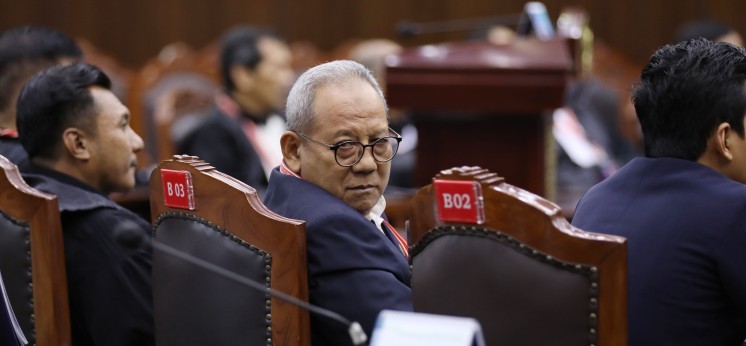
Petitioner Abu Bakar attending the Decision Pronouncement Hearing of judicial review on Notary Retirement Age, Thursday (30/10). Photo by MKRI/Ifa.
Jakarta (MKRI) – The Constitutional Court has entirely rejected the petition for judicial review of Article 8 paragraph (2) of Law No. 20 of 2004 on Notary as amended by Law No. 2 of 2014 (Notary Law) against the 1945 Constitution of the Republic of Indonesia. The pronouncement of Decision No. 179/PUU-XXIII/2025 was held at the Plenary Courtroom.
The case was submitted by two notaries, Zainun Ahmadi and Abu Bakar, who alleged a violation of their constitutional rights owing to the delay in the delivery of Constitutional Court Decision No. 84/PUU-XXII/2024 concerning the notary retirement age. The session was presided over by Chief Justice Suhartoyo and six other constitutional justices.
In its consideration, Justice M. Guntur Hamzah explained that after thoroughly reviewing the petition and the evidence submitted, the Court concluded that the petitioners’ complaint did not concern the substance of Article 8 paragraph (2) of the Notary Law, but rather the effective date of the previous Constitutional Court decision, which they deemed to have been delivered late.
“The issue raised by the Petitioners is not about the substance of Article 8 paragraph (2) of the Notary Law that has been interpreted in Constitutional Court Decision No. 84/PUU-XXII/2024. In principle, the Petitioners do not object to the new meaning formulated by the Court in that decision as a replacement for the previous interpretation. In fact, the Petitioners support the meaning as interpreted by the Court. This is evidenced by their desire to extend their retirement age from 67 to 70 based on the new meaning of Article 8 paragraph (2) as provided by the Court,” Justice Guntur stated.
Further, Justice Guntur elaborated that if the issue is examined closely, the petitioners’ constitutional grievance concerns the timing or pronouncement of the Constitutional Court’s interpretation of Article 8 paragraph (2), specifically, that the judgment was stated late due to the absence of uniform standards for case resolution time at the Constitutional Court, and because Constitutional Court decisions are generally prospective (non-retroactive) from the date of pronouncement. Therefore, the petitioners requested that Decision No. 84/PUU-XXII/2024 take effect retroactively from 19 March 2024, the date of their petition, instead of the date of the judgment. They argued that, had the ruling been effective from 19 March 2024—even though pronounced on 3 January 2025—they would still have had the opportunity to extend their tenure from age 67 to 70, as they were not yet 67 as of 19 March 2024.
The Court found that departing from the prospective principle would undermine the entire legal system, preventing legal subjects from reliably predicting the legal consequences of their actions. From a constitutional perspective, legal certainty is a fundamental right guaranteed by Article 28D paragraph (1) of the 1945 Constitution.
On this point, the Court noted that it has previously made exceptions to the prospective principle, applying retroactivity only under specific circumstances—namely, where the contested legal norm was already in force but had been misapplied, causing legal uncertainty or specific harm to petitioners, as in Decision No. 110-111-112-113/PUU-VII/2009. However, in the present case, the retroactive application sought by the petitioners did not meet those requisite conditions, and the newly defined meaning of Article 8 paragraph (2) of the Notary Law should remain prospective.
Accordingly, the principle of prospectivity in this case, in the Court’s view, must be realized in two ways. First, the substance of Article 8 paragraph (2) of the Notary Law, as already interpreted by Decision No. 84/PUU-XXII/2024, may not be given additional meaning that would render it retroactive. Second, the Constitutional Court’s decision, as the vehicle for reviewing statutory norms, must not be given retroactive effect.
“On this basis, the Court finds the petitioners’ arguments for retroactive application of the Constitutional Court’s decisions to be legally unfounded,” Justice Guntur stated.
The petitioners also argued that the varying duration of Constitutional Court case processing constituted discrimination. They claimed that had Decision No. 84/PUU-XXII/2024 been issued as rapidly as some other cases (within 42 days), they would have qualified for a tenure extension under the new interpretation.
However, the Court found that differences in case processing times do not constitute discrimination. The Court treats all petitions equally; hence, it cannot be found discriminatory.
“When deciding Petition No. 84/PUU-XXII/2024, which tested norm on the notary age or retirement, the Court could not, and is not required to, know the names of all notaries in Indonesia who would be affected by the Court’s decision,” Justice Guntur explained.
Moreover, if the Court were to adopt the reasoning and logic advanced by the Petitioners, namely, to retroactively adjust the effective date of Article 8 paragraph (2) of the Notary Law as interpreted by the Court to apply from 19 March 2024, quod non, such an approach might confer a "benefit" upon the Petitioners, but would also very likely "disadvantage" other notaries who reached the age of sixty-seven and retired prior to 19 March 2024. If, consequently, all notaries who had reached the age limit of sixty-seven years must be accommodated under the Constitutional Court’s ruling in order to extend their tenure to seventy years, the effective date of the provision a quo would have to be set back indefinitely, which would inevitably lead to legal uncertainty.
“Furthermore, normatively, there is no regulation setting a time limit for the resolution of judicial review petitions in the Constitutional Court. In this regard, variations in the time taken to resolve judicial review cases are highly dependent on the Court’s assessment of each petition, particularly regarding whether the proceedings require hearings and testimony as stipulated under Article 54 of the Constitutional Court Law. Based on these legal considerations, the Court finds that the Petitioners’ arguments regarding discrimination arising from differences in case resolution periods are unfounded in law,” Justice Guntur explained.
Also read:
Petitioners Ask Constitutional Court for Retroactive Application of Notary Retirement Age Ruling
Petitioners Seek Retroactive Effect for Notary Retirement Ruling
According to the petitioners, prior Constitutional Court decisions show that retroactive effect is possible, citing Decision No. 46/PUU-VIII/2010 on the status of children born out of wedlock, Decision No. 69/PUU-XIII/2015 on marital agreements, and Decision No. 112/PUU-XX/2022, which extended KPK Commissioners’ terms from four to five years. The petitioners also said the lengthy review process violated the principle of a simple, quick, and low-cost trial as stipulated in Article 2 paragraph (4) of Law No. 48 of 2009 on Judicial Power. They urged the Court to restore their right to extend their notarial office until age 70. (*)
Decision No. 179/PUU-XXIII/2025 in Indonesian language.
Author: Utami Argawati
Editor: Lulu Anjarsari P.
PR: Andhini S.F.
Translator: Rizky Kurnia Chaesario
Disclaimer: The original version of the news is in Indonesian. In case of any differences between the English and the Indonesian versions, the Indonesian version will prevail.
Thursday, October 30, 2025 | 13:47 WIB 362