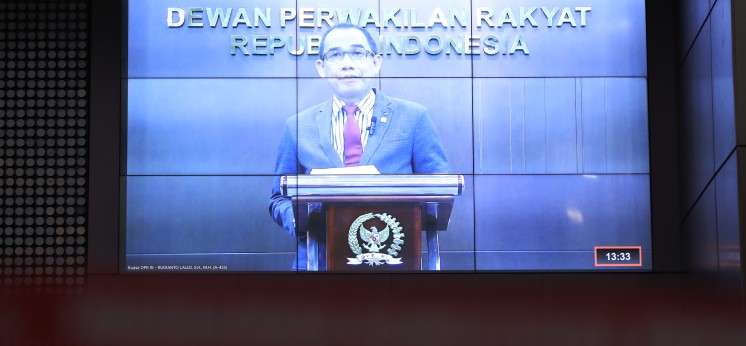
House Commission III member Rudianto Lallo testifying at the fifth hearing for the judicial review of the Press Law, Wednesday (10/29/2025). Photo by MKRI/Ifa.
JAKARTA (MKRI) — The Constitutional Court (MK) held another material judicial review hearing of Law No. 40 of 1999 on the Press on Wednesday, October 29, 2025. It heard testimonies of the House of Representatives (DPR), as well as the Press Council as the Relevant Party.
The Case No. 145/PUU-XXIII/2025 was filed by the Association of Legal Journalists (IWAKUM), represented by chairman Irfan Kamil and secretary-general Ponco Sulaksono. They challenge the constitutionality of Article 8 of the Press Law and its elucidation, which they consider ambiguous and potentially leading to legal uncertainty relating to protection for journalists.
Article 8 of the Press Law stipulates: “In carrying out their profession, journalists shall receive legal protection.” Meanwhile, the elucidation of Article 8 defines “legal protection” as “the guarantee of protection provided by the Government and/or society to journalists in carrying out their functions, rights, obligations, and roles in accordance with prevailing laws and regulations.” This, the Petitioner asserted, fails to provide a clear mechanism of legal protection for journalists.
At the hearing, the House of Representatives (DPR), represented by Commission III member Rudianto Lallo, stated that the enactment of the Press Law was intended to guarantee press freedom as part of citizens’ human rights to obtain and convey information.
“As stipulated in Article 3 of the Press Law, the press functions as a medium of information, education, entertainment, and social control. These functions play an important and strategic role in the life of the community, the nation, and the state,” he said before the panel of constitutional justices.
He added that the strategic position of the press makes journalists vulnerable to pressure from various parties, including those in power, legal entities, and the public. Therefore, journalists must be provided with firm legal protection, as stipulated in Article 8 of the Press Law.
Furthermore, Lallo explained that the Press Law also regulates the establishment of the Press Council, which serves to develop press freedom and improve the quality of the national press, as stated in Article 15 paragraph (2). The Press Council plays a role in ensuring that the press remains professional and responsible.
In addition, the House also emphasized that legal protection for journalists is not only provided in Article 8 but also in Article 18 paragraph (1) of the Press Law, which prohibits any act of obstructing or hindering journalists from performing their professional duties. Violations of this provision are punishable by up to two years of imprisonment or a maximum fine of Rp500 million.
“This provision forms part of the norms that guarantee legal protection for journalists in performing their professional duties independently and responsibly,” Lallo explained.
He stressed that legal protection for journalists does not mean granting them immunity or exemption from legal processes. Such protection is intended to enable journalists to work professionally without pressure or threats.
“The press has a vital role in a democratic society as a gatherer and disseminator of information, a watchdog of power, a conveyor of public opinion, and a means to enlighten the nation. In this era of information disruption, the press is required to maintain professionalism and provide accurate, reliable, and high-quality reporting,” he concluded.
State and Society’s Roles in Protecting Journalists
Meanwhile, the Press Council, represented by Abdul Manan, stated that the Press Law clearly provides sanctions for anyone who obstructs or hinders journalists in carrying out their duties, as stipulated in the applicable criminal provisions.
According to him, the institutions responsible for providing legal protection to journalists are the state and society, each in accordance with their respective roles and authority.
“Protection by the legislative branch is carried out through the formulation of regulations, including the Press Law. The executive branch has the authority to enforce the law through investigation, inquiry, and prosecution, while the judiciary provides protection in the judicial process,” he explained.
He added that the implementation of the Press Law can also be seen in various dispute cases involving journalists and media companies, in which the Press Council is often summoned as an expert to provide professional opinions on journalistic practices.
Abdul Manan noted that since the enactment of the Press Law in 1999, there have still been a number of criminal prosecutions against journalists, generally based on provisions in the Criminal Code (KUHP), such as defamation, blasphemy, and insults against the president and vice president.
“In this context, the Press Council continues to encourage that every case involving journalistic activities be resolved according to the mechanisms stipulated in the Press Law, not under the Criminal Code,” he said.
Also read:
IWAKUM Challenges Provision on Legal Protection for Journalists Under Press Law
IWAKUM Revises Petition on Legal Protection for Journalists Under Press Law
Govt: Press Law Has Provided Legal Protection for Journalists
PWI, AJI Emphasizes Importance of Protection for Journalists
IWAKUM asserted that Article 8 has failed to provide a clear mechanism of legal protection for journalists. By contrast, other professions such as advocates and prosecutors are explicitly granted protection from legal action, provided they perform their duties in good faith.
In the petition, the Petitioners further emphasized that Article 8 of the Press Law should ensure legal protection, yet its elucidation ambiguously broadens the meaning. They also cited cases of criminalization of journalists, such as Muhammad Asrul and Diananta Pramudianto, who faced criminal charges for their journalistic work. The Petitioners emphasized that this shows legal uncertainty due to the ambiguity of Article 8 of the Press Law.
Author : Utami Argawati
Editor : Lulu Anjarsari P.
PR : Andhini S. F.
Translator : Yuniar Widiastuti (NL)
Disclaimer: The original version of the news is in Indonesian. In case of any differences between the English and the Indonesian versions, the Indonesian version will prevail.
Wednesday, October 29, 2025 | 15:42 WIB 405