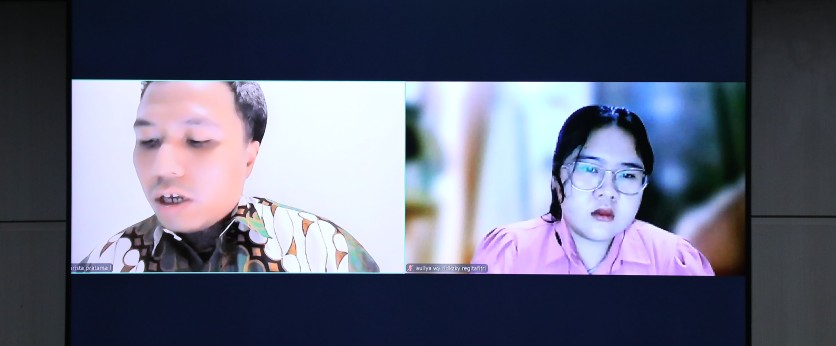
Petitioners Putra Arista Pratama and Aullya WY Ridzky Regitafitri attending the judicial review hearing of Law No. 7 of 2020 on the Third Amendment to Law No. 24 of 2003 on the Constitutional Court (MK Law) online. Photo by MKRI/Panji.
Jakarta (MKRI) – Two postgraduate law students, Putra Arista Pratama and Aullya Wy Ridzky Regitafitri, filed a judicial review of Law No. 7 of 2020 on the Third Amendment to Law No. 24 of 2003 on the Constitutional Court (MK Law) against the 1945 Constitution of the Republic of Indonesia to the Constitutional Court (MK). They argued that the MK Law fails to include any provision establishing an effective mechanism to guarantee the implementation of Constitutional Court decisions, particularly those that are non-self-executing or require follow-up by the legislative or executive branches.
“This legislative omission is not a mere technical gap, but amounts to a fundamental structural failure. This failure is directly against the very essence of the rule of law as enshrined in Article 1 paragraph (3) of the 1945 Constitution,” Putra stated online during the Preliminary Hearing of Case No. 196/PUU-XXIII/2025 on Wednesday, October 29, 2025.
The petitioners specifically challenged the constitutionality of Article 10 paragraph (1) of the MK Law, which reads, ““The Constitutional Court has the authority to adjudicate at the first and final instance, and its decisions shall be final, for: a. reviewing laws against the 1945 Constitution...” While this provision explicitly affirms the court’s finality, neither it nor the MK Law as a whole provides any norm or mechanism to ensure the practical effect of that finality.
They argue that the logical consequence of this final and binding character is that Constitutional Court decisions are erga omnes—legally effective for all parties. When the Court annuls a statutory norm for unconstitutionality, the ruling should apply not only inter partes (to the parties in dispute) but also to all citizens and state entities, without exception.
The absence of an “executive” norm is thus the central focus of their petition, as it has created a legal vacuum that undermines the rule of law and the guarantee of legal certainty and justice outlined in the 1945 Constitution. As future legal practitioners or academics, the petitioners contend they are at risk of suffering a constitutional rights violation.
In their petitum, the petitioners request the Court to declare Article 10 paragraph (1) of the MK Law inconsistent with Article 1 paragraph (1) and Article 28D paragraph (1) of the 1945 Constitution and not binding in law, unless the phrase “shall be final” is interpreted as “including a guarantee of implementation through an effective mechanism.” They also request that the Court order the legislature and the President to amend the MK Law to confer executive effect on the Court’s final decisions.
The case is heard by a panel led by Deputy Chief Justice Saldi Isra, joined by Justices Ridwan Mansyur and Arsul Sani. In the advice session, Deputy Chief Justice Saldi Isra pointed out that similar challenges regarding the finality and binding nature of MK decisions have been raised several times, but the Court has upheld none. He observed that the problem lies not in legal norms but in legal awareness and adherence.
Saldi also noted that the petitum submitted was highly unusual. The petitioners asked that the challenged article be declared unconstitutional without offering any new interpretive meaning. If so, the Court’s power to decide at first and last instance and the final, binding nature of its rulings would be left without legal foundation.
“If those provisions are gone, what remains? If the decisions are no longer binding, how would they ever be implemented?” Deputy Chief Justice Saldi remarked.
The petitioners also requested that a new chapter be added to the law. “You are essentially asking us to act as lawmakers, to change the law,” Deputy Chief Justice Saldi commented.
Before adjourning, Deputy Chief Justice Saldi stated that the revision must be filed within 14 days and received by the Court by Tuesday, November 11, 2025, at 12:00 WIB.
Author: Mimi Kartika.
Editor: N. Rosi.
PR: Tiara A.
Translator: Rizky Kurnia Chaesario
Disclaimer: The original version of the news is in Indonesian. In case of any differences between the English and the Indonesian versions, the Indonesian version will prevail.
Wednesday, October 29, 2025 | 18:22 WIB 267