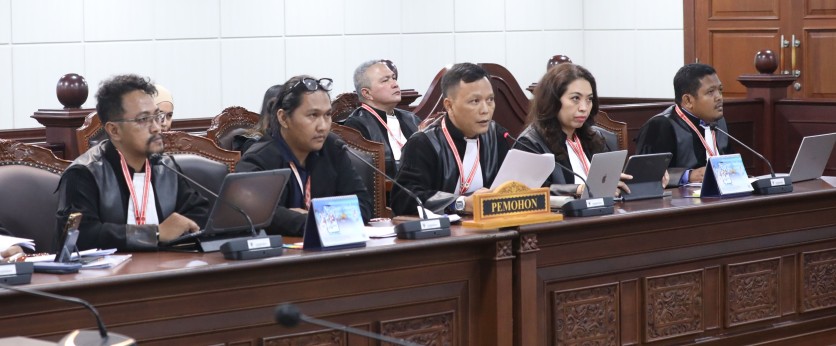
Petitioner, accompanied by legal counsel, delivering the main subjects of his petition on the judicial review of Law No. 40 of 1999 on Press at the Panel Courtroom, Wednesday (29/10). Photo by MKRI/Panji.
Jakarta (MKRI) – Freelance writer Yayang Nanda Budiman filed a material judicial review petition of Article 8 and Elucidation to Article 12 of Law No. 40 of 1999 on Press (Press Law) against Article 28D paragraph (3) and Article 28G paragraph (1) of the 1945 Constitution of the Republic of Indonesia to the Constitutional Court (MK). According to him, Article 8 of the Press Law, which narrowly defines journalists, creates legal ambiguities for his role within the journalistic ecosystem, undermining his right to legal certainty, personal protection and security, and his freedom of expression.
“Does legal protection under the law apply only to journalists with formal employment and certification or also to those who contribute to journalistic work, such as columnists and freelance contributors?” Yayang asked during the preliminary hearing of Case No. 192/PUU-XXIII/2025 on Wednesday, October 29, 2025.
Article 8 of the Press Law reads, “Journalists receive legal protection in the exercise of their profession.” The Elucidation to Article 12 of the Press Law reads, “An open announcement shall be made in the following manner: a. Printed media shall publish a column containing the name, address, and person responsible for publication, as well as the name and address of the printing house; b. Electronic media shall broadcast the name, address, and person responsible at the beginning or end of every broadcast of journalistic work; c. Other types of media shall adjust to the form, nature, and characteristics of the respective media. Such an announcement is intended as a means of accountability for the journalistic work that is published or broadcast.
The term “person responsible” refers to the person in charge within the press company, which includes both the business and editorial sectors. With respect to criminal liability, the applicable laws and regulations shall apply.
The petitioner argues that journalistic works, including news, articles, and opinion columns, are, by nature, collective institutional products involving writers, editors, editorial boards, and the press company as publisher. Responsibility for published content, therefore, should not rest solely with the individual writer, but also extend to the publishing organization and its editorial management. This principle aims to ensure institutional accountability in the production process and in the publication of information to the public.
Meanwhile, in the practice of the media industry nowadays, the Petitioner contended that there is a trend in the use of a statement of disclaimer at the end of opinion pieces, such as “this opinion is solely the responsibility of the author and does not reflect the editorial board’s position,” are often used to release editorial responsibility for legal consequences from publishing opinion pieces.
A freelance columnist and contributor since 2022, Yayang regularly produces articles on law, politics, society, and public policy that serve as oversight and criticism of government function, which are central to journalism and the public interest in several local and national media.
Although his employment is freelance and not as a permanent press staff member, his work is processed and published through editorial mechanisms equivalent to those used for regular press products, and thus should be considered press output. The position of columnists and freelance contributors is not strictly regulated in the Press Law for institutional protection.
In his petitum, the Petitioner requested that the Court declare Article 8 of the Press Law contrary to the 1945 Constitution and to be without legal binding force unless interpreted as, “Journalists receive legal protection in the exercise of their profession, including columnists and freelance contributors.” Similarly, the petitioner also requested that the Elucidation to Article 12 of the Press Law be interpreted as, “person in charge includes the press company official responsible for both business and editorial matters, including opinion columns prepared by columnists and freelance contributors, so long as those works have undergone editorial curation.”
The case was heard by a Panel of Justices presided over by Deputy Chief Justice Saldi Isra, accompanied by Justices Ridwan Mansyur and Arsul Sani. Justice Ridwan stated that the petitioner needed to explain in detail his legal standing and the constitutional harms he had potentially suffered or was likely to suffer from the enactment of the tested articles.
“This has not been sufficiently detailed or elaborated well in relation to the challenged provisions,” Justice Ridwan observed.
Before adjourning, Deputy Chief Justice Saldi informed the petitioner to revise his petition within 14 days. The revision must be submitted before Tuesday, November 11, 2025, at 12.00 WIB, at the latest.
Author: Mimi Kartika.
Editor: N. Rosi.
PR: Fauzan.
Translator: Rizky Kurnia Chaesario
Disclaimer: The original version of the news is in Indonesian. In case of any differences between the English and the Indonesian versions, the Indonesian version will prevail.
Wednesday, October 29, 2025 | 17:05 WIB 203