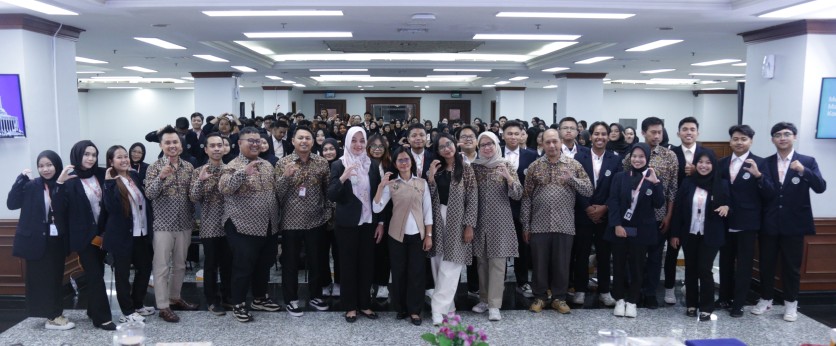
Court welcoming students of the State University of Malang, Monday (10/27/2025). Photo by MKRI/Bayu.
JAKARTA (MKRI) – A group of students from the State University of Malang visited the Constitutional Court (MK) on Monday, October 27, 2025. They were welcomed and received a lecture on constitutional court procedural law from Young Expert Legal Analysts Siswantana Putri Rachmatika and Andhyta Andam Nadia, in the auditorium of court building I.
Tika, as Siswantana is familiarly called, explained that the Court was established due to the absence of a clear mechanism for resolving constitutional legal issues in the past. Before the constitutional amendments, Indonesia did not have a judicial body authorized to review laws against the Constitution of the Republic of Indonesia (UUD NRI) 1945.
“Many laws were problematic, but at that time, there was no mechanism to review them against the 1945 Constitution,” Tika explained.
She added that, in the past, a president could be impeached solely for political reasons. Conflicts between state institutions or government bodies were often resolved under the President’s authority. Furthermore, there was no clear forum for resolving disputes over general election results, and the dissolution of political parties through the Supreme Court (MA) also lacked a clear mechanism.
During the third amendment to the 1945 Constitution, Article 24C was formulated, stipulating the establishment of the Court. To implement this constitutional mandate, the government and the House of Representatives (DPR) drafted the Constitutional Court Bill, which was later approved and enacted on 13 August 2003.
On August 13, 2003, was then declared the founding day of the Constitutional Court of the Republic of Indonesia. Today, the Court serves as an independent judicial body equal in status to the Supreme Court, tasked with upholding law and justice.
Tika emphasized, “So, which is higher, the Supreme Court or the Constitutional Court? Neither. Both are equal.”
She continued that although both are judicial institutions, they differ in authority, the nature of their decisions, the number of judges, and the scope of their jurisdiction. The Supreme Court (MA) serves as the highest judicial body, including hearing cases at the cassation and case revision levels to maintain consistency in the implementation of the law. The Supreme Court also has the authority to examine and adjudicate the review of regulations below the level of law against the law.
Meanwhile, the Constitutional Court has the authority to hear cases at the first and final instance with final decisions, including judicial review of laws against the Constitution, settlement of disputes between state institutions, dissolution of political parties, and disputes over general election results. The Court is also mandated to rule on the House of Representatives’ opinion regarding alleged constitutional violations by the President and/or Vice President.
Because the Supreme Court oversees other judicial bodies—general, religious, military, and administrative courts—it has 60 judges, while the Court has only nine constitutional justices, all located in the capital city.
Tika explained that the nine justices are nominated equally by three institutions: the Supreme Court, the House of Representatives, and the President. Once the Court renders a decision, it is erga omnes—meaning it applies universally and binds all parties.
In terms of the Court’s authority to review laws against the 1945 Indonesia Constitution (UUD NRI 1945), there are two types of judicial review: formal and material. A formal review, which concerns the lawmaking process, must be filed no later than 45 days after the law is enacted, and the Court must render a decision within 60 working days after holding a hearing in which the House of Representatives (DPR) and the President provide their statements. Meanwhile, a material review, which concerns the substance of the legal norms within a law, has no time limit for filing or for the issuance of a decision.
Tika also explained that the Court serves as the guardian of the Constitution by ensuring that laws and actions of state institutions do not contradict the Constitution, as well as by protecting the constitutional rights of citizens. Constitutional rights are the rights owned by every citizen as recognized and guaranteed by the constitution of their respective countries.
In Indonesia, constitutional rights are guaranteed and protected by the 1945 Constitution, such as Article 27 paragraph (1), which affirms the principle of equality before the law, meaning that every citizen has the same standing before the law and must obey the law and government without exception—regardless of social status, rank, or group—and Article 28A, which states that everyone has the right to live and to defend their life and livelihood. Therefore, any citizen who believes that their constitutional rights and/or authorities have been harmed by the enactment of a law may file a petition for judicial review of the law against the 1945 Constitution to the Court.
Petitioners for judicial review may include individual Indonesian citizens or groups with a common interest, customary law communities that still exist and are in line with societal development and the principles of the Republic of Indonesia as regulated by law, public or private legal entities, or state institutions. Tika stated that the Court grants legal standing to students in several cases they have filed, as long as they can demonstrate how their constitutional rights have been harmed by the enforcement of the provisions being reviewed.
The students also had the opportunity to visit the Constitutional History Center (Puskon) located on the 5th and 6th floors of the court building. Puskon functions as an educational media that documents the history of the Constitution and the Court through a blend of information, art, and advanced technology such as holograms and interactive touchscreens to enhance public awareness of the Constitution.
Author : Mimi Kartika
Editor : Lulu Anjarsari P.
Translator : Jessica Rivena Meilania/Donny Yuniarto
Disclaimer: The original version of the news is in Indonesian. In case of any differences between the English and the Indonesian versions, the Indonesian version will prevail.
Monday, October 27, 2025 | 15:24 WIB 230