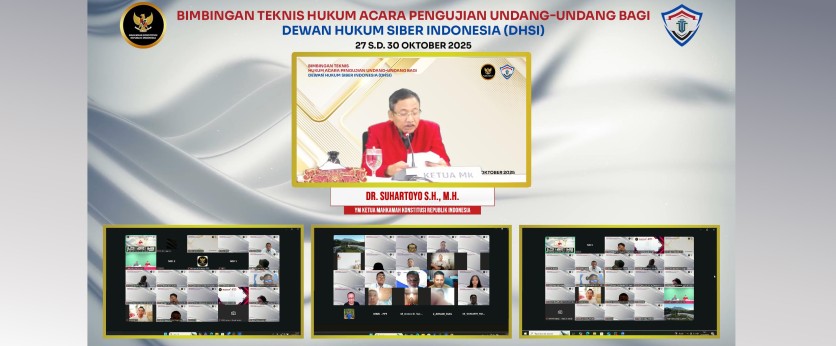
Chief Justice Suhartoyo delivering a keynote address and opening the Technical Assistance Program on Judicial Review Procedures for the Indonesian Cyber Law Council (DHSI), Monday (10/27). Photo by MKRI/Teguh.
JAKARTA (MKRI), The Constitutional Court (MK) held a Technical Assistance Program on Judicial Review Procedures for the Indonesian Cyber Law Council (DHSI) from Monday to Thursday, October 27–30, 2025. Chief Justice Suhartoyo officially opened the event, which was attended by approximately 400 participants.
In his keynote remarks, Chief Justice Suhartoyo stated that during the process of drafting or implementing laws, issues may arise that cause actual or potential harm to constitutional rights. In such circumstances, DHSI plays a significant role in advocating for and protecting citizens’ constitutional rights, thereby contributing to upholding the Constitution and those rights.
“Submitting a judicial review petition to the Constitutional Court requires accuracy in the filing mechanism, the drafting of the petition, and the courtroom procedures. These procedures must be carefully observed,” Chief Justice Suhartoyo said. Therefore, he added, this training program serves as an important preparation for participants to defend the constitutional rights of citizens seeking justice before the Court.
Form and Interpretation of the Constitution
The first session was delivered by Deputy Chief Justice Saldi Isra, who presented material on Constitutional Interpretation. In his presentation, he noted that studies on constitutional interpretation were once provided only after students had learned all constitutional theories. Interpretation, he emphasized, is essential to understanding a country’s constitution.
According to Deputy Chief Justice Saldi, a constitution is often interpreted as the supreme law of the land. If it is considered the supreme law, then there must also be other basic laws that are not supreme, which is usually applied in federal systems where each state has its own constitution. However, in Indonesia, the constitution is referred to as the basic law, because it is the only one, and the country has no other constitution.
“As the basic law, the constitution covers a very broad scope but only contains fundamental provisions,” he explained.
As a foundational instrument, the constitution must regulate the essential elements of a state, such as the minimum existence of legislative, executive, and judicial branches.
“So, when we read a country’s constitution, at the very least these state institutions must exist. If any of the three branches is absent, the state cannot perform its essential functions,” he said.
The constitution also regulates the relationship among branches of power and must at least describe citizens’ constitutional rights to define the relationship between the state and its people. It must also reflect the relationship between the central and regional governments.
Deputy Chief Justice Saldi elaborated that a constitution is a concise document that conveys the minimum amount of information necessary to understand a state, allowing readers to determine the system it adheres to. He further explained that constitutions generally exist in two forms: written and unwritten.
“But this terminology is not entirely accurate. The correct distinction is between a constitution codified in a single document and one dispersed across multiple instruments,” he noted. Indonesia adopts a codified constitution, while the United Kingdom relies on various documents considered constitutional.
A very concise constitution can lead to differing interpretations over time. As societies move further away from the historical moment of constitutional drafting, varying perspectives naturally emerge. Additionally, individuals who revisit constitutional provisions may develop different viewpoints.
Given this increasing distance and diversity in interpretation, methods are needed to properly understand the constitutional text. Thus, constitutional interpretation becomes crucial so that people share a common understanding, especially in matters with legal implications. “If participants wish to become interpreters of the constitution, the first step is to trace what the constitutional framers debated,” Deputy Chief Justice Saldi emphasized.
“When discussing post-reform constitutional amendments, many debates can be found in official transcripts, including books published by the Constitutional Court. However, those records only document discussions held in formal sessions. Debates occurring in informal negotiations were never recorded,” he added.
Deputy Chief Justice Saldi explained that Constitutional Court justices today find it easier to interpret norms in cases where the law being reviewed is explicitly mentioned in the constitution, such as the electoral system. However, challenges arise when the constitution does not refer to a subject at all, such as traffic regulations or notary positions. In such circumstances, justices must explore deeper constitutional norms. He underlined that interpretation is essential so that dormant provisions can remain adaptive to the times.
DHSI Members Join Judicial Review Procedure Training to Strengthen Constitutional Understanding
Previously, DHSI President Director Muhamad Bayu Firmanyah stated that the Technical Assistance Program on Judicial Review Procedures is not only a technical legal learning forum but also a space for constitutional reflection to strengthen participants’ integrity, understanding, and responsibility as part of Indonesia’s legal community.
Bayu stressed that the Constitutional Court holds a vital role as the guardian of the constitution and protector of citizens’ constitutional rights. Through judicial review mechanisms, the Court ensures that existing laws remain aligned with justice, the rule of law, Pancasila, and the 1945 Constitution of the Republic of Indonesia.
In the modern era, issues of constitutional and legal significance extend beyond traditional domains, as technological transformation, artificial intelligence, cybersecurity, and personal data protection introduce new challenges and constitutional debates.
Therefore, Bayu asserted, studying judicial review procedures is not only for academic purposes but also a moral and professional obligation for all legal practitioners to respond to the dynamics of the times while remaining grounded in constitutional principles.
He concluded that technological progress must align with legal maturity, meaning digitalization must not distance society from justice. He expressed hope that through this program, participants would deepen their understanding, broaden their insights, and strengthen their commitment to constitutional supremacy amid rapid change.
Author: Ilham W. M.
Editor: Lulu Anjarsari P.
Translator: Aski V. Rumere / Yuanna Sisilia
Disclaimer: The original version of the news is in Indonesian. In case of any differences between the English and the Indonesian versions, the Indonesian version will prevail.
Monday, October 27, 2025 | 15:26 WIB 231