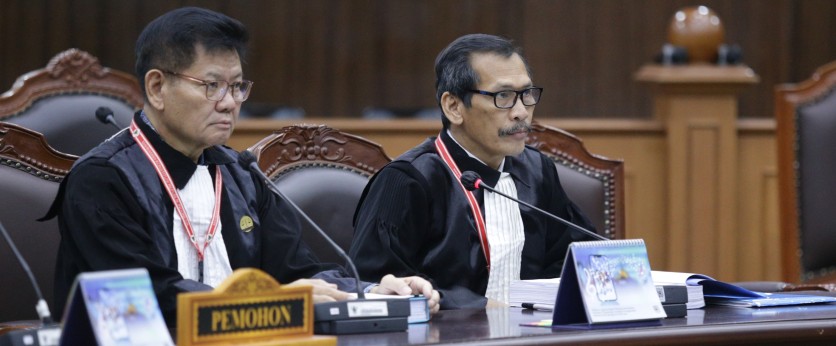
Petitioner attending the Petition Revision Hearing of Case No. 174/PUU-XXIII/2025 on the judicial review of Law No. 14 of 2008 on the Public Information Openness, Thursday (23/10). Photo by MKRI/Bay.
Jakarta (MKRI) – The Constitutional Court (MK) held a resumed hearing for the judicial review of Article 17 letter g, Article 17 letter h point 5, and Article 18 paragraph (2) letter a of Law No. 14 of 2008 on Public Information Openness (KIP Law) against the 1945 Constitution of the Republic of Indonesia on Thursday, October 23, 2025. The second hearing of Case No. 174/PUU-XXIII/2025 filed by Komardin was presided over by Deputy Chief Justice Saldi Isra, accompanied by Justices M. Guntur Hamzah and Arsul Sani at the Panel Courtroom.
During the hearing, Komarudin conveyed the key points of his revised petition. Among other things, he added arguments on the Constitutional Court’s authorities based on the Constitutional Court Regulation No. 7 of 2025 on Procedures for Judicial Review of Laws (PMK 7/2025). He also provided further explanation in the Petitioner’s legal standing, specifically related to the nature of the constitutional harm and norms contradiction tested against the 1945 Constitution of the Republic of Indonesia.
“To declare that Article 17 letter (g) of the KIP Law contrary to the 1945 Constitution and does not have binding legal force as long as it is not interpreted as ‘Public Information that, if disclosed, would reveal the contents of an authentic deed of a personal and last will of testament.’” To declare that Article 17 letter h point 5 of the KIP Law contradicts the 1945 Constitution and has no legal binding force as long as it is interpreted as ‘Records concerning a person’s privacy related to activities within formal and non-formal education units,’” Komarudin read out he petitums in his revised petition.
Also read:
Opening Access to the Academic Credentials of Officials and Former Officials
Case No. 174/PUU-XXIII/2025 was filed by an advocate named Komarudin, challenging Article 17 letter g, Article 17 letter h point 5, and Article 18 paragraph (2) letter a of Law No. 14 of 2008 on the Public Information Openness (KIP Law) against the 1945 Constitution.
Article 17 letter g of Law No. 14 of 2008 states, “Public information that, if disclosed, could reveal the content of authentic private documents and a person’s last wishes or will.” Article 17 letter h point 5 reads, “Records concerning an individual’s personal matters related to activities at formal and non-formal educational institutions.” Article 18 paragraph (2) letter a states, “The party whose confidentiality is disclosed gives written consent.”
Diploma Controversy
The petitioner argued that Article 17 letter g of Law No. 14 of 2008 is open to multiple interpretations, with some parties considering diplomas confidential documents and others regarding them as non-confidential, leading to public controversy. Moreover, Article 18 paragraph (2) letter a effectively renders diplomas confidential documents that cannot be accessed without the owner's written consent. The petitioner asserted that these conflicting norms could disrupt public order and undermine the education system.
“My loss is the uproar everywhere, which has made our business difficult—demonstrations, debates, even the economy has been affected,” Komardin said, describing the constitutional harm caused by the articles in question.
As a case in point, the petitioner recounted the controversy over a former president’s diploma from Universitas Gadjah Mada; the university declined to provide a statement with supporting evidence, which only fueled the debate. Komardin brought a civil lawsuit against the university in the Sleman District Court and sought mediation to have the contested document presented to the court, but UGM refused. An official request for public information was not answered, with the university citing the document’s exemption status.
Accordingly, in the petitum, the Petitioner requests the Constitutional Court to declare that Article 17 letter g of the KIP Law is contrary to the 1945 Constitution and does not have binding legal force insofar as it is not interpreted as “Public information that, if disclosed, could reveal the content of authentic private documents and a person’s last wishes or will.”
Subsequently, the Petitioner asks the Court to declare that Article 17(h) point 5 of the KIP Law is contrary to the 1945 Constitution and does not have binding legal force unless it is interpreted as “Records concerning an individual’s personal matters related to activities at formal and non-formal educational institutions.”
The Petitioner also requests the Court to declare Article 18(2)(a) of the KIP Law contrary to the 1945 Constitution and of no binding legal force unless it is construed to mean, “The party whose confidentiality is disclosed gives written consent.”
Tracking: Case No. 174/PUU-XXIII/2025
Author: Sri Pujianti
Editor: N. Rosi
PR: Fauzan
Translator: Rizky Kurnia Chaesario
Disclaimer: The original version of the news is in Indonesian. In case of any differences between the English and the Indonesian versions, the Indonesian version will prevail.
Thursday, October 23, 2025 | 15:01 WIB 198