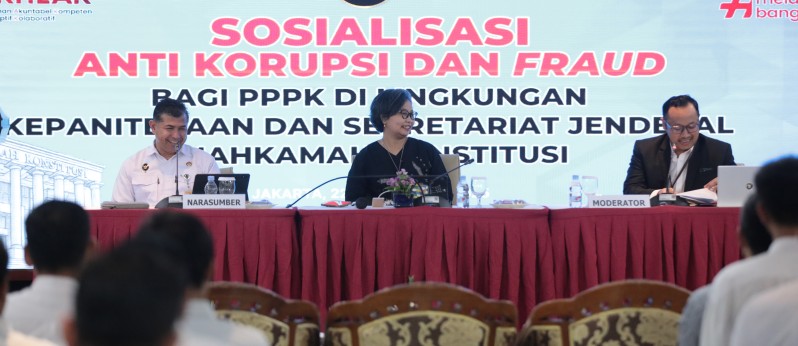
The Registrar’s Office and the Secretariat General of the Constitutional Court holding the second batch of Anti-Corruption and Fraud Awareness Socialization for Government Employees with Work Agreements on Thursday (10/23/2025), at its first building hall. Photo by MKRI/IlhamWM.
JAKARTA, MKRI – The Anti-Corruption and Fraud Awareness Session for Government Employees with Work Agreements (PPPK) within the Registry and the Secretariat General of the Constitutional Court (MK) was once again held on Thursday, October 23, 2025. The second batch of the event took place in person at its first building hall and virtually from each PPPK’s workplace.
The session featured Adhi Satya Perkasa, Assistant Deputy for Coordination of the Handling of Transactional and Extraordinary Crimes at the Coordinating Ministry for Political, Legal, and Security Affairs. He presented a material titled “A Joint War Against Online Gambling: The Government’s Efforts to Eradicate Online Gambling.”
In his presentation, Adhi explained the dangers of online gambling, which can cause both material and non-material losses. He emphasized that no one can win in online gambling because the results are predetermined by the operators, either manually or through algorithmic systems.
“Instead of playing online gambling, it’s better to spend money on other forms of entertainment that bring real enjoyment,” Adhi said.
Adhi revealed that many workers from Indonesia and other countries are employed by online gambling providers based abroad. He also mentioned that gambling networks often approach residents in rural areas, offering money to use their names for opening bank accounts used as fund receivers.
“That’s why many online gambling sites seem to be based in Indonesia,” Adhi added.
He further explained that online gambling is a systematic and organized crime, and some even infiltrate and advertise on government websites. These operations involve international networks that use local agents to recruit workers, particularly during periods of scarce job opportunities.
Adhi also warned that once someone becomes addicted to online gambling, it leads to declining productivity, negligence of responsibilities, financial instability, and mental disorders. Socially, online gambling addicts tend to commit crimes. From an economic standpoint, it drains national finances as large amounts of money flow abroad, weakening the Rupiah. He stressed that online gambling addiction is as dangerous as drug addiction, as addicts would do anything to keep playing.
Corruption Driven by Gambling
The next speaker, Dian Rachmawati from the Directorate of Anti-Corruption Socialization and Campaign of the Corruption Eradication Commission (KPK), stated that corruption can be linked to online gambling. She cited a case involving a KPK suspect who committed corruption to fund gambling activities, even owning a private jet to travel abroad for gambling.
Dian revealed that the state’s losses from corruption are actually much greater than the amount embezzled, as the government must spend additional funds to prevent corruption through various preventive measures. Moreover, acts of corruption also generate reactionary costs, namely, expenses for handling corruption cases. Corruption also leads to implicit costs, such as opportunity costs, as well as consequential costs arising from corrupt practices—for example, a collapsed bridge that must be rebuilt due to corruption during its construction.
She elaborated on the types of corruption: bribery, extortion, and gratuities. Bribery and extortion occur immediately, while gratuities have long-term effects because they create a sense of indebtedness toward the giver.
At the end of the session, the Court’s Inspector Sigit Purnomo, in his closing remarks for the second batch of “Anti-Corruption and Fraud Awareness Session for Government Employees with Employment Agreements within the Court’s Registrar’s Office and the Secretariat General”, urged participants not to engage in any form of deceit. Sigit emphasized that even the smallest act of dishonesty is like a tiny hole in a boat—it may eventually sink the great vessel called integrity.
Sigit then reminded participants to preserve what they earn while working at the Court so that it remains lawful (halal) and brings blessings. He stated that lawful income fosters peace of mind, whereas illicit earnings only bring restlessness.
Finally, Sigit encouraged all participants to act wisely and critically, and not to remain silent when witnessing dishonest practices. He concluded by saying that the courage to be honest is the highest form of love for one’s institution and nation.
Author : Ilham Wiryadi Muhammad.
Editor : N. Rosi.
Translator : Jessica Rivena Meilania/Rizky Kurnia Chaesario
Disclaimer: The original version of the news is in Indonesian. In case of any differences between the English and the Indonesian versions, the Indonesian version will prevail.
Thursday, October 23, 2025 | 17:55 WIB 305