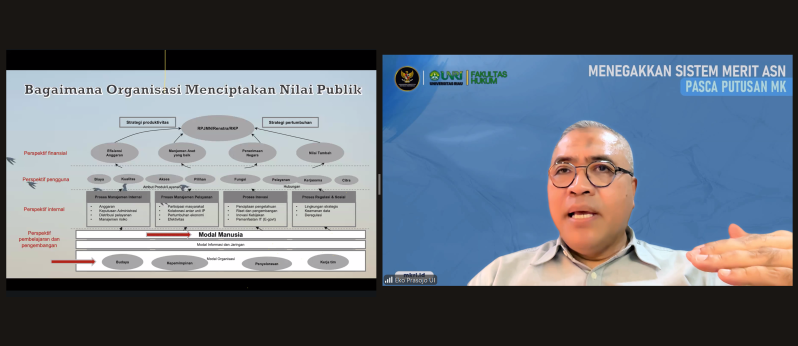
Eko Prasojo, chair of the Board of Professors of the Universitas Indonesia, speaking at the constitution webinar on the civil service merit system, Thursday (10/23/2025).
JAKARTA (MKRI) — The Constitutional Court (MK), in collaboration with the Law Faculty of the University of Riau, held a constitution webinar with the theme “Upholding the Civil Service Merit System after the Constitutional Court’s Decision” on Thursday, October 23, 2025. Eko Prasojo, chair of the Board of Professors at Universitas Indonesia and speaker at the event, expressed appreciation for the Constitutional Court Decision No. 121/PUU-XXII/2024. The ruling mandates the establishment of an independent institution responsible for supervising the merit system, including monitoring the application of principles, values, foundations, codes of ethics, and conduct of state civil apparatus (ASN), within two years from the issuance of the decision on October 16, 2025.
“[Thank God], the Court has granted the judicial review [petition] of Law No. 20 of 2023 on State Civil Apparatus and ordered the re-establishment of an oversight and protection agency for state civil apparatus. This is an important step toward strengthening the merit system,” Eko stated.
He explained that the merit system is a policy and management approach based on qualifications, competency, and performance applied fairly and justly, without discrimination based on political background, race, color, religion, origin, gender, marital status, age, or disability. The merit system protects employees from political interference and arbitrary actions by emphasizing integrity, ethical behavior, public interest, and fair and competitive recruitment and promotion.
Eko noted that indicators used to measure meritocracy have a strong and positive correlation with various governance indices. According to him, countries such as the Philippines, Thailand, Singapore, South Korea, Japan, and Australia, implement the merit system through independent institutions that uphold merit principles and promote good governance free from prohibited employment practices.
“No country can progress without meritocracy or a merit-based system,” he emphasized.
However, he pointed out that Law No. 20 of 2023 removed this merit system and dissolved the Civil Service Commission (KASN). Eko hopes that following Court Decision No. 121/PUU-XXII/2024, which orders the formation of an independent oversight body for the merit system, the Government will strengthen civil service oversight institutions.
Eko further stated that the new institution should be independent and non-structural, with decisions that are final and binding, and sanctions implemented by the personnel development officer (PPK). It should also have a secretariat-general with its own budget separate from the Ministry of Administrative and Bureaucratic Reform, and be empowered to oversee, develop the merit system, and coordinate national senior executive positions (JPT).
According to the Worldwide Governance Indicators, government effectiveness is built on the quality of public services, the competence of civil servants, independence from political pressure (neutrality), the quality of policy formulation and implementation, and the credibility of government commitments. Eko concluded that the key to a nation’s success lies in a professional bureaucracy, supported by strong leadership commitment, culture, and economic development strategy.
Read more: Decision No. 121/PUU-XXII/2024
Author : Mimi Kartika
Editor : N. Rosi.
Translator : Jessica Rivena Meilania/YW
Disclaimer: The original version of the news is in Indonesian. In case of any differences between the English and the Indonesian versions, the Indonesian version will prevail.
Thursday, October 23, 2025 | 17:16 WIB 310