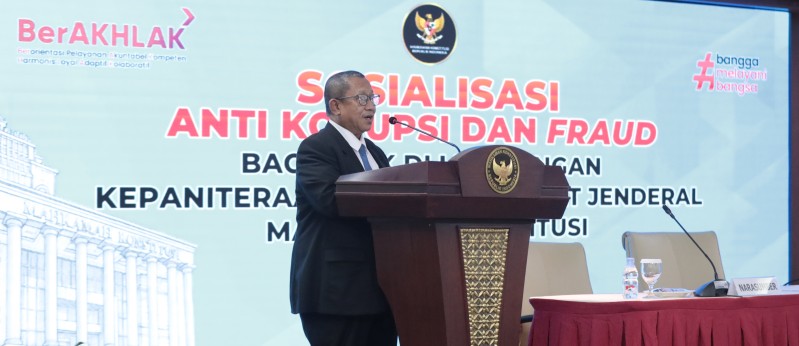
Acting Registrar of the Constitutional Court, Wiryanto, delivered opening remarks and officially inaugurated the Anti-Corruption and Fraud Awareness Program for Government Employees under Work Agreements within the Registrar’s Office and the Secretariat General of the Constitutional Court, on Wednesday, October 22, 2025. (Photo: MKRI/IlhamWM)
JAKARTA, MKRI – Acting Registrar of the Constitutional Court, Wiryanto, opened the Anti-Corruption and Fraud Awareness Program for Government Employees under Work Agreements (PPPK) within the Registrar’s Office and the Secretariat General of the Constitutional Court on Wednesday, October 22, 2025. In his address, Wiryanto emphasized that as a judicial institution, the Constitutional Court demands its employees to always uphold honesty and responsibility as clean and integrity-driven public servants.
“A constitutional judiciary demands the highest standards of ethics and integrity. Every step, every decision, and every behavior must reflect honesty and moral responsibility as part of a clean and integrity-based public service,” stated Wiryanto at the event held in the Main Hall of the Constitutional Court Building 1.
The Court continuously monitors the conduct and behavior of its employees and enforces disciplinary actions against those who commit violations.
“If any of you engage in unlawful conduct, there will certainly be consequences,” Wiryanto asserted.
He further reminded that aside from corruption and fraud, employees must refrain from all forms of social misconduct that may undermine their morals, discipline, and reputation—such as online gambling, drug abuse, unhealthy associations, and excessive consumerism. Therefore, he called upon employees to take an active role in fostering internal control systems and a culture of integrity within their respective units. Should they notice any colleague behaving suspiciously, they should provide advice and understanding that such actions are improper.
“Case handling is highly sensitive in its process. Hence, the Constitutional Court maintains a strong commitment that those involved in handling cases must never engage in conversations or informal interactions with the parties concerned,” Wiryanto explained.
He also reminded staff members working in case registration and hearings to safeguard their integrity, as these positions could potentially become entry points for corruption.
“In other institutions, cases of corruption often begin in informal settings—sometimes even in parking areas,” he remarked.
Previously, Inspector of the Constitutional Court, Sigit Purnomo, reported that the purpose of this awareness program was to: Enhance participants’ understanding of the concepts, forms, and impacts of corruption and fraud in the workplace; Foster awareness and early prevention of corrupt and fraudulent practices; and Build an anti-corruption work culture by upholding honesty to create a clean and integrity-based work environment.
Sigit further warned that PPPK employees found guilty of corruption crimes would face sanctions in accordance with the applicable laws and regulations.
“If any PPPK employee is proven to have committed fraud or a criminal act of corruption, sanctions will be imposed in accordance with prevailing laws and regulations,” he affirmed.
The Dangers of Online Gambling
The event also featured Adhi Satya Perkasa, Assistant Deputy for the Coordination of the Handling of Transactional and Extraordinary Crimes at the Coordinating Ministry for Political, Legal, and Security Affairs. Adhi presented material titled “United in Combating Online Gambling: Government Efforts to Eradicate Online Gambling.”
In his presentation, Adhi elaborated on the dangers of online gambling, particularly its potential to destroy family life and to serve as a gateway to corruption. He asserted that “the greatest victory in online gambling is quitting it altogether.”
The next speaker, Alfaina Rachmawati, Functional Official for Anti-Corruption Socialization and Campaigns from the Corruption Eradication Commission (KPK), explained various types of corruption crimes and the forms of corrupt behavior frequently occurring in society, especially within institutions.
Author : Ilham Wiryadi Muhammad
Editor : N. Rosi
Translator : Nies Lindy
Disclaimer: The original version of the news is in Indonesian. In case of any differences between the English and the Indonesian versions, the Indonesian version will prevail.
Wednesday, October 22, 2025 | 18:50 WIB 197