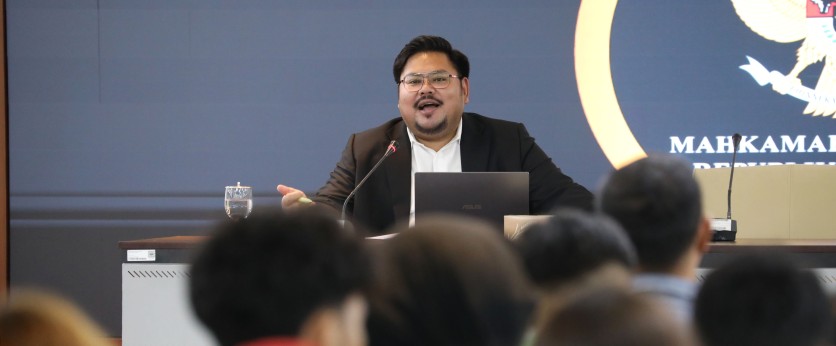
JAKARTA, (MKRI) – Approximately 76 students from the Faculty of Law, Universitas Pembangunan Nasional Veteran Jakarta (UPNVJ), visited the Constitutional Court (MK) on Monday (10/20/2025). During the visit, they attended a session on the role and functions of the Court, delivered by MK Legal Analyst Arinta Sulistiyo, familiarly known as Tyo.
Opening the presentation, Tyo explained the background of the Court’s establishment. The Constitutional Court, he said, was born out of the absence of a clear mechanism to resolve constitutional disputes in Indonesia’s past. Before the amendment of the 1945 Constitution, Indonesia did not have a judicial body authorized to review laws against the Constitution.
“Since 2003, Indonesia has had the Constitutional Court, as a manifestation of the spirit of reform,” said Tyo at the MK Building Hall in Jakarta.
Since then, the Court has served as the guardian of the constitution, endowed with the authority to review laws against the Constitution, adjudicate disputes between state institutions, dissolve political parties, resolve disputes over general election results, and decide on the House of Representatives’ opinion concerning alleged violations committed by the President or Vice President. Through these powers, the Court ensures that laws and actions of state institutions comply with the Constitution and protect citizens’ constitutional rights.
Tyo further explained that constitutional rights are rights possessed by every citizen, recognized and guaranteed by the constitution of their respective countries. In Indonesia, such rights are protected by the 1945 Constitution, including Article 27 paragraph (1), which affirms the principle of equality before the law, meaning every citizen has equal standing before the law and must obey it without exception, regardless of social status, rank, or class. Similarly, Article 28A stipulates that every person has the right to live and to defend their life and livelihood.
Therefore, any citizen who believes that their constitutional rights and/or authority have been impaired by the enactment of a law may file a petition for judicial review of that law against the 1945 Constitution before the Court. Petitioners may include individual Indonesian citizens or groups with common interests, customary law communities that are still alive and consistent with societal development and the principles of the Unitary State of the Republic of Indonesia, public or private legal entities, or state institutions.
“The Court provides the broadest possible access for citizens to submit judicial review petitions, as long as they fulfill the requirements and conditions stipulated by law,” Tyo emphasized.
The students also had the opportunity to visit the Constitutional History Center (Puskon), located on the 5th and 6th floors of the MK Building. The Puskon serves as an educational space that documents the history of the Constitution and the Court through a blend of information, art, and modern technology such as holograms and interactive touchscreens, aimed at enhancing public awareness of constitutional matters.
Author : Mimi Kartika.
Editor : N. Rosi.
Translator : Aski V Rumere/Agusweka Poltak Siregar.
Disclaimer: The original version of the news is in Indonesian. In case of any differences between the English and the Indonesian versions, the Indonesian version prevails.
Monday, October 20, 2025 | 15:38 WIB 539