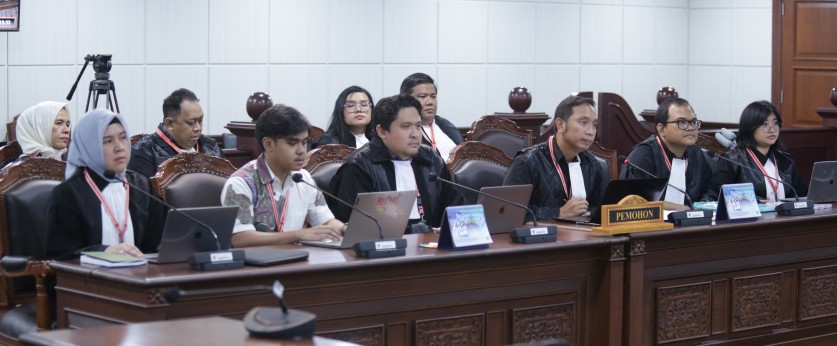
Petitioners and their legal counsel during the Preliminary Hearing of Case No. 184/PUU-XXIII/2025 on the material judicial review of Law No. 4 of 2009 on Mineral and Coal Mining as last amended by Law No. 2 of 2025 on the Fourth Amendment to Law No. 4 of 2009 on Mineral and Coal Mining, Monday (20/10). Photo by MKRI/Bay.
JAKARTA (MKRI) – Six citizens have filed a petition for judicial review of Law No. 4 of 2009 on Mineral and Coal Mining (Minerba Law), as last amended by Law No. 2 of 2025 on the Fourth Amendment to Law No. 4 of 2009. The petitioners argued that several provisions in the law have shifted the role of the state from the controller of natural resources to merely a recipient of revenue from mining operations.
The six petitioners are Wahyu Ilham Pranoto (Petitioner I), Muhammad Faza Aulya’urrahman (Petitioner II), Fauzan Akbar Mulyasyah (Petitioner III), Yudi Amsoni (Petitioner IV), Nasidi (Petitioner V), and Sharon (Petitioner VI). The preliminary hearing for Case No. 184/PUU‑XXIII/2025 was held on Monday, October 20, 2025, at the Constitutional Court (MK), presided over by Justice Arief Hidayat, alongside Justices Enny Nurbaningsih and Arsul Sani.
The petitioners’ legal counsel, Aristo Pangaribuan, stated that the Minerba Law opens the door to excessive privatization of natural resources, which contradicts Article 33 of the 1945 Constitution mandating that natural wealth be utilized for the greatest benefit of the people.
“This law makes the state merely a recipient of royalties, not a manager of resources. Our data show that state revenue from mining royalties has never exceeded 20 percent of corporate profits,” Aristo said during the hearing.
The petition challenges several articles of the Minerba Law—including Articles 35, 39, 79, 105 paragraph (3), 128 paragraphs (4) and (5), 129 paragraph (1), 130 paragraphs (1) and (2), 132 paragraphs (1) and (2), 92, 51, 51A–51B, 60, 60A, and 60B—which the petitioners claim reduce the state’s role in controlling and managing natural resources, thereby violating the 1945 Constitution.
One provision under scrutiny is Article 92, which grants ownership rights to mining permit (IUP) and special mining permit (IUPK) holders over extracted minerals. According to the petitioners, this creates an impression of private ownership over resources that constitutionally belong to the state.
“Article 92 gives the impression that mining outputs wholly belong to the permit holders, not the state. This creates inequality and discrimination against the people, who are the rightful owners of natural resources,” Aristo explained.
The petitioners also objected to Articles 51A and 60A, which allow higher education institutions to manage Mining Business License Areas (WIUP). They argued that this arrangement could create conflicts of interest and erode academic independence by turning universities into passive beneficiaries of mining operations.
From a constitutional law perspective, the delegation of regulatory authority through government regulations (PP) was also deemed inconsistent with the principle of legal certainty, as the state’s control over natural resources should not be delegated to lower-level regulations.
In their petitum, the petitioners requested that the Court declare the challenged articles unconstitutional and void, and that the licensing mechanism for WIUP be revised to ensure recognition of indigenous law communities, local participation, and environmental sustainability.
Clarifying the Claim of Constitutional Harm
Responding to the petition, Justice Enny Nurbaningsih advised the petitioners to refer to Constitutional Court Regulation No. 7 of 2025 on Procedures for Judicial Review of Laws (PMK No. 7 of 2025) as a guide for refining their petition. She also urged the petitioners to clearly articulate the constitutional rights allegedly impaired by the disputed provisions.
“Out of the 15 norms being challenged, you must specify which ones actually cause constitutional harm. A petition cannot simply reflect disagreement with the existing legal regime,” Justice Enny emphasized.
Before adjourning, the panel granted the petitioners 14 days to revise their petition, setting a deadline for submission by Monday, 3 November 2025, at 12:00 WIB.
Case tracking: Case No. 184/PUU-XXIII/2025
Author: Utami Argawati
Editor: Nur R.
PR: Raisa Ayuditha M.
Translator: Rizky Kurnia Chaesasrio
Disclaimer: The original version of the news is in Indonesian. In case of any differences between the English and the Indonesian versions, the Indonesian version will prevail.
Monday, October 20, 2025 | 16:46 WIB 319