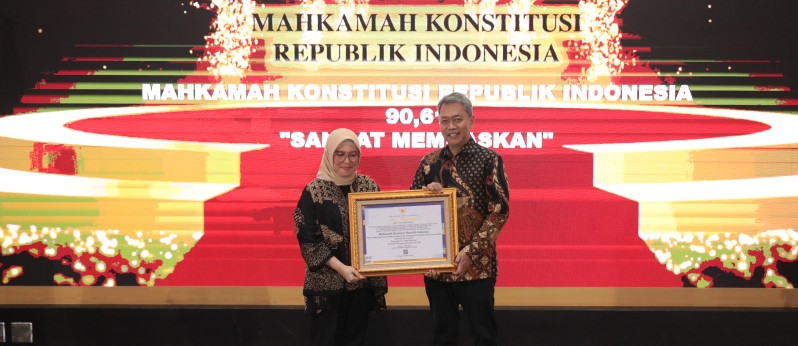
Court receiving award for the 2024 Archival Implementation in the “Very Satisfactory” category at the Noerhadi Magetsari Room ANRI, delivered by Deputy for Archival Systems and Information of ANRI, Wiwi Widianasari, to Secretary General of the Court, Heru Setiawan, on Monday (10/20/2025). Photo by MKRI/Ilham W.M.
JAKARTA (MKRI) – The Constitutional Court (MK) received an award for its 2024 Archival Implementation in the “Very Satisfactory” category, achieving a score of 90.61. The award was presented by Deputy for Archival Systems and Information of the National Archives of the Republic of Indonesia (ANRI), Wiwi Widianasari, received by the Secretary General of the Court, Heru Setiawan, held on Monday, October 20, 2025, at the Noerhadi Magetsari Room, ANRI Office, Jakarta.
Minister of National Development Planning, Rachmat Pambudy, in his remarks stated that archives serve as the nation’s collective memory, providing valuable lessons for the future. He emphasized that archives must remain active and meaningful for the next generation. According to him, archives are crucial as based on historical records, there was a trading company in the past whose meeting minutes were well preserved, enabling it to dominate trade for hundreds of years.
“Archives serve as a foundation for building our future, while also shaping and developing the collective memory of the nation and the governance system,” said Minister Rachmat Pambudy. He added that archives should not only be stored but must also remain alive, meaningful, and beneficial for society.
Head of ANRI, Mego Pinandito, in his remarks explained that archives have often been seen merely as old records stored in warehouses, whereas they actually contain valuable historical notes from which lessons can be drawn. He stated that, in the context of supervision, ANRI carries out various activities to assess the extent to which national archival standards have been implemented.
“In terms of supervision, as mandated to us, we conduct various events that are not the same as financial audits, but rather assessments to jointly evaluate how far we have implemented national archival standards,” said ANRI Head Mego Pinandito.
He further explained that the evaluation process involves multiple aspects, including network infrastructure, making it a complex task. Nevertheless, the assessment primarily focuses on how archives are managed. Going forward, archival management will be digitally based, which in turn supports the realization of digital governance.(*)
Author : Ilham W.M.
Editor : Lulu Anjarsari P.
Translator: Aski V. Rumere/Donny Yuniarto
Disclaimer: The original version of the news is in Indonesian. In case of any differences between the English and the Indonesian versions, the Indonesian version will prevail.
Monday, October 20, 2025 | 13:10 WIB 205