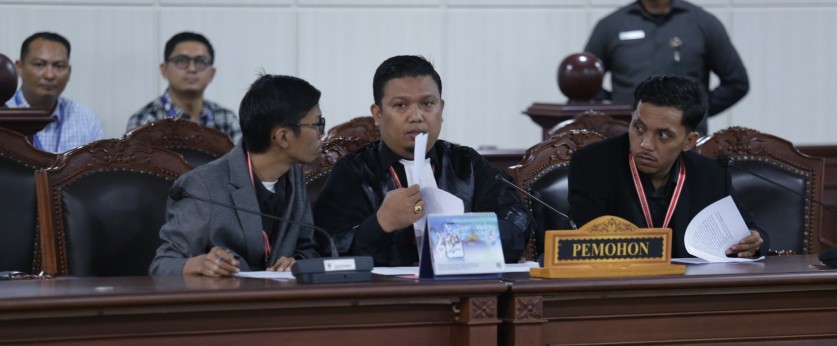
The Petitioner (center) and his counsels at the preliminary hearing of the judicial review of Laws on the Supreme Court, Judicial Commission, Constitutional Court, and State Treasury, Friday (10/17/2025). Photo by MKRI/Bayu.
JAKARTA (MKRI) — Advocate Viktor Santoso Tandiasa has filed another judicial review petition. This time it concerns Article 81 paragraph (1) of Law No. 3 of 2009 on the Supreme Court, Article 9 of Law No. 22 of 2004 on the Judicial Commission as amended by Law No. 18 of 2011, Article 9 of Law No. 24 of 2003 on the Constitutional Court as last amended by Law No. 7 of 2020, and Article 7 paragraph (2) letter b of Law No. 1 of 2004 on the State Treasury before the Constitutional Court (MK). He contended that the provisions being reviewed reflect the absence of budgetary independence within the judiciary, thereby failing to realize the principle of an independent judicial power as mandated by Article 24 paragraph (1) of the 1945 Constitution.
“The absence of budgetary independence for judicial institutions such as the Supreme Court and the courts under its authority, as well as the Constitutional Court, has serious implications in many respects,” said the Petitioner’s legal counsel Isam Saifudin at the preliminary hearing for Case No. 189/PUU-XXIII/2025 on Friday, October 17, 2025.
The impacts include a reduction of judicial independence due to budgetary dependence on the executive, which enables interference and pressure on judicial impartiality; non-autonomous budget management, as judicial institutions are limited in formulating and managing budgets according to their actual needs; limited budgets that may reduce judges’ welfare, affecting motivation and work quality; budget constraints that hinder the development of facilities, technology, training, and other essential resources; and the overall decline in judicial quality resulting from decreased independence and welfare. These effects, the Petitioner argued, undermine the quality of judicial services and case handling, directly affecting the performance of judicial institutions within the Petitioner’s professional scope.
For reference, Article 81A paragraph (1) of the Supreme Court Law provides: “The budget of the Supreme Court shall be charged to a separate budget line in the State Budget (APBN).” Article 9 of the Judicial Commission Law states: “The budget of the Judicial Commission shall be charged to the State Budget.” Article 9 of the Constitutional Court Law provides: “The budget of the Constitutional Court shall be charged to a separate budget line in the State Budget.” Article 7 paragraph (2) letter b of the State Treasury Law provides: “The Minister of Finance, as the State General Treasurer, shall have the authority to: b. ratify budget implementation documents.”
According to the Petitioner, these provisions regulate the submission of judicial institutions’ budget proposals for inclusion in the State Budget (APBN) without explicitly affirming autonomy or independence, thereby allowing the executive to reduce or substantially alter the proposals before approval by the House of Representatives (DPR). If the judiciary is substantively dependent on the executive’s approval for its core budget, the system of checks and balances becomes distorted, ultimately diminishing the judiciary’s independence in upholding law and justice.
The Petitioner argued that the Minister of Finance should act solely as an administrative facilitator and should not alter the substance of budget proposals without the mutual consent of the concerned judicial institutions and the House, as the people’s representative, in the budget deliberation process. Therefore, in his petitums, he requested the Court to declare Article 81A paragraph (1) of the Supreme Court Law, Article 9 of the Judicial Commission Law, and Article 9 of the Constitutional Court Law conditionally unconstitutional and without binding legal force insofar as they are not interpreted as requested by the Petitioner. He sought an interpretation that the formulation and submission of budget proposals must be carried out independently and autonomously by the Supreme Court, the Judicial Commission, and the Constitutional Court, and that the executive branch may not reduce or substantially alter them without the consent of those institutions and the House.
The Petitioner also requested the Court to declare Article 7 paragraph (2) letter b of the State Treasury Law conditionally unconstitutional insofar as it is not interpreted to mean that “The ratification of budget implementation documents for judicial institutions (the Supreme Court, the Constitutional Court, and the Judicial Commission) shall be limited to the verification of administrative compliance and formal accountability, and shall not be used to amend, reduce, delay, or annul the substance of budget allocations proposed by judicial institutions in the exercise of independent judicial functions.”
The case was examined by a panel of justices comprising Deputy Chief Justice Saldi Isra as chair, accompanied by Constitutional Justices Ridwan Mansyur and Arsul Sani. Justice Saldi drew attention to the principle of nemo judex in causa sua, which means that no one may be a judge in their own case. In this context, the Constitutional Court cannot refuse to examine a case submitted in accordance with the principle of ius curia novit, including judicial review cases on its own law, such as the Constitutional Court Law.
However, on the other hand, the Court must uphold the nemo judex principle. If the Court were to rule on provisions on itself, it could be perceived as violating that principle. Therefore, according to Justice Saldi, the Petitioner must be able to articulate reasons demonstrating that this petition on budgetary matters does not fall within the scope of cases subject to the nemo judex principle.
“What is the argument to explain that budget-related matters do not fall within the scope of nemo judex?” he asked.
Before adjourning the hearing, Deputy Chief Justice Saldi Isra announced that the Petitioner may revise the petition within 14 days. The revised petition must be received by the Court by Thursday, October 30, 2025 at 12:00 WIB.
Editor: N. Rosi.
Author : Mimi Kartika
Editor : N. Rosi
Translator : Yuniar Widiastuti (NL)
Disclaimer: The original version of the news is in Indonesian. In case of any differences between the English and the Indonesian versions, the Indonesian version will prevail.
Friday, October 17, 2025 | 14:39 WIB 378