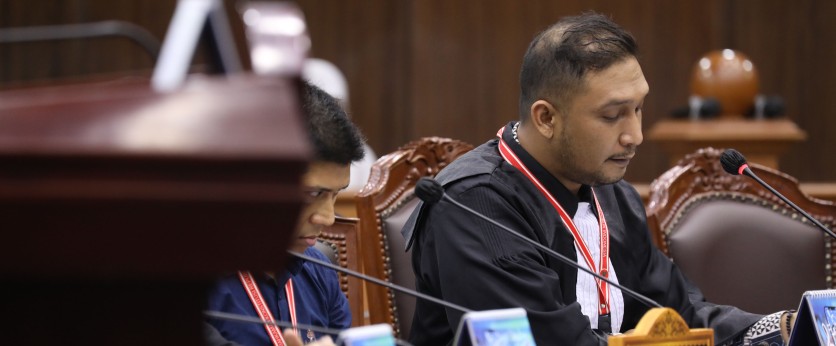
Doris Manggalang Raja Sagala delivering the key points of the petition for the judicial review of Law No. 1 of 2014 on the Election of Governors, Regents, and Mayors into Law (Regional Election Law) in the panel courtroom of the Constitutional Court, Friday (10/17/2025). Photo by MKRI/Panji.
JAKARTA (MKRI) — The Constitutional Court (MK) held a preliminary hearing for Case No. 185/PUU-XXIII/2025 to review the constitutionality of Article 7 paragraph (2) letter t of Law No. 10 of 2016 on the Second Amendment to Law No. 1 of 2015 on the Stipulation of Government Regulation in Lieu of Law No. 1 of 2014 on the Election of Governors, Regents, and Mayors into Law (Regional Election Law).
The first hearing took place in the plenary courtroom of the Constitutional Court on Friday, October 17, 2025. It was chaired by Chief Justice Suhartoyo with Constitutional Justices Daniel Yusmic P. Foekh and M. Guntur Hamzah. The petition was filed by four citizens, Doris Manggalang Raja Sagala, Jonswaris Sinaga, Amudin Laia, and Roy Sitompul, who challenged the resignation requirement for police officers running as regional head candidates.
During the session, Doris Manggalang Raja Sagala asserted that the petition was not nebis in idem because the contested provision had never been reviewed or ruled on by the Court. She argued that Article 7 paragraph (2) letter t of the Regional Election Law should be reexamined, as it fails to provide a clear mechanism for the resignation of members of the Indonesian National Police (Polri) intending to run in regional elections.
“Under Article 135 paragraphs (1) and (2) of Law No. 1 of 2015, the police have the authority to investigate and follow up on criminal offenses in regional elections. Furthermore, Articles 146 and 152 of Law No. 10 of 2016 stipulate that the police are part of Gakkumdu (Integrated Law Enforcement), authorized to conduct searches, seizures, and evidence collection,” Doris explained before the panel of justices.
Police Resignation Regulation
Doris also elaborated on the resignation regulation for police officers as stipulated in Indonesian National Police Regulation No. 1 of 2019. Under this regulation, police officers resigning to contest regional elections fall under the category of “honorable discharge” (PDH).
An honorable discharge constitutes the termination of service by an authorized official based on applicable laws and regulations. Article 32 paragraph (1) of the regulation states that one of the grounds for an honorable discharge is resignation approved by an authorized official, which must first undergo administrative review as provided in Article 40.
“Therefore, to ensure that a police officer has indeed resigned and no longer holds the status of an active member of the police, an official decree or decision from the Indonesian National Police or the Chief of Police is required, particularly for officers running in the 2024 regional elections,” Doris emphasized.
She cited several instances from the 2024 regional elections where high-ranking police officers ran for office while awaiting administrative approval of their discharge decisions from the Chief of Police, which only arrived close to the candidate certification stage.
The petitioners also questioned provisions on the resignation of police officers in the General Elections Commission Regulation (PKPU) No. 8 of 2024 on the Nomination of Governors and Deputy Governors, Regents and Deputy Regents, and Mayors and Deputy Mayors.
According to the petition, Article 14 paragraph (2) letter r of PKPU 8/2024 requires candidates from the military, police, state civil apparatus (ASN), and village heads or equivalent officials to submit a written statement of resignation once they are certified as candidate pairs.
Meanwhile, Article 25 paragraph (1) letter b and paragraph (2) letter b stipulate that if the resignation letter has not yet been approved by an authorized official, candidates may attach proof of submission and a statement that the resignation is being processed.
The petitioners contended that such provisions pose legal problems, as the position of the police differs fundamentally from that of other institutions. The police play a crucial role in regional elections and in enforcing laws on electoral crimes as part of Gakkumdu.
Therefore, the petitioners argued that the resignation of police officers cannot be equated with that of members of the military, ASN, or village heads, who do not hold law enforcement powers. They asserted that if Article 7 paragraph (2) letter t of the Regional Election Law merely requires a written statement of resignation, it violates Articles 18 paragraph (4), 22E paragraph (1), 27 paragraph (1), and 28D paragraph (1) of the 1945 Constitution, as it undermines the principles of justice, equality before the law, and neutrality of law enforcement institutions.
In their petitum, the petitioners requested the Court to declare Article 7 paragraph (2) letter t of the Regional Election Law unconstitutional and not legally binding unless it is interpreted to mean that for police officers, resignation must be proven by a discharge decree approved by the police institution effective since the candidate pair certification.
Petition Structure
Responding to the petition, Constitutional Justice Daniel Yusmic P. Foekh remarked that the petition was generally well-prepared, though several aspects required refinement, particularly in its structure and presentation of the Court’s jurisdiction.
“First, regarding the Court’s jurisdiction, it should be elaborated systematically, beginning with the constitutional basis, Article 24 paragraph (2) and Article 24C of the 1945 Constitution, followed by the Constitutional Court Law, the Judicial Authority Law, and the Law on Lawmaking, as amended. Finally, the Constitutional Court Regulation (PMK) No. 7 of 2025 may also be referenced, as this petition concerns the review of Article 7 paragraph (2) letter t of the Regional Election Law against the 1945 Constitution,” Daniel explained.
He further advised the petitioners to strengthen the explanation of their legal standing, particularly in their capacity as advocates. “The petition would be stronger if the petitioners could demonstrate direct constitutional harm, for instance, if they had previously served as legal counsels to regional head candidates disadvantaged by the participation of active police officers. This would clarify the causal link between the challenged norm and the alleged constitutional injury,” he said.
The panel granted the petitioners fourteen days to revise their petition, with the revised version due to be received by the Court no later than Thursday, October 30, 2025.
Author: Utami Argawati
Editor: Lulu Anjarsari P.
PR: Raisa Ayuditha M.
Translator: Yuanna Sisilia
Disclaimer: The original version of the news is in Indonesian. In case of any differences between the English and the Indonesian versions, the Indonesian version will prevail.
Friday, October 17, 2025 | 13:19 WIB 168