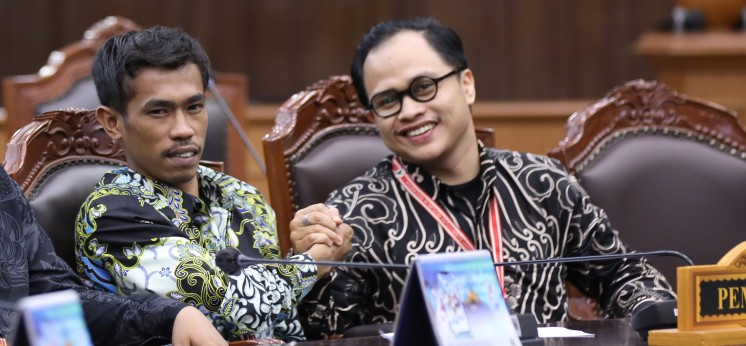
Petitioner Agus Setiawan attending the Decision Pronouncement Hearing on the material judicial review of Law No. 11 of 2021 on the Attorney General’s Office, Thursday (16/10). Photo by MKRI/Ifa.
JAKARTA (MKRI) – The Constitutional Court (MK) on Thursday, October 16, 2025, partially granted a judicial review petition of Law No. 11 of 2021 on the Amendment to Law No. 16 of 2004 on the Attorney General’s Office of the Republic of Indonesia (AGO Law). The petition was filed by Agus Setiawan (activist/student), Sulaiman (advocate), and the Madani Youth Association.
Decision No. 15/PUU-XXIII/2025 was pronounced in the Plenary Courtroom with Chief Justice Suhartoyo presiding over the session along with eight other constitutional justices.
In its verdict, the Court granted the petition of Petitioners I and II in part. The Court declared that Article 8 paragraph (5) of the AGO Law conflicts with the 1945 Constitution and is conditionally unconstitutional unless interpreted to include exceptions for prosecutors caught in flagrante delicto or reasonably suspected of committing a grave or special criminal offense. The provision is therefore to read: “During the performance of their duties, any summons, examination, search, arrest, or detention of a prosecutor may only be conducted with the approval of the Attorney General, except in cases where:
(a) The prosecutor is caught in the act of committing a crime; or (b) sufficient preliminary evidence exists that the prosecutor is suspected of committing a crime punishable by death, a crime against state security, or a special crime.”
The Court also struck down Article 35 paragraph (1) letter e and its elucidation as unconstitutional and lacking binding legal force. Meanwhile, the petition of Petitioner III and parts of the petition by Petitioners I and II concerning Article 11A paragraph (1) letters a, e, and paragraph (3) were deemed inadmissible.
Equality Before the Law
Justice Arsul Sani, delivering the Court’s legal consideration, emphasized that while legal protection for law enforcement officers and state officials involved in the judicial process is necessary, such protection must not undermine the principle of equality before the law.
According to Justice Arsul, every citizen—including prosecutors and other law enforcement officers—must remain subject to legal process without special treatment. Legal protection may only be justified within reasonable limits to safeguard independence from undue pressure or interference.
The Court found that Article 8 paragraph (5) of the AGO Law, which requires approval from the Attorney General before investigating or detaining a prosecutor, creates a privilege that potentially violates the principle of equality before the law.
“This provision runs counter to the spirit of equality before the law and risks weakening the rule of law. Therefore, the Court holds that the norm is conditionally unconstitutional,” Justice Arsul stated in his explanation.
Court Shifts Its Stance
Justice Arsul Sani continued by explaining that Article 8 paragraph (5) of Law No. 11 of 2021, upon careful examination and as identified by the Constitutional Court in its legal considerations, was initially intended to provide legal protection for prosecutors performing their official duties. As such, the law prohibits summoning, investigating, searching, arresting, or detaining prosecutors without the Attorney General’s approval.
Therefore, if a prosecutor is suspected of committing a criminal act in connection with the exercise of their duties and authority, such actions—summons, investigation, search, arrest, or detention—cannot be carried out without prior authorization from the Attorney General. In other words, even if a prosecutor is caught in flagrante delicto while carrying out duties related to their official functions, no legal action may be taken against them without the Attorney General’s consent.
The Court observed that while legal safeguards for law enforcement officers or state officials whose functions relate to the exercise of judicial power are indeed necessary, such protections must not erode the principle of equality before the law. Accordingly, both citizens and law enforcement officials, including among law enforcers themselves, must remain equally subject to the rule of law.
By examining the spirit underlying Article 8 paragraph (5) of the Prosecutor’s Law, the Court found that while it aims to protect prosecutors in exercising their duties, the provision is inconsistent with the broader purpose of legal protection applicable to other law enforcement bodies and state officials performing judicial functions.
To harmonize the validity of Article 8 paragraph (5) with the constitutional principle that all individuals are equal before the law—particularly from the standpoint of equal legal protection for law enforcers and citizens alike—the Court concluded there was no alternative but to declare the provision conditionally unconstitutional.
Based on this reasoning, the Constitutional Court decided to depart from its earlier stance expressed in Decision No. 55/PUU‑XI/2013, dated 24 April 2014, which had upheld a substantively identical provision in Law No. 16 of 2004 as constitutional. Considering the above legal reasoning and comparing it with the treatment of other law enforcement agencies, the Court shifted its position regarding the constitutionality of Article 8 paragraph (5) of Law No. 11 of 2021.
Thus, the Court held that Article 8 paragraph (5) of the Prosecutor’s Law contravenes the 1945 Constitution and lacks binding legal force unless interpreted as excluding its application in circumstances where a prosecutor is caught in the act of committing a crime or where sufficient preliminary evidence exists to suspect the commission of a crime punishable by death, a crime against state security, or a special crime.
Dissenting Opinions
The decision was accompanied by dissenting opinions from two justices— Justice Arief Hidayat and Justice M. Guntur Hamzah—who both argued that the petition should have been dismissed. They reasoned that Article 8 paragraph (5) was designed as a protective mechanism for prosecutors in performing their duties, not as an absolute grant of immunity.
The dissenting justices further maintained that the Attorney General’s participatory role as advocatus generalis—in providing technical legal considerations during cassation proceedings—if conducted professionally, transparently, and accountably, actually strengthens the system of checks and balances in upholding justice.
Author: Utami Argawati.
Editor: N. Rosi.
PR: Raisa Ayuditha Marsaulina.
Translator: Rizky Kurnia Chaesario
The full decision in Indonesian is available at: Decision No. 15/PUU-XXIII/2025
Disclaimer: The original version of the news is in Indonesian. In case of any differences between the English and the Indonesian versions, the Indonesian version will prevail.
Thursday, October 16, 2025 | 16:36 WIB 387