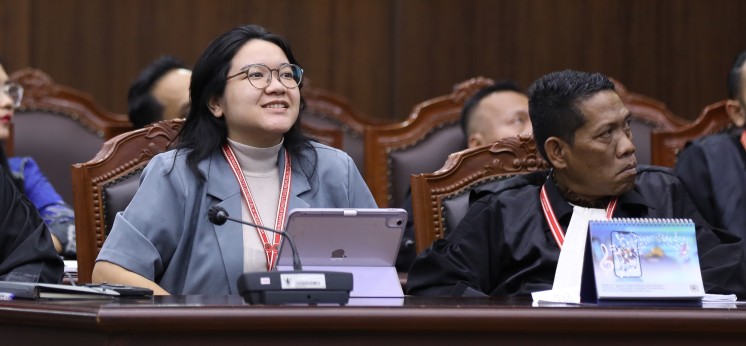
Petitioners’ legal counsel, Nadya Jessica Junita (left) attending the Decision Pronouncement Hearing of the material judicial review of Law No. 20 of 2023 on the State Civil Apparatus (ASN Law), Thursday (16/10). Photo by MKRI/Ifa.
JAKARTA (MKRI) – The Constitutional Court (MK) on Thursday, October 16, 2025, partially granted a judicial review petition concerning supervision of the Merit System under Law No. 20 of 2023 on State Civil Apparatus (ASN Law). Through Decision No. 121/PUU-XXII/2024, the Court ordered the establishment of an independent institution to monitor the implementation of the Merit System—including the enforcement of principles, core values, the code of ethics, and the code of conduct of civil servants—within two years from the pronouncement of the decision.
“[The Court] declares that Article 26 paragraph (2) letter d of Law No. 20 of 2023 on State Civil Apparatus (State Gazette of the Republic of Indonesia No. 141 of 2023 Supplement to the State Gazette of the Republic of Indonesia No. 6897) contradicts the 1945 Constitution and is conditionally unconstitutional insofar as it is not interpreted as ‘the supervision of the Merit System, including oversight of the principles, core values, code of ethics, and code of conduct of civil servants, is carried out by an independent institution.’ Such an independent institution must be established within no later than two years from the pronouncement of this decision,” stated Chief Justice Suhartoyo when delivering the decision filed by the Association for Elections and Democracy (Perludem), the Regional Autonomy Implementation Monitoring Committee, and Indonesia Corruption Watch (ICW).
The Court considered that the ASN Law had transferred the supervisory authority previously held by the Civil Service Commission (KASN) to the National Civil Service Agency (BKN) and the Ministry of State Apparatus Empowerment and Bureaucratic Reform (PANRB), as stipulated in Article 70 paragraph (3) of the ASN Law. This Article formed the basis for Presidential Regulation No. 91 of 2024 on the amendment to the Presidential Regulation No. 47 of 2021 on the Ministry of PANRB, and Presidential Regulation No. 92 of 2024 on the National Civil Service Agency.
Under these provisions, the PANRB Ministry—through its Deputy for Human Resources—formulates policies on civil service management and oversees the implementation of the Merit System, while BKN executes governmental functions related to formulating, implementing, and supervising technical civil service policies.
“According to the Court, considering the historical development of Indonesia’s civil service up to the enactment of Law No. 20 of 2023, one persistent issue has been that civil servants are highly susceptible to political or personal interference. To address this, a clear separation of functions and authorities between policy makers, policy implementers, and policy overseers is essential to avoid overlapping roles or conflicts of interest. In this context, a supervision body must not function solely as a supervisor an sich, but also serve as an external balancing institution to ensure that the Merit System operates effectively, accountably, and transparently—thus supporting a professional and efficient bureaucracy free from political interference and safeguarding the careers of civil servants,” Justice Guntur stated.
He further noted that the phrase “ministries and/or institutions” in Article 26 of the ASN Law could lexically include not only internal government bodies but also the establishment of an external institution as an independent supervisory body. For this reason, the Court deemed it crucial to establish an independent institution authorized to oversee the implementation of the Merit System, including the application of principles, values, and ethical standards of civil service conduct.
“Moreover, under Law No. 5 of 2014, a similar independent, non-structural body once existed to monitor and evaluate civil service management policies to develop a professional and high-performing bureaucracy while protecting civil service careers,” Justice Guntur said.
He added that the specific model of such an independent agency lies within the legislature’s discretion, but its establishment is necessary for an effective and accountable government. The independent body will function as an external overseer to ensure consistent implementation of the Merit System, free from political interference or conflicts of interest in civil service management.
Loss of Relevance
Regarding Article 70 paragraph (3) of the ASN Law, the Court found no further need for review because its substance had been addressed through the interpretation of Article 26 paragraph (2) letter d. The existence of an independent supervision institution, as sought by the petitioners, had been accommodated within that interpretation. “Accordingly, the petitioners’ arguments concerning the review of Article 70 paragraph (3) of Law No. 20 of 2023 are legally unfounded,” Justice Guntur said.
Justice Anwar Usman delivered a dissenting opinion, rejecting the petitioners’ claims. He argued that transferring KASN’s duties to the PANRB Ministry and BKN constituted an open legal policy, noting that issues concerning civil servant neutrality are not directly related to oversight and management of the civil service as a whole.
Also read:
Questioning the Absence of KASN Merit System Supervision under ASN Law
Petitioners Affirm Argument Against Abolition of KASN Merit System
House: The Abolition of KASN As Part of Civil Servants' Management Structure Reorganization
Govt Established Task Force to Enforce ASN Neutrality Replacing KASN
Separation of ASN Management Authority Needed to Avoid Duplication of Institutional Tasks
Govt and Petitioner Not Ready to Testify on ASN Law Review, Hearing Postponed
Expert: No Legal Vacuum from Transfer of Duties from KASN to BKN
At the preliminary hearing on September 19, the Petitioners argued that Article 26 paragraph (2) letter d of the ASN Law is unconstitutional. Petitioner I believes that the abolition of supervision over the ASN’s merit system, principles, code of ethics, and code of conduct has created legal uncertainty. It has also abolished independent supervision over the neutrality of the organizers of the 2024 simultaneous regional election.
Petitioner I saw this as an urgent matter considering the resulting weakening of the bureaucratic system, which must be professional, has integrity, and follows meritocratic principles, so as to achieve good governance that is professional, free of corruption, collusion, and nepotism. Hence, as a person concerned about democracy and bureaucratic reform, especially related to the organization of clean and fair elections, Petitioner I has an interest in filing the petition.
Meanwhile, as a supporter of regional autonomy, business development, central government, and the need for freedom of expression, Petitioner II believes that the articles being reviewed could potentially obstruct the free and just organization of regional elections. With the absence of independent supervision, civil servants are prone to be mobilized as partisans during elections. Hence, these practices should be prevented and dealt with wisely.
Petitioner III believes that the removal of the ASN’s merit system, code of ethics and conduct, and independent supervision over the ASN’s neutrality would result in prolonged exploitation of ASNs in partisan practices, which is politically motivated and results in recruitment, promotion, or demotion that is similarly politically-motivated. This, it argues, is far from the principle of meritocracy and good governance that is directly related to the goals and work of Petitioner III’s organization.
Author: Sri Pujianti
Editor: Lulu Anjarsari P.
PR: Raisa Ayuditha M.
Translators: Rizky Kurnia Chaesario/Yuniar Widiastuti
Disclaimer: The original version of the news is in Indonesian. In case of any differences between the English and the Indonesian versions, the Indonesian version will prevail.
The full decision in Indonesian is available at: Decision No. 121/PUU-XXII/2024
Thursday, October 16, 2025 | 16:10 WIB 2157