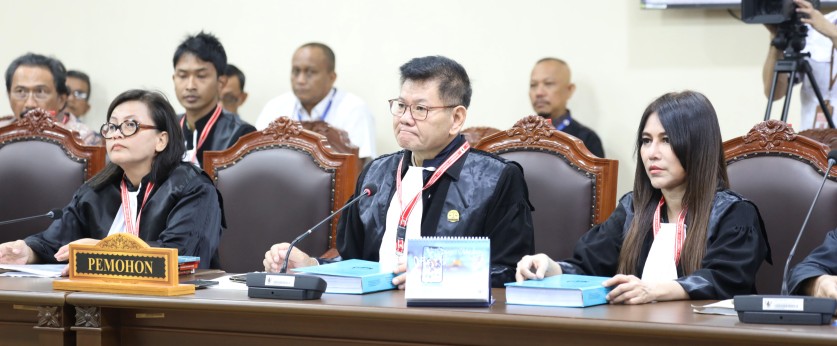
Attorney Hans Karyose (Petitioner) delivering the petition at the preliminary hearing for the judicial review of the Mortgage Law, Friday (10/10/2025). Photo by MKRI/Panji.
JAKARTA (MKRI) — Hans Karyose, an attorney by profession, has filed a petition for judicial review of the Elucidation to Article 11 paragraph (1) letter (e) of Law No. 4 of 1996 on Mortgage Rights over Land and Objects Related to the Land (Mortgage Law) before the Constitutional Court (MK). The preliminary hearing for Case No. 177/PUU-XXIII/2025 was held on Friday, October 10, 2025, presided over by Deputy Chief Justice Saldi Isra (chair) and Constitutional Justices Ridwan Mansyur and Arsul Sani in one of the panel courtrooms.
The Elucidation to Article 11 paragraph (1) letter (e) of the Mortgage Law stipulates that: “A clear description of the object of Mortgage Right as referred to in this letter shall include details of the certificate of title to the land concerned or, for unregistered land, at least a description of ownership, location, boundaries, and area of the land.”
In the concrete case cited by the Petitioner, based on the land mortgage deed (APHT) No. 1090 of 2006, the head of the Agrarian Office/Land Agency (ATR/BPN) of Bogor Regency in Cibinong issued land mortgage certificate No. 126 of 2007, which described nine land certificates. On April 16, 2012, an auction No. 296 of 2012 was conducted for the land and the buildings on it as a single package. The land certificates and their respective areas were specified, but the type of building auctioned was not described.
Subsequently, on October 18, 2012, execution was carried out on the nine parcels of land along with the buildings standing on them, all pharmaceutical processing machines, and other items, including ten coal briquette press machines still under fiduciary security pursuant to fiduciary deed No. 124 dated November 27, 2006.
According to the Petitioner, the provision being challenged has violated his constitutional rights, as his buildings and machinery were auctioned and executed together with the land. In fact, the buildings standing on the land were factory buildings owned by another party and thus should not have been included in the collateral. The Petitioner argued that if his petition were granted, notaries would be prevented from making similar mistakes in the future and would be required to specify the buildings situated on the land, such as factory buildings, residences, shop-houses, and hospitals.
In practice, when the buildings on the land are not specified, after the mortgage right is granted, the debtor could legally replace a 10,000-square-meter building with one of only 100 square meters. The lack of specification of the object of mortgage rights has thus created ambiguity and legal uncertainty in the APHT prepared by the land deed official (PPAT) and in the mortgage certificate issued by the National Land Agency.
“If not specified, the object of the mortgage right becomes defective. An agreement must meet four valid conditions; in this case, the agreement violates the law and lacks legal certainty. That’s the crux of the problem—the object is the essence of the Mortgage Law,” Karyose explained.
For this reason, the Petitioner requests that the Constitutional Court declare that the Elucidation to Article 11 paragraph (1) letter (e) of the Mortgage Law unconstitutional and not legally binding insofar as it is not interpreted as follows: “A clear description of the object of Mortgage Rights as referred to in this letter shall include details of the certificate of title to the land concerned or, for unregistered land, at least a description of ownership, location, boundaries, and area of the land, as well as at minimum a clear description of the type of building, its area and number of floors, the materials used, the number of rooms, the building permit number, the certificate number on which it stands, and a clear description of any trees and their quantities, as well as any works of creation, their dimensions, and materials.”
Legal Standing
Regarding the petition, Constitutional Justice Ridwan Mansyur noted that while the Petitioner’s legal standing as an Indonesian citizen and entrepreneur was acknowledged, its formulation was not yet appropriate. “The Petitioner provided an extensive description of legal standing, but it still does not meet the criteria required for explaining legal standing in this petition. Please reframe it using the five parameters, demonstrating that the enforcement of this article is inconsistent with the 1945 Constitution,” he advised.
Meanwhile, Constitutional Justice Arsul Sani explained that the Petitioner should include the legal basis for the Court’s authority within the hierarchy of the 1945 Constitution. “In addition, regarding the petitums, since what is being sought is a specific interpretation, please refer to examples of well-drafted petitions and sharpen the argument on constitutional harm,” he stated.
Deputy Chief Justice Saldi Isra then requested the Petitioner to elaborate on the contradiction between the challenged article and the Constitution. “Which article serves as the constitutional benchmark for review? Building a sound argument is essential so that the Court is convinced of the Petitioner’s alleged constitutional injury,” he emphasized.
At the end of the session, Deputy Chief Justice Saldi Isra stated that the Petitioners would have 14 days to revise the petition. The revised petition must be submitted to the Registrar’s Office no later than Thursday, October 23, 2025. The Court will then hold the second hearing to examine the revisions to the petition.
Author : Sri Pujianti
Editor : N. Rosi
PR : Fauzan F.
Translator : Yuniar Widiastuti (NL)
Disclaimer: The original version of the news is in Indonesian. In case of any differences between the English and the Indonesian versions, the Indonesian version will prevail.
Friday, October 10, 2025 | 13:39 WIB 210