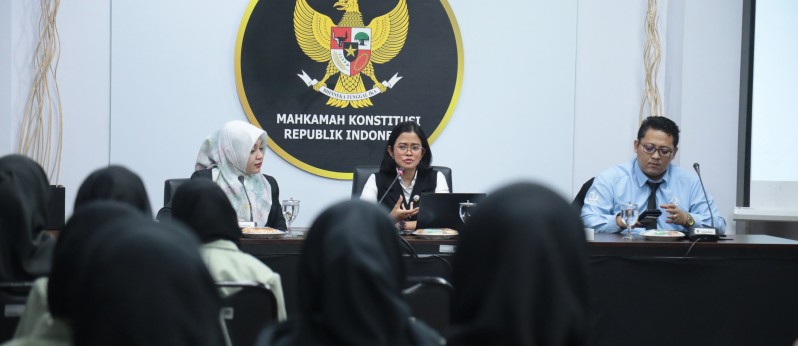
Students of UIN Siber Syekh Nurjati Cirebon visit the Constitutional Court (MK), Thursday (9/10/2025). The group was received by the Court’s Legal Analyst, Siswantana Putri Rachmatika, at the Auditorium of Building II. Photo by MKRI/IlhamWM.
The Constitutional Court (MK) received a visit from students of Universitas Islam Negeri (UIN) Siber Syekh Nurjati Cirebon on Thursday (9/10/2025) at the Auditorium of Building II. The group, accompanied by several faculty members, was welcomed by the Court’s Legal Analyst, Siswantana Putri Rachmatika.
Tika, as she is warmly called, began by explaining the history of the Constitutional Court’s establishment. She noted that before the Court existed, Indonesia lacked a clear mechanism for resolving constitutional disputes, including the judicial review of laws against the 1945 Constitution (UUD 1945).
“Many laws were problematic, but at that time, there was no mechanism to test them against the 1945 Constitution,” Tika explained before the students at the Court’s Auditorium.
Before the amendments to the 1945 Constitution, Tika continued, many constitutional issues—such as presidential impeachment, institutional conflicts, and election disputes—had no clear resolution forum. This situation underscored the need for a specialized institution capable of upholding constitutional supremacy in Indonesia.
During the Third Amendment to the 1945 Constitution, Article 24C was formulated as the constitutional basis for the establishment of the Constitutional Court. The government and the House of Representatives (DPR) later deliberated the Bill on the Constitutional Court, which was enacted on 13 August 2003 as Law Number 24 of 2003 on the Constitutional Court.
Tika went on to explain the Court’s authorities, which include reviewing laws against the Constitution, resolving disputes over authorities among state institutions, deciding on the dissolution of political parties, and adjudicating disputes over general election results. The Court also has the duty to decide upon the House of Representatives’ opinion concerning alleged constitutional violations by the President and/or Vice President.
She also elaborated on the mechanisms of formal and material judicial review. A formal review concerns the legislative process and must be filed within 45 days after a law’s enactment, while a material review concerns the substantive content of legal norms and may be submitted at any time.
Lastly, Tika described the types of petitioners eligible to file for judicial review: individuals (Indonesian citizens), customary law communities, public or private legal entities, and state institutions whose constitutional rights or authorities are impaired by the enactment of a law.
Author : Utami Argawati.
Editor : Lulu Anjarsari P.
Translator : Aski V Rumere/Agusweka Poltak Siregar.
Disclaimer: The original version of the news is in Indonesian. In case of any differences between the English and the Indonesian versions, the Indonesian version will prevail.
Thursday, October 09, 2025 | 15:55 WIB 454