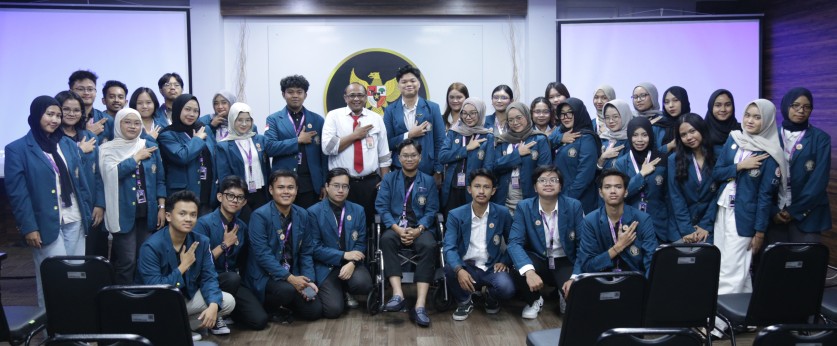
Court welcoming students from the Faculty of Economics and Business, Diponegoro University, on Thursday (10/9/2025). Photo by MKRI/ Bay.
JAKARTA (MKRI) – The Constitutional Court (MK) welcomed a group of students from the Faculty of Economics and Business, Diponegoro University (FEB Undip), on Thursday, October 9, 2025. They engaged in a discussion with the Court’s Young Expert Legal Analyst, Mohammad Chamid Zuhri, commonly known as Hari, at the Court’s Building II Auditorium in Jakarta.
Hari explained that the Court holds the authority to adjudicate at the first and final instance, with its decisions being final and binding. Its jurisdiction includes reviewing laws against the 1945 Constitution (UUD 1945); resolving disputes over the authority of state institutions whose powers are granted by the Constitution, deciding on the dissolution of politics, and deciding disputes over general election results. The Court is also obliged to render a decision on the House of Representatives (DPR) opinion regarding alleged violations committed by the President and/or Vice President under the Constitution. Such violations, as stipulated in Article 7A of the 1945 Constitution, include treason against the state, corruption, bribery, other criminal acts, or morally reprehensible acts, as well as circumstances where the President and/or Vice President no longer meet the qualifications prescribed in the 1945 Constitution of the Republic of Indonesia (NRI 1945).
One of the students asked about the meaning of formal review at the Court. Hari explained that a formal review is one of the types of judicial review filed before the Court. It refers to the examination of the legislative process in enacting a law or a Perppu that fails to comply with procedural requirements for the formation of laws or Perppu as stipulated in the 1945 Constitution.
“This relates to the background of a law’s formation. It differs from a material review, which examines the substance of specific legal norms within a law,” Hari explained.
The definitions of formal and material judicial review petitions are regulated under Constitutional Court Regulation (PMK) No. 7 of 2025 on Procedural Rules for Judicial Review Cases. A material review petition concerns the substance of provisions, articles, clauses, and/or sections, within a law or Government Regulation in Lieu of Law (Perppu) that are alleged to contradict the 1945 Constitution
A petition for a formal review shall be submitted no later than 45 days after the law or Perppu is promulgated in the State Gazette of the Republic of Indonesia. The petition shall be decided no later than 60 working days from the date of the hearing for the submission of statements by the House of Representatives (DPR) and the President.
Meanwhile, there is no time limit for submitting a material review petition concerning the substance of legal norms within a law, nor is there a time restriction for the case to be decided. Therefore, a formal review petition must be separated from a material review petition and registered under a different case number.
Both formal and material review petitions may be submitted offline or online, or through other electronic means. Anyone who considers that their constitutional rights and/or authority have been harmed by the enactment of a law or Perppu may act as the Petitioner in a judicial review case.
A petitioner in a judicial review case may be an individual Indonesian citizen, a group of people with a common interest, a customary law community unit that remains in existence and aligns with societal development and the principles of the Unitary State of the Republic of Indonesia (NKRI) as regulated by law, a public or private legal entity, or a state institution. The parties involved in a judicial review case are referred to as the Petitioner, Information Provider, and the Related Party.
“Students may also file a judicial review petition, provided that they can explain their legal standing by describing the constitutional rights that have been or may be harmed,” said Hari.
After the discussion, the FEB Undip students were also invited to tour the Constitutional History Center (Puskon). Puskon is an educational facility at the Constitutional Court that documents the history of Indonesia’s constitution and promotes constitutional awareness among the public. The center provides information and collections related to the constitution and the Court’s activities, using a blend of art, technology, and information, including archives of the Court’s historic decisions.
Author: Mimi Kartika
Editor: Tiara Agustina
Translator: Aski V Rumere/Donny Yuniarto
Disclaimer: The original version of the news is in Indonesian. In case of any differences between the English and the Indonesian versions, the Indonesian version will prevail.
Thursday, October 09, 2025 | 13:42 WIB 236