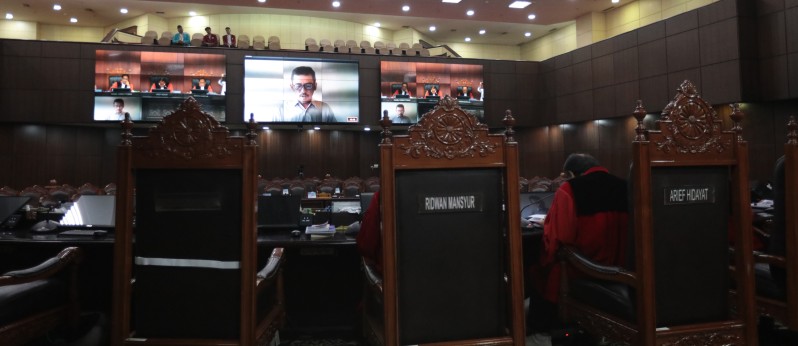
The petition revision hearing for the material judicial review of Law No. 2 of 2011 on the Political Party, Wednesday (10/8/2025). Photo by MKRI/Ilham W. M.
JAKARTA (MKRI) — The Constitutional Court (MK) held the second hearing for the material judicial review of Law No. 2 of 2008 on Political Parties as amended by Law No. 2 of 2011 on Wednesday, October 8, 2025. The petition in case No. 166/PUU-XXIII/2025 was filed by Tri Makno, who appeared at the hearing without legal counsel. He said that the entire petition had been revised.
“What is being reviewed is the Political Party Law No. 2 of 2011, specifically Article 23 paragraphs (1) and (2), as well as Article 29 paragraph (2),” he stated before the panel of justices.
Tri explained that these articles have caused several constitutional losses—actual, potential, and structural. He argued that the norms granting broad discretion to a political party’s articles of association and bylaws (AD/ART) without minimum standards of democracy risk fostering elitist recruitment and limiting members’ participation.
“My loss occurred when a member of the House of Representatives from electoral district VI of Central Java, Nafa Urbach, was deactivated by her party without a democratic internal process. This has diminished my political representation rights as a voter,” Tri explained.
He claimed the provision requiring only the registration of the central executive board with the ministry also reduces the autonomy of regional party leadership and closes off space for local aspirations. He stated that this contradicts the spirit of regional autonomy as provided in Articles 18 through 18B of the 1945 Constitution.
In the posita of his petition, Tri argued that Article 23 paragraph (1) of the Political Party Law contradicts Article 1 paragraph (2) of the 1945 Constitution because it fails to guarantee the sovereignty of party members as an embodiment of the people’s sovereignty. Furthermore, Article 23 paragraph (2) is deemed inconsistent with Articles 18, 18A, and 18B of the 1945 Constitution, while Article 29 paragraph (2) is considered to violate Articles 28D paragraph (3) and 22E paragraph (3) of the 1945 Constitution because it does not ensure equal opportunity in political recruitment processes.
Tri also highlighted the low level of public trust in political parties. Based on a survey by Indikator Politik Indonesia in January 2025, the level of trust in political parties ranked the lowest among all democratic institutions.
“The lack of public trust cannot be separated from the prevalence of corruption cases involving politicians, the lack of organizational transparency, and the minimal orientation toward the people’s interests. Public trust is not only about reputation but also a form of social capital for the sustainability of democracy,” he said.
Therefore, in his revised petitums, Tri requested that the Court declare Article 23 paragraphs (1) and (2) and Article 29 paragraph (2) of the Political Party Law unconstitutional and not legally binding unless interpreted as follows: a. “Changes in the leadership of a Political Party at every level shall be conducted democratically, involving all party members equally through a one member one vote mechanism, with organizational support that may be facilitated by the General Elections Commission (KPU) up to the regency/city level.” b. “The composition of Political Party leadership at all levels shall be registered with the Ministry as an official document, with leadership changes made in accordance with the Articles of Association and Bylaws, so that each level of leadership is autonomous, and the election of the chairperson or equivalent position must use a one member one vote mechanism.” c. “The recruitment of candidates for legislative office, regional head positions, and for president and vice president shall be carried out democratically, transparently, and accountably through a one member one vote mechanism or another mechanism that ensures equal participation of all members.”
Also read: Petitioner Highlights Democratization of Political Parties
In case No. 166/PUU-XXIII/2025, Tri Makno challenges Article 23 paragraphs (1) and (2) and Article 29 paragraph (2) of Law No. 2 of 2008 on Political Parties, as amended by Law No. 2 of 2011 on Political Parties. He previously challenged Article 4 of the Party Law, which he then changed in the revised petition.
At the preliminary hearing on Thursday, September 25, he highlighted the low level of public trust in political parties, as reflected in a polling by Indikator Politik Indonesia in January 2025. He also mentioned the demonstrations calling for the dissolution of the House of Representatives (DPR) some time ago, which he said arose from public disappointment with the performance of political parties.
“The lack of public trust cannot be separated from the prevalence of corruption cases involving politicians, the lack of organizational transparency, and the minimal orientation toward the people’s interests. Public trust is not only about reputation but also a form of social capital for the sustainability of democracy,” he said.
In his petition, he argued that Article 4 of the Political Party Law is contrary to Article 1 paragraph (2) of the 1945 Constitution and inconsistent with the articles of association/bylaws (AD/ART) of political parties. He emphasized that although the AD/ART guarantees members the right to elect party executives and legislative candidates, the law does not regulate a “one member, one vote” mechanism.
He claimed that the absence of such a mechanism risks perpetuating internal oligarchy in which power is concentrated in the hands of a handful of party elites. “In fact, the principle of decentralization has proven to improve the quality of public services in the executive. Political parties, as pillars of democracy, should apply the same model,” he stressed.
Author : Utami Argawati
Editor : Nur R.
PR : Raisa Ayuditha Marsaulina
Translator : Yuniar Widiastuti (NL)
Disclaimer: The original version of the news is in Indonesian. In case of any differences between the English and the Indonesian versions, the Indonesian version will prevail.
Wednesday, October 08, 2025 | 16:05 WIB 385