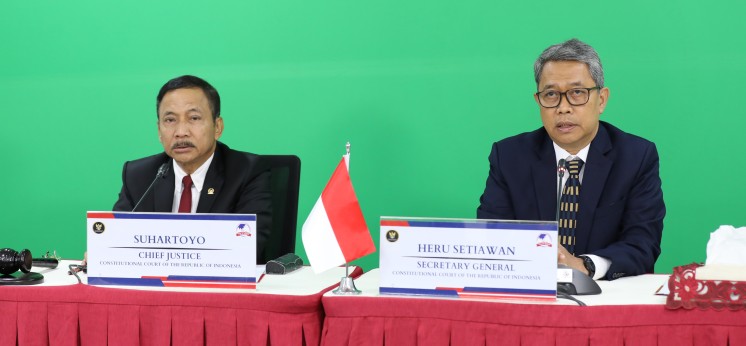
Secretary-General of the Constitutional Court (MK) Heru Setiawan and Chief Justice Suhartoyo delivering remarks and officially opened the 7th Indonesia Constitutional Court International Symposium (ICCIS) virtually on Wednesday (10/8/2025) at the Constitutional Court Building. Photo by MKRI/Ifa.
JAKARTA, MKRI – The Constitutional Court (MK) held the 7th Indonesia Constitutional Court International Symposium (7th ICCIS). The 7th ICCIS, themed “Strengthening the Protection of Constitutional Rights Through Constitutional Complaint,” was held virtually over two days on Wednesday, October 8, and Thursday, October 9, 2025.
In his opening remarks, Chief Justice Suhartoyo emphasized that the issue of constitutional complaint is essential to safeguard citizens’ constitutional rights. Across various constitutional courts worldwide, the constitutional complaint mechanism has evolved into a vital instrument for ensuring the protection of individual rights while expanding public access to justice.
“This mechanism primarily protects the public from the abuse of state power and provides a platform for marginalized voices to be heard. In Indonesia, discussions about the necessity of adopting a constitutional complaint mechanism have increasingly emerged in various constitutional law forums,” said Chief Justice Suhartoyo, who was attending the forum, which was attended by around 300 participants.
He further explained that the main goal of the 7th ICCIS is to deepen collective understanding of the concept of constitutional complaint, particularly its role in protecting human rights, identifying its challenges, and exploring its potential implementation in Indonesia.
“The papers and discussions presented in this symposium will enrich academic literature and offer valuable insights for the development of Indonesia’s constitutional framework,” Chief Justice Suhartoyo concluded during the opening of the 7th ICCIS held on Wednesday, October 8, 2025.
Constitutional Complaint Mechanism in Thailand
In the first session, chaired by Law Professor from Universitas University, Susi Dwi Harjanti, the discussion featured Constitutional Justice Noppadon Theppitak, representing the Constitutional Court of Thailand. Justice Noppadon delivered a presentation titled “Jurisdiction of the Constitutional Court to Adjudicate on the Constitutionality of Actions under Section 213 of the Constitution.” He explained the origins of the constitutional complaint system in Thailand, which was previously regulated under Section 212 of the 2007 Constitution. Initially, the object of a constitutional complaint was limited only to legal provisions that violated citizens’ rights and freedoms.
“The process required the petitioner to first submit a complaint to the National Human Rights Commission (NHRC) or the Ombudsman, which would then consider whether to refer the case to the Constitutional Court,” said Justice Noppadon.
He added that if the NHRC or Ombudsman did not pursue the case, the petitioner had the right to file a petition directly to a competent court, such as the Administrative Court. “And if that court did not refer the matter, only then would the petitioner have the right to submit a petition directly to the Constitutional Court,” he continued.
On this occasion, Justice Noppadon briefly discussed the 2017 Constitution, which expanded citizens’ rights under Section 213. The Constitution established a new constitutional complaint system allowing individuals to directly file a petition to the Constitutional Court if their rights or freedoms were violated.
“Under the 2018 Organic Act, the Constitutional Court has the power to examine and adjudicate petitions filed directly by individuals to determine whether the actions of a state body that violate rights or freedoms guaranteed by the Constitution are contrary to or inconsistent with the Constitution,” Justice Noppadon explained.
Adopting a Constitutional Complaint Mechanism for Indonesia
Next, Law Professor at Udayana University, I Dewa Gede Palguna, who also served as a speaker in the first session, delivered a presentation titled “Revisiting the Idea of Adopting Constitutional Complaint for Indonesia.” He explained that the Constitutional Court of the Republic of Indonesia (MKRI) currently lacks the authority to handle constitutional complaints, as its powers are limited to those stipulated in Article 24C of the 1945 Constitution. According to him, the absence of a constitutional complaint mechanism in Indonesia can result in violations of citizens’ constitutional rights—caused by government actions or negligence—being left unaddressed.
“Then, an interesting question arises: Is it possible to introduce the authority to handle constitutional complaints without going through a constitutional amendment? I personally believe it should go through the amendment process, as politically it is feasible. However, I also believe there are alternative paths to adopting a constitutional complaint mechanism,” said the former Constitutional Justice who served during 2003–2008 and 2015–2020.
According to Hausmaninger, Palguna elaborated that the constitutional review is the core idea behind the establishment of a constitutional court. Meanwhile, constitutional review itself is a product of the modern state system, founded on the principles of the rule of law, separation of powers, and the protection of human rights. It serves two main functions: first, to safeguard the democratic process within the framework of the interaction between the legislative, executive, and judicial branches; and second, to protect citizens’ rights and lives from violations by any branch of state power.
In other words, the primary purpose of establishing a constitutional court is to uphold the principles of the rule of law and ensure the maximum protection of fundamental rights. A constitutional complaint, therefore, represents a legal remedy designed to realize the protection of human rights. Theoretically, the authority to adjudicate constitutional complaints is inherently linked to the constitutional powers of a constitutional court.
“Upon closer examination, judicial review and constitutional complaint essentially fall within the same domain—the review of laws. The only difference lies in the object being examined. In a judicial review, the object is a law, whereas in a constitutional complaint, the object is a government action or omission,” explained Palguna.
The first session concluded with a presentation by Jane Natasha and Nisrina Mumpuni Eurikinasih from Airlangga University, who discussed “The Urgency of Introducing Constitutional Complaint in Indonesia for the Reconstruction of Human Rights Protection Under the 1945 Constitution.”
Implementation of Constitutional Complaints in Hungary and Azerbaijan
In the second session, chaired by Law Professor at Semarang State University (UNNES) Saru Arifin, Constitutional Justice Ágnes Czine represented the Constitutional Court of Hungary and delivered a presentation titled “Fundamental Rights Protection through Constitutional Complaints, with Special Respect to Its Effectiveness.” She explained that the Hungarian Constitutional Court most frequently handles constitutional complaint cases, which serve as a modern, functional, and effective legal remedy. The constitutional complaint mechanism allows individuals and organizations adversely affected by laws or court decisions that violate the Fundamental Law of Hungary to seek legal redress.
Also present was Constitutional Justice Rauf Guliyev, representing the Constitutional Court of Azerbaijan, who presented “The Procedure of Examination of Constitutional Complaints by the Constitutional Court of the Republic of Azerbaijan.” He explained that any person may file a constitutional complaint with the Court. The concept of “everyone” implies that it includes every person, not only citizens of the Republic of Azerbaijan.
Furthermore, Justice Rauf elaborated that the objects of a constitutional complaint include violations resulting from policies of the legislative and executive branches, as well as local government (municipal) policies, and judicial acts. “All these objects of complaint must be considered as violations of the rights and freedoms guaranteed by the Constitution,” he stated.
The second session concluded with a presentation titled “Judicial Independence at Stake? Constitutional Complaint and the Perceived Immunity of Political Elites in Madagascar” delivered by researchers from the ASTA Research Center, Antananarivo, Madagascar—Ramalina Ranaivo Mikea Manitra and Adya Paramita Prabandari.
Meanwhile, the third session featured presentations by Tanto Lailam (Academy for European Human Rights Protection, University of Cologne, Germany) and Thomas Sheku Marah (Nusa Putra University, Sukabumi, Indonesia).
Academic Forum
In his report, Heru Setiawan, Secretary-General of the Indonesian Constitutional Court, stated that the Indonesian Constitutional Court has become an active and respected participant within the global judicial community. Through its involvement in regional and international organizations, the Court has consistently contributed to advancing constitutionalism, the rule of law, and the protection of human rights. Beyond its formal memberships, the Constitutional Court continues to demonstrate its commitment through various academic initiatives and capacity-building programs, including the publication of its international journal, Constitutional Review.
“This year’s theme, ‘Strengthening the Protection of Constitutional Rights through Constitutional Complaint,’ holds significant strategic and contemporary relevance. In 2025, the Constitutional Court was assigned a significant national mandate by the Ministry of National Development Planning (BAPPENAS) to develop a Policy Paper on the Constitutional Complaint Mechanism as part of a National Priority Program. This positions ICCIS 2025 at the heart of a transformative moment—not only as an academic forum but also as a consultative platform for high-level policy development,” Heru said.
ICCIS is an annual event that began with the 1st ICCIS in Surakarta. Since then, it has consistently served as a leading international platform dedicated to the comparative study of constitutional justice. Subsequent ICCIS events were held in Yogyakarta (2018), Bali (2019), Bandung (2021), Bali (2022), and Jakarta (2023). Each symposium edition has uniquely examined diverse aspects of constitutional adjudication, facilitating dynamic dialogue among distinguished justices, scholars, and practitioners from around the world. For the 7th ICCIS, the Constitutional Court received 51 paper submissions from various countries. After review, 11 selected papers were chosen to be presented in the symposium sessions. The event was held virtually via Zoom and live broadcast on the Indonesian Constitutional Court’s official YouTube channel.
Author : Lulu Anjarsari P.
Editor : L.A.P
Translator : Jessica Rivena Meilania/Rizky Kurnia Chaesario
Disclaimer: The original version of the news is in Indonesian. In case of any differences between the English and the Indonesian versions, the Indonesian version will prevail.
Wednesday, October 08, 2025 | 15:26 WIB 548