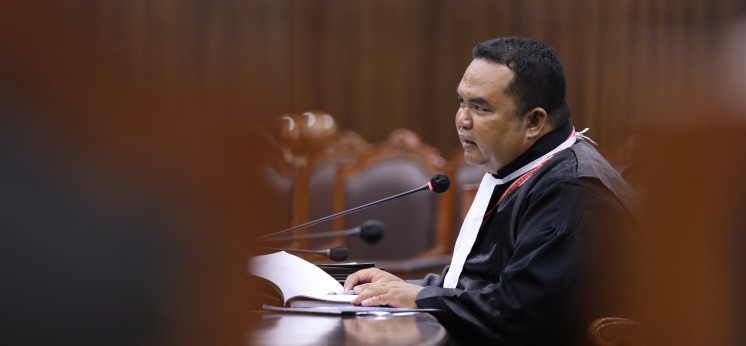
Counsel Ali Mukmin delivering the petition at the preliminary hearing for the judicial review of Law No. 7 of 1983 on Income Tax, Monday (10/6/2025). Photo by MKRI/Ifa.
JAKARTA (MKRI) — Two private-sector employees, Rosul Siregar and Maksum Harahap, filed a petition for the judicial review of Law No. 7 of 1983 on Income Tax (PPh Law), as last amended by Law No. 7 of 2021 on the Harmonization of Tax Regulations (HPP Law), against the 1945 Constitution. They challenge Article 4 paragraph (1) of the Income Tax Law, which classifies all additional economic capacity—including severance pay and pensions—as taxable income, and Article 17 of the same law in conjunction with the HPP Law, which applies a progressive tax rate to such income.
“Severance pay and pensions are savings accumulated by workers over decades. Why should they be treated the same as progressive income tax?” asked the Petitioners’ legal counsel Ali Mukmin at the preliminary hearing for Case No. 170/PUU-XXIII/2025 on Monday, October 6, 2025 at the Constitutional Court.
The Petitioners argued that normatively, the provisions have caused severance pay and pensions—rights that workers are entitled to after years of service—to be treated as new income arising from economic activity. Philosophically and sociologically, they contended, severance pay and pensions cannot be equated with business profits or capital gains, as they represent a form of “final savings” accumulated from a worker’s lifelong work.
According to them, the Government and the House of Representatives (DPR) view severance pay received in a lump sum as additional economic capacity, even though it is actually a portion of wages set aside each month and a form of appreciation from the employer for the employee’s service and dedication. They argued that the state unjustly takes a share of what should support people’s livelihoods until death, even though workers and retirees have paid income tax for decades and gain no direct reciprocal benefit.
The Petitioners asserted that these provisions clearly contradict the Constitution, particularly Article 28D paragraph (1) of the 1945 Constitution, which guarantees the right to recognition, guarantees, protection, and fair legal certainty, as well as equal treatment before the law. By taxing severance pay and pensions, the State treats retirees—who are in a vulnerable position in their old age—as though they were still strong and productive, thereby undermining the principle of fair legal certainty by placing vulnerable groups in the same category as productive ones, despite clear socio-economic differences.
In their petitums, the Petitioners ask the Court to declare that Article 4 paragraph (1) and Article 17 of the Income Tax Law in conjunction with the HPP Law contrary to Article 28D paragraph (1), Article 28H paragraph (1), and Article 34 paragraph (2) of the 1945 Constitution; to rule that these provisions have no binding legal force insofar as they apply to severance pay, pensions, old-age benefits (THT), and employment termination benefits (JHT); to order the Government not to impose taxes on these forms of income for all Indonesian citizens—both government and private employees; and to instruct the legislature to adjust the taxation system to align with the 1945 Constitution.
For context, Petitioner I is set to retire this October, while Petitioner II will retire in a few years at a different company. They expressed concern that, under the challenged provisions, their pension funds—intended to support them after retirement—would be significantly reduced by the imposition of progressive tax deductions.
Article 4 paragraph (1) of the Income Tax Law reads: “The objects of taxation shall be income, namely any increase in economic capacity received or obtained by a Taxpayer, whether originating from within Indonesia or from outside Indonesia, which may be used for consumption or to increase the Taxpayer’s wealth, under any name and in any form, including: a. salaries, wages, commissions, bonuses, or gratuities, pensions, or other compensation for work performed; b. honoraria, lottery prizes, and awards; c. gross business profits; d. gains from the sale or transfer of assets, including gains obtained by companies, partnerships, and other entities from the transfer of assets to shareholders, partners, or members, as well as from liquidation; e. refunds of tax payments previously accounted for as expenses; f. interests; g. dividends, under any name and in any form, paid by companies, including dividend payments from insurance companies to policyholders, the distribution of cooperative surplus to management, and the return of cooperative surplus to members; h. royalties; i. rental income from assets; j. receipts or income from periodic payments.”
Justices’ Advice
The case was heard by a panel consisting of Chief Justice Suhartoyo (chair) and Constitutional Justices Daniel Yusmic P. Foekh and M. Guntur Hamzah. Justice Foekh highlighted the fact that the petition’s format has not followed the Constitutional Court Regulation (PMK) No. 7 of 2025 on the procedure for judicial review of laws.
“The petition’s merits, from what I noted, must be reformulated by explaining the argument on the contradiction between the norms a quo and the articles in the Constitution previously mentioned. The argument must be arranged systematically,” Justice Foekh said.
Before adjourning the hearing, Chief Justice Suhartoyo announced that the Petitioners may revise the petition within 14 days. The revised petition must be received by the Court by Monday, October 20, 2025 at 12:00 WIB.
Author : Mimi Kartika
Editor : N. Rosi
PR : Fauzan F.
Translator : Yuniar Widiastuti (NL)
Disclaimer: The original version of the news is in Indonesian. In case of any differences between the English and the Indonesian versions, the Indonesian version will prevail.
Monday, October 06, 2025 | 16:01 WIB 929