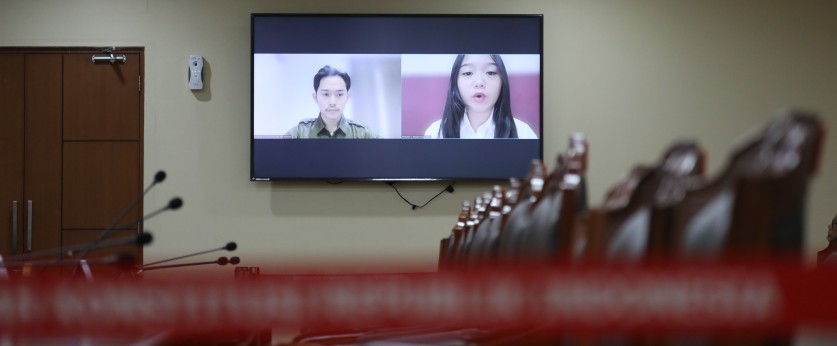
Petitioners in the judicial review of Law No. 7 of 2017 on General Elections withdrawing their petition, Monday (10/6/2025). Photo by MKRI/Panji.
JAKARTA (MKRI) — The Constitutional Court (MK) held the second hearing for the judicial review of Article 240 paragraph (1) letter e of Law No. 7 of 2017 on General Elections (Election Law), filed by Nanda Yuniza Eviani and Muhammad Rafli Nur Rahman (Petitioners I and II). They challenge the minimum requirement of high school education for candidates for the House of Representatives (DPR) and Regional Legislative Council (DPRD).
The hearing for case No. 162/PUU-XXIII/2025 on Monday, October 6, 2025 was supposed to hear the revisions to the petition. However, Nanda Yuniza emphasized, the Petitioners would like to withdraw the petition with full awareness and without any coercion from any party.
“By your permission, as of today, the Petitioners hereby request the withdrawal of the petition in light of a further analysis of the substance of the norm being challenged and consideration of the legal standing aspect. The Petitioners in this case a quo have concluded that it is necessary to revise the structure of the petition, particularly through the inclusion of new petitioners who possess stronger and more relevant legal standing in relation to the object of constitutional review. To preserve the integrity of the judicial process and avoid any formal issues that might weaken the merits of the petition, the Petitioners, with full awareness and without any coercion from any party, intend to voluntarily withdraw the petition a quo, with the intention of submitting a new, revised, restructured petition with more representative petitioners,” explained Nanda Yuniza before Deputy Chief Justice Saldi Isra and Constitutional Justices Ridwan Mansyur and Arsul Sani on the panel.
Also read: Petitioners Demand Bachelor’s Degree for Legislative Candidates
The case No. 162/PUU-XXIII/2025 was filed by Nanda Yuniza Eviani and Muhammad Rafli Nur Rahman (Petitioners I and II). They challenge Article 240 paragraph (1) letter e of the Election Law, which stipulates: “Prospective candidates for the DPR, provincial DPRD, and regency/city DPRD must be Indonesian citizens and fulfill the following requirements: … e. have completed at least senior high school, Islamic senior high school, vocational high school, Islamic vocational high school, or other equivalent schools….”
Intellectual Capacity
At the preliminary hearing on Monday, September 22, Muhammad Rafli Nur Rahman said the norm requiring only a high school education for parliamentary candidates is disproportionate to the constitutional authority vested in the legislature, which holds the power to make laws. Such a minimal requirement, he argued, fails to ensure adequate intellectual capacity, analytical ability, and legislative competence. As a result, the legislative function, which should produce responsive, visionary, and people-oriented regulations, risks yielding weak, overlapping, discriminatory, and socially negligent laws.
“If judges, prosecutors, and advocates—professions that merely interpret the law—are required to hold a university degree, is it reasonable that lawmakers need only a high school diploma? Allowing this to stand degrades, even reduces, the dignity of Article 20 paragraph (1) of the Constitution to a minimalist threshold,” emphasized Nanda Yuniza Eviani.
Shadow of Fragile Legislation
The Petitioners expressed deep concern over the frequent enactment of flawed legislation by the DPR and DPRD, much of which has been repeatedly annulled by the Constitutional Court. This, they argued, is not simply a technical weakness but clear evidence that citizens, including themselves, are forced to live under fragile, inconsistent laws that fail to provide protection. As a result, constitutional rights guaranteed by the 1945 Constitution—such as the right to proper education, affordable healthcare, a healthy environment, and equitable social welfare—have been neglected.
The provision in Article 240 paragraph (1) letter e, requiring only a high school education for legislative candidates, they argued, is at the root of this problem. It has reduced parliament to little more than an arena of popularity contests and political transactions rather than a forum of intellect and integrity.
Accordingly, the Petitioners asked the Court to declare Article 240 paragraph (1) letter e of Law No. 7 of 2017 on General Elections (State Gazette of the Republic of Indonesia Year 2017 No. 182, Supplement No. 6109) conditionally unconstitutional and without binding legal force, unless interpreted to mean “at least a bachelor’s degree (S-1) or equivalent.”
Author : Sri Pujianti
Editor : N. Rosi
PR : Raisa Ayuditha M.
Translator : Yuniar Widiastuti (NL)
Disclaimer: The original version of the news is in Indonesian. In case of any differences between the English and the Indonesian versions, the Indonesian version will prevail.
Monday, October 06, 2025 | 15:40 WIB 227