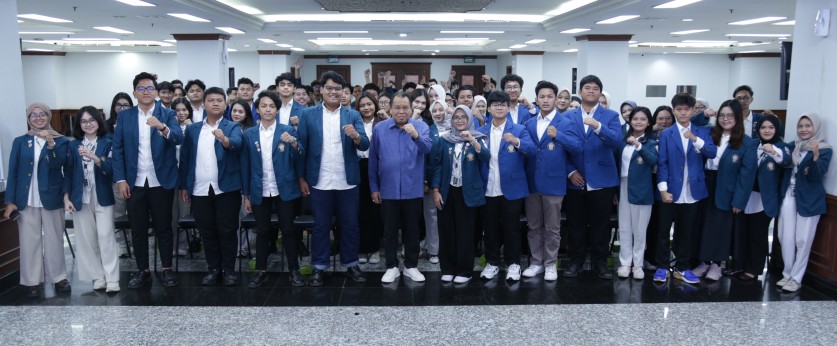
Visit of the Student Executive Board of Diponegoro University (BEM UNDIP) to the Court, Thursday (10/2/2025). Photo by MKRI/Bay.
JAKARTA (MKRI) – Around 82 students from the Student Executive Board of Diponegoro University (BEM UNDIP) Semarang visited the Constitutional Court (MK) on Thursday, October 2, 2025. They were welcomed and engaged in a discussion with Court’s Legal Analyst Arinta Sulistiyo, commonly known as Tyo.
Opening his presentation, Tyo explained the background behind the establishment of the Court. The Court was founded because in the past there was no clear mechanism to resolve constitutional law issues. Before the amendments to the 1945 Constitution, Indonesia had no judicial institution with the authority to review laws against the constitution.
“Since 2003, Indonesia has had the Court as a manifestation of the spirit of reform,” said Tyo.
According to Tyo, the establishment of the Court serves as a check on power and a mechanism to guarantee that citizens’ constitutional rights are not violated by laws enacted by the Parliament (DPR) and the government. As a judicial body, the Court has the authority to review laws against the Constitution to ensure that legislation does not contradict constitutional principles.
“Constitutional rights, simply put, are rights granted by the Constitution, guaranteed and protected by Constitution,” Tyo emphasized.
Tyo also shared that the Registrar’s Office and the Secretariat-General of the Court have compiled and published a Pocket Book of Constitutional Rights Icons (i-HKWN). This book illustrates citizens’ constitutional rights as enshrined in the 1945 Constitution in the form of icons, presented with attractive graphics and distinctive colors to make them easier to recognize. It is designed to encourage citizens to understand and foster awareness of the essence of constitutional rights.
He mentioned that there are 66 icons of constitutional rights grouped into three categories: individual rights (34 icons), collective rights (29 icons), and vulnerable group rights (3 icons). In this regard, the Court plays the role as the protector of the citizens’ constitutional rights.
The students then had the opportunity to visit the Constitutional History Center (Puskon), located on the 5th and 6th floors of its building. Puskon serves as an educational space documenting the history of the Constitution and the Court through a blend of information, art, and advanced technology such as holograms and interactive touchscreens to raise public awareness of the Constitution.
Author : Sri Pujianti
Editor : N. Rosi.
Translator : Jessica Rivena Meilania/Donny Yuniarto
Disclaimer: The original version of the news is in Indonesian. In case of any differences between the English and the Indonesian versions, the Indonesian version will prevail.
Thursday, October 02, 2025 | 14:18 WIB 164