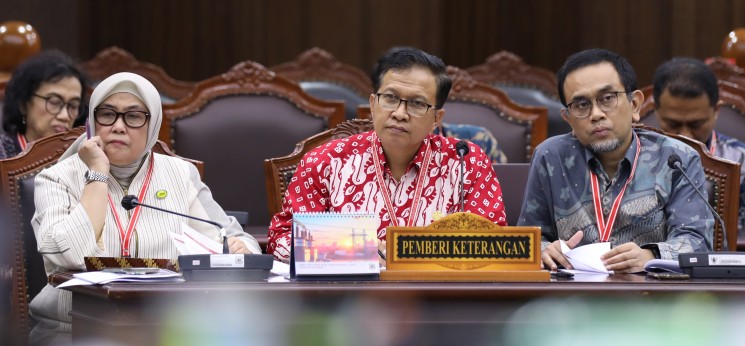
Chairman of AIPKI Wisnu Barlianto, Chairman of AFDOKGI Suryono, and Chairwoman of ARSPI Andi Wahyuningsih Attas delivering their remarks at the continued judicial review hearing of Law No. 17 of 2023 on Health, Tuesday (9/30/2025). Photo by MKRI/Ifa.
JAKARTA (MKRI) — The enactment of Law No. 17 of 2023 on Health and Government Regulation No. 28 of 2024 on the Implementation of Law No. 17 of 2023 on Health has brought implications for the position and composition of health collegia. Among them are disharmonious cooperation in implementing the competency test (Ukom), which has led to tension and anxiety among educational institutions as well as prospective doctors and specialists; unclear and unaccommodated roles of study programs; and a dualism between the higher education policy under the Ministry of Education (Dikti) directed toward study programs and the Indonesian Medical Education Institutions Association (AIPKI), and the Ministry of Health’s policy through health collegia, particularly in relation to competency tests and main teaching hospitals (RSPPU). These developments, AIPKI argued, pose significant risks to medical education and public health services.
Such was conveyed by AIPKI Chairman Wisnu Barlianto during the eleventh hearing of the judicial review of Law No. 17 of 2023 on Health, Case No. 111/PUU-XXII/2024, filed by Djohansjah Marzoeki. The hearing took place on Tuesday, September 30, 2025, in the plenary courtroom of the Constitutional Court.
Wisnu further elaborated that one of the most evident impacts is the growing dominance of collegia, which have assumed authority beyond their mandate by withdrawing the powers of educational institutions, exceeding the scope of duties, functions, and authorities stipulated in Articles 704, 705, and 706 of Government Regulation No. 28 of 2024. Pursuant to the mandate of Law No. 12 of 2012 on Higher Education and its implementing regulations, AIPKI serves to strengthen coordination among study program providers, particularly in specialist education, to ensure that their duties, functions, and authorities as educational providers are properly fulfilled. This coordination is essential to foster harmonious and conducive collaboration between study programs and relevant parties, including collegia.
“In essence, AIPKI’s aspiration is to restore the establishment, position, composition, duties, functions, and authorities of collegia to the state prior to Law No. 17 of 2023, thereby reinstating a balanced and collegial partnership among AIPKI, ARSPI, and the collegia, under a harmonious policy framework between the Ministry of Education and the Ministry of Health,” Wisnu stated before the plenary bench chaired by Chief Justice Suhartoyo, alongside the other constitutional justices.
As additional background, the petition in Case No. 111/PUU-XXII/2024 was filed by Djohansjah Marzoeki, a medical doctor and emeritus professor of plastic surgery at Airlangga University, who challenges several provisions of the Health Law, Articles 451, 272 paragraph (2), Article 1 point 26, Article 272 paragraph (5), and Article 421 paragraph (2)(b).
At the preliminary hearing on Tuesday, August 27, 2024, the Petitioner’s legal counsel, Muhammad Joni, argued that the challenged provisions contravene Article 28C paragraph (1), Article 28D paragraph (1), Article 28H paragraph (1), and the Preamble of the 1945 Constitution. He maintained that the newly established concept of collegium in Article 451 renders the existing collegia illegitimate as scientific institutions, thereby invalidating their legal recognition. The Petitioner asserted that the provisions are repressive, authoritarian, and arbitrary, lacking sound legal reasoning.
Furthermore, concerning Article 421 paragraph (2)(b), the Petitioner claimed that granting supervisory powers over professional ethics and discipline to central and regional governments infringes upon the professional domain, which should remain independent from governmental control.
As academic bodies, collegia are responsible for the stewardship of medical science, but they would lose their academic foundation if institutionalized as governmental apparatuses, susceptible to political or bureaucratic interference. Therefore, the Petitioner underscored the need for collegia to remain independent academic entities whose existence and functions must be protected, respected, and maintained. He contended that the collegia’s duties, functions, and authorities would be unconstitutional if they were established by the Minister of Health and made part of the executive apparatus under Government Regulation No. 28 of 2024, as stipulated in Article 272 paragraph (5) of the Health Law.
In his petitum, the Petitioner requested the Court to declare Article 272 paragraph (2) of the Health Law conditionally constitutional insofar as it is interpreted as “facilitated by the state without intervention and conflict of interest.” Thus, the provision would read: “The collegium as referred to in paragraph (1), in carrying out its role, shall be independent and facilitated by the state without intervention and conflict of interest.”
Author: Sri Pujianti
Editor: Nur R.
PR: Fauzan
Translator: Yuanna Sisilia
Disclaimer: The original version of the news is in Indonesian. In case of any differences between the English and the Indonesian versions, the Indonesian version will prevail.
Petition Revision Hearing for Case No. 111/PUU-XXII/2024 (in Bahasa Indonesia)
Tuesday, September 30, 2025 | 12:20 WIB 190