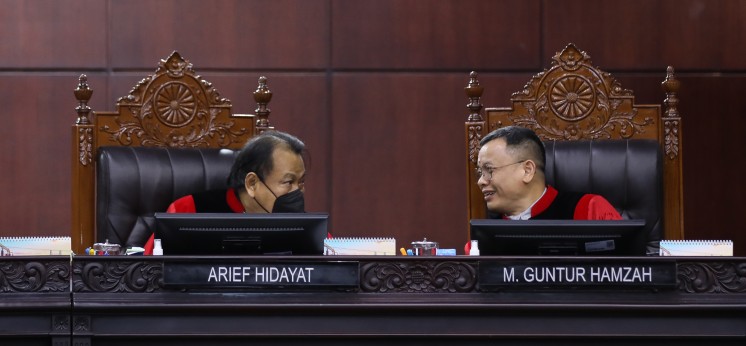
Constitutional Justices M. Guntur Hamzah and Arief Hidayat talking amidst the ruling hearing for the judicial review of Law No. 7 of 2017 on General Elections, Monday (9/29/2025). Photo by MKRI/Ifa.
JAKARTA (MKRI) — The Constitutional Court (MK) rejected the entire material judicial review petition of Law No. 7 of 2017 on General Elections filed by retired state civil apparatus (ASN) of the Ministry of Finance Almizan Ulfa, lecturer Wazri Abdullah Afifi, and three other petitioners. The Decision No. 141/PUU-XXIII/2025 was pronounced at a ruling hearing on Monday, September 29, 2025. The Petitioners appeared before Chief Justice Suhartoyo and seven other constitutional justices without any legal counsel.
Delivering the Court’s legal considerations, Constitutional Justice M. Guntur Hamzah said that with respect to the issue of the constitutionality of Article 393 paragraph (2), Article 397 paragraph (1), Article 398 paragraph (2), and Article 402 paragraph (2) of Law No. 7 of 2017 as alleged by the Petitioners, the Court found it important to link them to the principles of elections as stipulated in Article 22E paragraph (1) of the 1945 Constitution, which, among other things, states that elections shall be conducted honestly and fairly. In this regard, Article 393 paragraph (2), Article 397 paragraph (1), Article 398 paragraph (2), and Article 402 paragraph (2) of Law No. 7 of 2017 constitute mechanisms created by the legislature and used as the legal basis for the election organizers to ensure that the process of recapitulating vote counts is attended by election witnesses and election supervisory committees.
Nevertheless, for the possibility of irregularities such as fraud and systematic, structured, and massive (TSM) electoral violations as alleged by the Petitioners, Law No. 7 of 2017 in fact provides remedies should there be allegations of violations in the recapitulation process that may harm certain parties. In this respect, the Law affords avenues to restore violated rights in accordance with the legal maxim lex semper dabit remedium. Concretely, all the concerns raised by the Petitioners can be addressed through legal measures, including filing objections with the election organizers. Furthermore, if dissatisfied with the remedies provided by the election organizers, and in order to uphold the principle of lex semper dabit remedium, pursuant to Article 24C paragraph (1) of the 1945 Constitution, any party claiming harm due to alleged fraud in the recapitulation process may file an electoral dispute petition before the Constitutional Court. Indeed, for the sake of ensuring elections with integrity, in line with Article 22E paragraph (1) of the 1945 Constitution, the Court not only rules on disputes over election results but may also examine all matters arising during the electoral stages prior to the official announcement of results by the General Elections Commission (KPU).
Accordingly, the norms regulating tiered manual recapitulation must be understood and interpreted as an integral part of strengthening electoral oversight systems to uphold the principles of honest and fair elections, ultimately ensuring elections with integrity. In this context, the Court emphasized that the space for non-manual or electronic recapitulation, including KPU’s vote recapitulation information system Sirekap or similar systems, must be placed as a means of supporting and improving the integrity of manual recapitulation. Nonetheless, electronic recapitulation is not without weaknesses; indeed, within certain limits, electronic recapitulation may even be more vulnerable than manual recapitulation. Thus, the Court is of the view that for now, tiered manual recapitulation, supported by electronic recapitulation, remains more secure compared to relying solely on electronic recapitulation.
“Based on the foregoing legal considerations, the Petitioners’ arguments that Article 393 paragraph (2), Article 397 paragraph (1), Article 398 paragraph (2), and Article 402 paragraph (2) are unconstitutional are legally unfounded,” said Justice Guntur.
The Petitioners further argued that Article 405 paragraph (2) of Law No. 7 of 2017 contradicts their constitutional rights guaranteed in the fourth paragraph of the Preamble to the 1945 Constitution, Article 22E paragraph (1), Article 23 paragraph (1), Article 27 paragraph (3), and Article 28D paragraph (3) of the 1945 Constitution, unless interpreted as sought in their petitums. After careful examination, the Court held that the essence of the constitutional issue raised by the Petitioners was their objection to the duties and authority of the KPU regarding the national tiered manual recapitulation of vote counts.
Since the Petitioners’ claim that tiered manual recapitulation is contrary to the 1945 Constitution and lacks binding legal force was already deemed legally unfounded, then within reasonable bounds of reasoning, their claim seeking the invalidation of Article 405 paragraph (2) of Law No. 7 of 2017 likewise has no relevance to be considered further. “Therefore, the argument a quo must also be declared legally unfounded,” Justice Guntur concluded.
Also read:
Petitioners Request Ruling for Electronic Election Recapitulation
Petitioners Revise Petition on the Material Judicial Review of the General Election Law
The Petitioners argued that the provisions of the Election Law regulating tiered manual recapitulation—Article 393 paragraph (2), Article 397 paragraph (1), Article 398 paragraph (2), Article 402 paragraph (2), and Article 405 paragraph (2)—are prone to manipulation. They contended that manual recapitulation opens opportunities for fraud, manipulation, and falsification of election results in a structured, systematic, and massive (TSM) manner.
They added that the tiered manual recapitulation system functions like an “assembly line,” passing through several levels from the district election committee (PPK), the Regency/City Elections Commission (KPU), the Provincial KPU, up to the Central KPU. They believed such a process magnifies the risk of TSM electoral fraud. The Petitioners further argued that such vulnerabilities were evident in a number of cases during the 2024 Election, including the case of Tia Rahmania in the electoral district of Banten I, a dispute in East Aceh Regency, cases concerning the Regional Representatives Council (DPD) election, as well as findings in 20 Constitutional Court rulings on the 2024 election result disputes (PHPU).
The Petitioners proposed that, in order to prevent electoral fraud, election result data be disclosed transparently in CSV, Excel, or SQL formats accessible to the public on a regular basis. This, they argued, would enable millions of citizens to participate in monitoring the recapitulation process, rather than relying solely on the limited number of official election supervisors.
Author : Utami Argawati
Editor : Lulu Anjarsari P.
PR : Fauzan Febriyan
Translator : Yuniar Widiastuti (NL)
Disclaimer: The original version of the news is in Indonesian. In case of any differences between the English and the Indonesian versions, the Indonesian version will prevail.
Monday, September 29, 2025 | 20:50 WIB 194