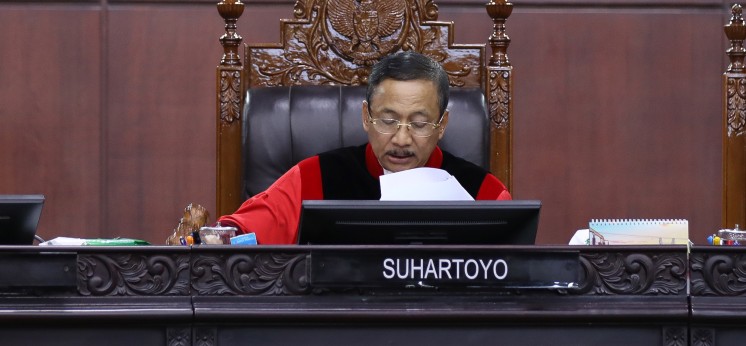
Chief Justice Suhartoyo delivering the verdict of the judicial review of the Law on Dual Positions of State-Owned Enterprise Commissioners, Tuesday (9/30/2025) in the plenary courtroom of the Constitutional Court. Photo by MKRI/Ifa.
JAKARTA (MKRI) — The Constitutional Court (MK) declared inadmissible a petition for judicial review concerning dual positions as commissioners in state-owned enterprises (SOEs). The petition was filed by Christianto (Petitioner I), Beckham Jufian Podung (Petitioner II), Christfael Noverio Sulung (Petitioner III), Muhammad Gufron Rum (Petitioner IV), Ihsan Firmansyah (Petitioner V), and Dwi Perdita Sari (Petitioner VI).
The ruling hearing of Case No. 156/PUU-XXIII/2025 took place on Monday, September 29, 2025, in the plenary courtroom of the Court. Delivering the Court’s legal considerations, Chief Justice Suhartoyo stated that the Petitioners had submitted their evidence online without affixing stamps as required. Meanwhile, the evidence that did include stamps could not be considered by the Court as it was submitted after the preliminary hearing, which had been scheduled to examine the revised petition and the validation of evidence.
“Therefore, the petition does not fulfill the formal requirements as stipulated in Article 10 paragraph (4) and Article 12 paragraph (3) of Constitutional Court Regulation (PMK) No. 7 of 2025. … The Court adjudicates to declare the Petitioners’ petition inadmissible,” said Chief Justice Suhartoyo delivering the verdict for the case a quo.
The Petitioners challenged Article 27B of Law No. 1 of 2025 on the Third Amendment to Law No. 19 of 2003 on State-Owned Enterprises (the SOE Law), arguing that the provision was discriminatory and contained disparities.
At the preliminary hearing of Case No. 156/PUU-XXIII/2025 on Wednesday, September 3, 2025, Beckham Jufian, representing the Petitioners, explained that the article regulates the possibility of holding concurrent positions as SOE commissioners, which in practice has led to instances where deputy ministers also serve as commissioners. Such practices, he argued, could lead to conflicts of interest that harm state finances, government integrity, and the public sense of justice.
The Petitioners further argued that the phenomenon of concurrent commissioner positions had sparked public concern over potential abuse of power, bureaucratic inefficiency, and lack of focus in government duties. They contended that the dual roles arising from the disparity in Article 27B of the SOE Law were in violation of Article 28D paragraph (1) and Article 28I paragraph (2) of the 1945 Constitution.
Referring to Constitutional Court Decision No. 80/PUU-XVII/2019 and Decision No. 21/PUU-XXIII/2025, which affirmed that deputy ministers are prohibited from serving concurrently as SOE commissioners, the Petitioners asserted that these rulings had not been implemented by the government. This legal vacuum, they warned, could open the door to abuse of power by executive authorities exercising discretion without adequate legal constraints. In fact, under Articles 24 and 17 of Law No. 30 of 2014 on Government Administration, officials’ discretionary powers must adhere to the General Principles of Good Governance (AUPB), including professionalism, proportionality, and the prohibition of misuse of authority.
Author: Sri Pujianti
Editor: N. Rosi
PR: Raisa Ayuditha Marsaulina
Translator: Yuanna Sisilia
Disclaimer: The original version of the news is in Indonesian. In case of any differences between the English and the Indonesian versions, the Indonesian version will prevail.
Full Decision: Case No. 156/PUU-XXIII/2025 (in Bahasa Indonesia)
Monday, September 29, 2025 | 15:46 WIB 158