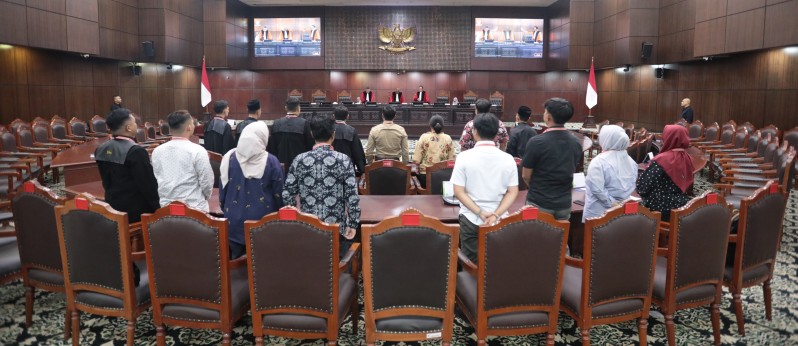
Jakarta, (MKRI) – A coalition of farmer and civil society organizations has filed a petition for judicial review of Law No. 6 of 2023 on the Enactment of Government Regulation in Lieu of Law No. 2 of 2022 on Job Creation into Law (Job Creation Law) with the Constitutional Court (the Court). The first hearing for Case No. 168/PUU-XXIII/2025 took place on Monday (29 September 2025).
The petitioners are the Indonesian Farmers Union (Serikat Petani Indonesia/SPI), Agrarian Reform Consortium (KPA), Bina Desa Sadajiwa Foundation, Indonesia Human Rights for Social Justice (IHCS), Indonesian Farmers’ Network (Jamtani), Indonesia for Global Justice, Indonesian Peasants Alliance (API), Palm Oil Monitoring Association, Palm Oil Farmers Union (SPKS), Indonesian Organic Alliance, People’s Coalition for Food Sovereignty, Association for the Study and Education of Economic, Social, and Cultural Rights, Coalition for Fisheries Justice (Kiara), and Udin Karnudin.
The petition challenges 16 provisions, including: Article 20(1) and (2) of Law No. 27 of 2007 on the Management of Coastal Areas and Small Islands, as amended by Law No. 1 of 2014 and further amended by Chapter III Part Three Paragraph 2 Article 18 Item 18 of the Job Creation Law’s annex, limited to the phrase “Business Licensing.”
Article 30(1) of Law No. 39 of 2014 on Plantations, as amended by Chapter III Part Four Paragraph 3 Article 29 Item 7 of the annex, limited to the phrase “Varieties Resulting from Breeding.”
Article 30(1) of Law No. 19 of 2013 on the Protection and Empowerment of Farmers, as amended by Chapter III Part Four Paragraph 3 Article 32 Item 2 of the annex, limited to the phrase “Import of Agricultural Commodities.”
Business Licensing at Sea
Counsel for the petitioners, Mulya Sarwono, argued that Article 20(1) and (2) of the Coastal Management Law, insofar as it requires “Business Licensing,” obliges local and traditional communities to obtain business permits merely to use coastal resources for their daily needs.
This, he said, effectively forces them to comply with corporate-style licensing requirements and risks indirect discrimination, undermining legal certainty and fair recognition of traditional communities.
Mulya stated, “Accordingly, Article 20(1) and (2), insofar as it requires ‘Business Licensing,’ contradicts Article 28D(1) and Article 28I(2) of the 1945 Constitution unless it is interpreted as ‘Protection of Rights.’”
The panel was presided over by Deputy Chief Justice Saldi Isra, with Constitutional Justices M. Guntur Hamzah and Ridwan Mansyur as members.
Plant Breeding Varieties
The petition also targets Article 30(1) of the Plantation Law on “Varieties Resulting from Breeding or foreign introductions,” which mandates government release or approval before distribution.
Mulya noted that this clause had already been conditionally unconstitutional under Decision No. 138/PUU-XIII/2015, which exempted small farmers who breed for their own communities.
Food Reserve Sufficiency
The petitioners likewise contest Article 30(1) of the Farmers’ Protection and Empowerment Law regarding “Import of Agricultural Commodities,” which treats domestic production and imports equally in ensuring food reserves.
They argue the government should prioritize domestic production, given Indonesia’s seven million hectares of rice fields, to guarantee food security and protect farmers’ rights.
Foreign Investment in Horticulture
The coalition further challenges Article 100 of the Horticulture Law, as amended by Chapter III Part Four Paragraph 3 Article 33 Item 18 of the annex, concerning central-government encouragement of investment in horticulture.
Mulya recalled the Court’s Decision No. 20/PUU-XII/2014, which upheld a 30 percent cap on foreign investment in key sectors essential to the public interest, arguing that the Job Creation Law weakens this safeguard and thus conflicts with Article 28D(1) of the Constitution unless the 30 percent limit is preserved.
Justices’ Advice
Presiding Judge Saldi Isra noted the petition’s complexity and advised the coalition to split the case: “It would be clearer to file separate petitions for each issue to help the Court trace the norms and constitutional losses,” he said.
Justice Ridwan Mansyur added that the petitioners must comply with Constitutional Court Regulation No. 7 of 2025 on Judicial Review Procedure, highlighting incomplete citations and insufficient constitutional arguments.
Justice M. Guntur Hamzah agreed, stressing that separate cases would allow more focused expert testimony and a more comprehensive review.
Before adjourning, Deputy Chief Justice Saldi gave the petitioners 14 days—until Monday, 13 October 2025 at 12:00 WIB—to revise and refile their application. The Court will schedule a follow-up hearing to examine the amended petition.
Author : Sri Pujianti.
Editor : N. Rosi.
Translator : Agusweka Poltak Siregar.
Disclaimer: The original version of the news is in Indonesian. In case of any differences between the English and the Indonesian versions, the Indonesian version will prevail.
Monday, September 29, 2025 | 14:20 WIB 409