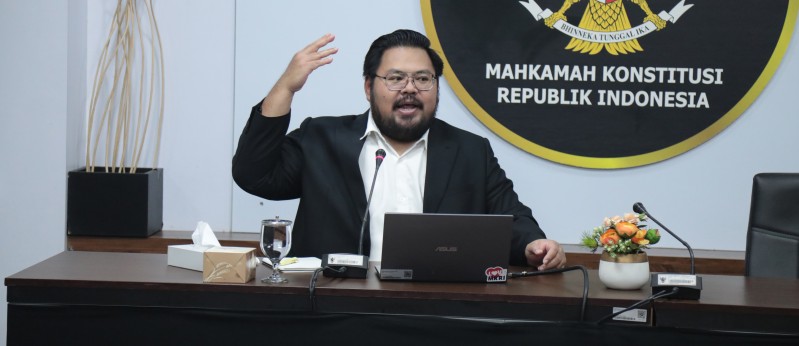
Constitutional Court Legal Analyst Arinta Sulistyo delivering a presentation on the Court to a group of lawyers participating in the Drew Network Asia Secondment Program 2025 at the Makarim & Taira S. law firm on Thursday (9/25/2025). Photo by MKRI/IlhamWM.
JAKARTA, MKRI – Around 13 lawyers from Makarim & Taira S. (M&T) visited the Constitutional Court (MK) on Thursday, September 25, 2025. Some of them were lawyers from Laos, Vietnam, Malaysia, and Singapore, currently undertaking assignments under the Drew Network Asia Secondment Program 2025 at the Makarim & Taira S. law firm.
The delegation came to learn more about Indonesia’s constitutional justice system. They held a discussion with Court’s Legal Analyst Arinta Sulistyo, familiarly known as Tyo, about the Court at the auditorium of the second building.
“There are six roles and functions of the Court, one of which is the Guardian of Democracy,” said Tyo.
As stipulated in the 1945 Constitution of the Republic of Indonesia, the Court has the authority to adjudicate at the first and final level, with decisions that are final and binding, to review laws against the Constitution, resolve disputes over authority between state institutions whose powers are granted by the Constitution, decide on the dissolution of political parties, and settle disputes over general election results. The Court is also mandated to rule on the House of Representatives’ (DPR) opinion regarding alleged violations committed by the President and/or Vice President, known as impeachment. Such violations, as stated in Article 7A of the 1945 Constitution, include treason against the state, corruption, bribery, other criminal acts, disgraceful conduct, and/or no longer fulfilling the requirements to serve as President and/or Vice President.
Tyo further explained that the Court and the Supreme Court (MA) of the Republic of Indonesia hold equal standing. However, the MK serves as the guardian of the Constitution, with the authority to review laws against the 1945 Constitution and exercise other special powers, while the MA acts as the highest judicial body, overseeing the judiciary beneath it and reviewing regulations that fall below the law.
Decisions of the Supreme Court may still be subject to legal remedies, such as judicial review, while decisions of the Court are final and binding once they are pronounced. Moreover, there is only one Court in Indonesia, located in Jakarta, whereas the Supreme Court oversees judicial bodies, including the general courts, religious courts, military courts, and administrative courts.
Another distinction is that the Court consists of nine constitutional justices, while the Supreme Court may have up to 60 supreme justices whose candidates are nominated by the Judicial Commission (KY).
Answering a question, Tyo emphasized that the legal considerations in a ruling are an integral part of the Court’s final and binding decisions, not merely the ruling’s verdict. Thus, every citizen is expected to comprehend the Court's decisions holistically.
“Constitutional justices always stress that legal reasoning is inseparable from the verdict of the Court,” said Tyo.
In addition, the Makarim & Taira S. lawyers had the opportunity to visit the Constitutional History Center (Puskon) located on the 5th and 6th floors of the Court’s Building, covering 1,462 square meters. Puskon serves as a documentation and learning center on the history of Indonesia’s constitution, aiming to raise public awareness and encourage contributions toward fostering a constitutional culture. (*)
Author : Mimi Kartika
Editor : Lulu Anjarsari P.
Translator : Jessica Rivena Meilania/Rizky Kurnia Chaesario
Disclaimer: The original version of the news is in Indonesian. In case of any differences between the English and the Indonesian versions, the Indonesian version will prevail.
Thursday, September 25, 2025 | 15:22 WIB 93