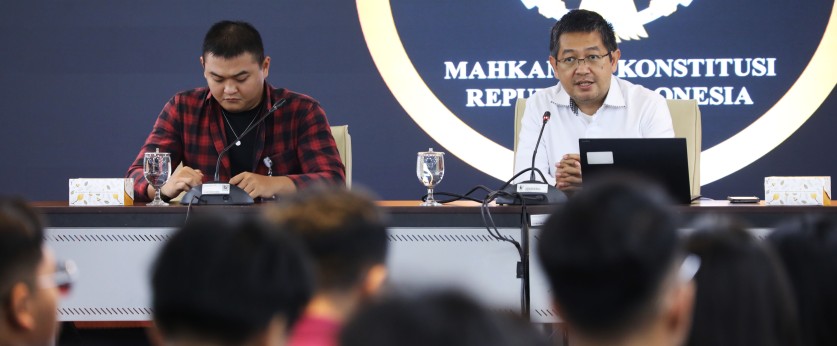
Court’s Legal Analyst Rio Tri Juli Putranto receiving and delivering a lecture during the visit of students from the Faculty of Law and Communication, Soegijapranata Catholic University Semarang, at Auditorium of Building I, Wednesday (9/24/2025). Photo by MKRI/Panji
JAKARTA, MKRI – Students of the Faculty of Law and Communication, Soegijapranata Catholic University (FHK SCU), visited the Constitutional Court (MK) on Wednesday, September 24, 2025. The visit was received by Court’s Legal Analyst Rio Tri Juli Putranto.
In front of 94 students, Rio explained the history of the Court’s establishment and its role in safeguarding the Constitution. According to him, prior to the existence of the Court, many laws were problematic because no institution had the authority to review them. He cited that the establishment of the Court was inseparable from the need for an electoral dispute resolution forum and a presidential impeachment mechanism, as was the case during the administration of President Abdurrahman Wahid (Gus Dur).
“Since then, the Court has stood as the guardian of the Constitution and the constitutional rights of citizens,” Rio explained.
Rio emphasized that the existence of the Court is enshrined in Article 24C of the 1945 Constitution and strengthened through the Law on Judicial Power and the Constitutional Court Law. The Court has several core authorities, including judicial review of laws against the Constitution, adjudicating disputes over state authority granted by the Constitution, deciding on the dissolution of political parties, and resolving disputes regarding election results. In addition, the Court also has the authority to decide on the House of Representatives (DPR) opinion concerning alleged violations committed by the President and/or Vice President.
Rio further elaborated that the Court consists of nine justices, each nominated by the President, the House of Representatives, and the Supreme Court (MA). Each of these institutions nominates three candidates, forming a total of nine Constitutional Justices, who are then appointed by Presidential Decree. At present, the Court is chaired by Chief Justice Suhartoyo and Deputy Chief Justice Saldi Isra.
He also explained the procedure for submitting a judicial review application to the Court. Eligible applicants include Indonesian citizens, customary law communities, private legal entities, and state institutions. Applications must contain the applicant’s identity, the grounds for the application covering the Court’s authority, the applicant’s legal standing, the reasons for the application, and the requested ruling (petitum).
“Currently, a considerable number of students are active in submitting judicial review applications, and some of their petitions have been granted, particularly those concerning electoral laws,” he said.
Regarding formal reviews, Rio explained that applications must be filed no later than 45 days after a law is promulgated. The Court is required to deliver a decision within a maximum of 60 working days after the first hearing.
At the end of the visit, FHK SCU students toured the Constitutional History Center (Puskon MK), located on the 5th and 6th floors of the Court’s Building. The center presents the history of Indonesia’s constitution and the establishment of the Court through engaging and modern displays. The students also had the opportunity to observe a court session directly from the courtroom.
Author : Utami Argawati
Editor : N. Rosi.
Translator : Jessica Rivena Meilania/Agusweka Poltak Siregar
Disclaimer: The original version of the news is in Indonesian. In case of any differences between the English and the Indonesian versions, the Indonesian version will prevail.
Wednesday, September 24, 2025 | 14:50 WIB 360