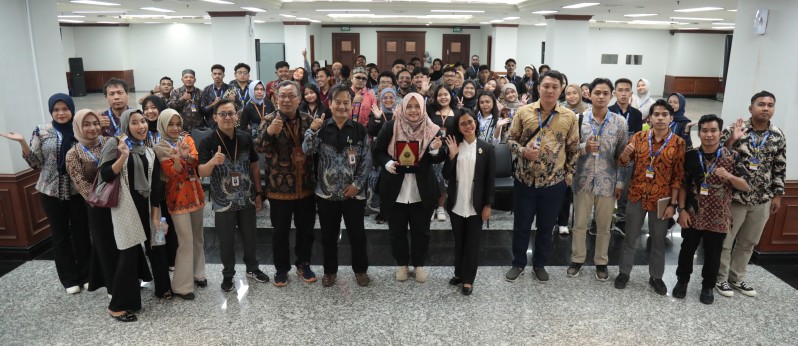
JAKARTA, MKRI – Students from the Faculty of Law, Widya Mataram University (FH UWM), visited the Constitutional Court (MK) on Tuesday, September 23, 2025. The visit was attended by around 57 students, accompanied by nine lecturers. They joined a discussion to learn more about the Court with the Court’s Legal Analyst Lia Nur Jannah in the Court’s Auditorium of the first building, Jakarta.
Lia explained that the Court has the authority to adjudicate at the first and final instance, with decisions that are final. These include judicial review of laws against the Constitution, disputes over the authority of state institutions granted by the Constitution, the dissolution of political parties, and disputes over election results.
“The Court is also obliged to rule on the House of Representatives (DPR) opinion regarding alleged violations committed by the President and/or Vice President according to the Constitution,” Lia stated.
Such violations, as stipulated in Article 7A of the 1945 Constitution, include treason against the state, corruption, bribery, other criminal acts, or disgraceful conduct, and/or no longer meeting the requirements to serve as President and/or Vice President under the 1945 Constitution of the Republic of Indonesia (NRI).
This time, Lia focused on the Court’s authority to review laws against the Constitution. Anyone may file a petition as long as they meet the qualifications, including individual Indonesian citizens, customary law communities still in existence and consistent with societal developments, and the principles of the Unitary State of the Republic of Indonesia as regulated by law, public/private legal entities, or state institutions.
Applicants must also outline the requirements for constitutional loss, namely: the existence of constitutional rights and/or authorities granted by the 1945 Constitution; the rights and/or authorities are considered harmed by the enactment of the law being reviewed; such harm must be specific and actual, or at least potential, which can reasonably be expected to occur; a causal relationship (causal verband) between the harm and the enactment of the law being reviewed; and the possibility that, if the petition is granted, the alleged harm will no longer occur.
Lia emphasized that these points must be clearly explained by the applicant to be deemed to have legal standing. In addition to the petitioner, other parties in judicial review cases include information providers —People’s Consultative Assembly (MPR), DPR, Regional Representative Council (DPD), and/or the President, as well as Related Parties who have direct or indirect interests in the petition.
Lia continued that the MK positions itself as a modern and transparent court. From the submission of petitions to the issuance of rulings, all processes can be carried out online. The public may access the Court’s official website (mkri.id) to obtain information, hearing transcripts, decisions, and even file petitions online—demonstrating Cthe ourt’s commitment to transparency and accessibility.
Independence of Constitutional Justices
During the Q&A session, a student asked how constitutional justices maintain their independence when the nine justices are nominated by the Supreme Court, the DPR, and the President. Lia explained that the nomination and appointment process, finalized through a Presidential Decree, does not involve the Court itself. However, strict requirements must be met to become a constitutional justice.
The general requirements under Article 24C paragraph (5) of the 1945 Constitution include integrity, unimpeachable character, fairness, statesmanship with expertise in the Constitution and constitutional law, and not holding concurrent state office. Specific requirements under Article 15 paragraph (2) of Law Number 7 of 2020 include being an Indonesian citizen, holding a doctoral degree in law with a bachelor’s degree in law as a foundation, and being at least 55 years old.
Currently, the Constitutional Court Honorary Council (MKMK) exists to uphold the honor, dignity, and code of ethics of constitutional justices. Justices must strictly adhere to the ethical code and conduct known as Sapta Karsa Hutama. MKMK handles reports or findings related to alleged ethical violations.
“Such reports can also come from the public, including you, the students,” Lia remarked.
The students and lecturers also had the opportunity to visit the Constitutional History Center (Puskon MK), which functions as a documentation, learning, and information hub on Indonesia’s constitutional history and practice. It also showcases historical collections and the Court’s important archives. Located on the 5th and 6th floors of the first building of the Court, Puskon spans 1,462 square meters and offers facilities for the public to gain a deeper understanding of the Constitution.
Author : Mimi Kartika.
Editor : N. Rosi.
Translator : Jessica Rivena Meilania/Rizky Kurnia Chaesario
Disclaimer: The original version of the news is in Indonesian. In case of any differences between the English and the Indonesian versions, the Indonesian version will prevail.
Tuesday, September 23, 2025 | 14:45 WIB 136